
Zimbabwean writer Simbarashe Kundizeza has denied using artificial intelligence to write his short story, which won this year’s Caine Prize for African Writing. The denial came a week after he received the award of £10,000 ($13,000). It followed a recent article in a US magazine, which said that AI-detection software called Pangram had shown the story, about a boy whose family falls on hard times, was entirely AI generated.
In a post on X, Kundizeza wrote: “For the avoidance of doubt, I wrote The Blue Fighter.” The accusation has triggered a strong reaction on social media. Ellah Wakatama, chair of the Caine Prize’s board of trustees, told the she was shocked that the magazine had published its piece before a full investigation was complete.
Prize chair criticises timing of the allegation
Wakatama said she had been contacted on a Friday about the allegation, and the article, written by Vauhini Vara, appeared the following Sunday. She said she wished the magazine had spent more time investigating before publishing. In her view, the article should have included evidence of human investigation alongside the Pangram results, rather than damaging the prize and its winner.
The row comes after other literary prizes this year faced similar disputes. The Commonwealth Short Story Prize was won by Trinidadian writer Jamir Nazir despite allegations that he had used AI. Separately, Canadian-Haitian author Thélyson Orélien was withdrawn from France’s top literary award, the Goncourt, over allegations that he used AI for his first novel. Orélien denies the claim.
Wakatama said that, as part of an internal investigation, Kundizeza would send documentation about his various drafts. She said the Caine Prize was also in ongoing conversations with all the judges and with The Shallow Tales Review, which first published The Blue Fighter in 2025. Wakatama explained that Caine Prize submissions are all previously published and are not routinely checked for AI. Writers had vouched that their work was original.
Questions over reliability of AI detection tools
Wakatama said she was not opposed to using AI tools to check entries, but she objected to the idea of such a tool being the final judge in this case. She also noted that Pangram had not yet been fully tested. She said it was unfair for writers, particularly Black writers, to become the testing ground for a technology that was, at best, still rough and ready.
Vara acknowledged that AI-detection products can get things wrong. She said that “including one as good as Pangram” would “not be 100% accurate”. She added that Pangram’s own internal research suggested its assessments were rarely wrong. Her article also cited a recent paper by researchers at the Free University of Brussels. That study reported that Pangram and two other AI-detection tools had produced no errors when assessing English-language writing by non-native speakers. The paper said such tools should be treated as an initial flag for further investigation.
Vara told the she had also relied on her own judgement. She said every previous Caine Prize-winning story she had run through Pangram had come out as fully human. She also tested an earlier 2021 story by the same author, which she said also registered as fully human, and she said its tone was very different from The Blue Fighter. Vara pointed to stylistic features she believed were common in AI-generated text, including a frequent “X but Y” sentence structure and a heavy use of metaphor.
Kundizeza responded that suggesting a writer cannot work in different styles or genres, or improve substantially after five or more years, misunderstands the craft of writing.
Writers and publishers challenge the accusations
Comments from African writers on social media have argued that such accusations are mainly directed at non-white writers. Wale Lawal, the Nigerian founder of The Republic magazine, described the article as “crazy, racist and wildly unethical”. Zimbabwean writer Joe Ruzvidzo, whose novel Welcome to Anywhere was published last year, said he stood by Kundizeza and called for an end to what he described as a “literary stop-and-frisk”.
Nigerian publisher Modupe Daramola said it was necessary to discuss how AI allegations were targeting Black and African writers and were often scrutinised more harshly than other work. She questioned why Pangram, which is itself powered by AI, should be treated as definitive.
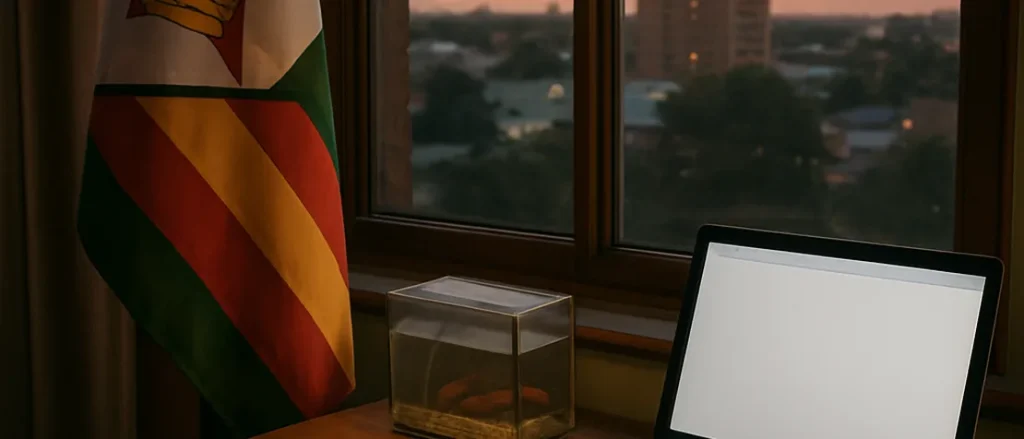
Kundizeza has said the story has a “concrete, documented history” and set out the chronology of its development in his statement. He told the that he drew on a poem read by South African Vangile Gantsho at an event in Ghana the previous year. The poem described her father’s obsession with building fish tanks. Kundizeza said he combined that idea with fictionalised details from his own life, linked to the period around 2002, when Zimbabwe’s economic troubles began.
Kundizeza also drew a parallel between the story’s father and his own. “Much like the father in the story, my own dad… was an accountant, but he quit his job to grow tomatoes,” he told the . In his latest post on X, he said he was encouraged by messages of support from fellow writers and readers, and that he would keep writing.