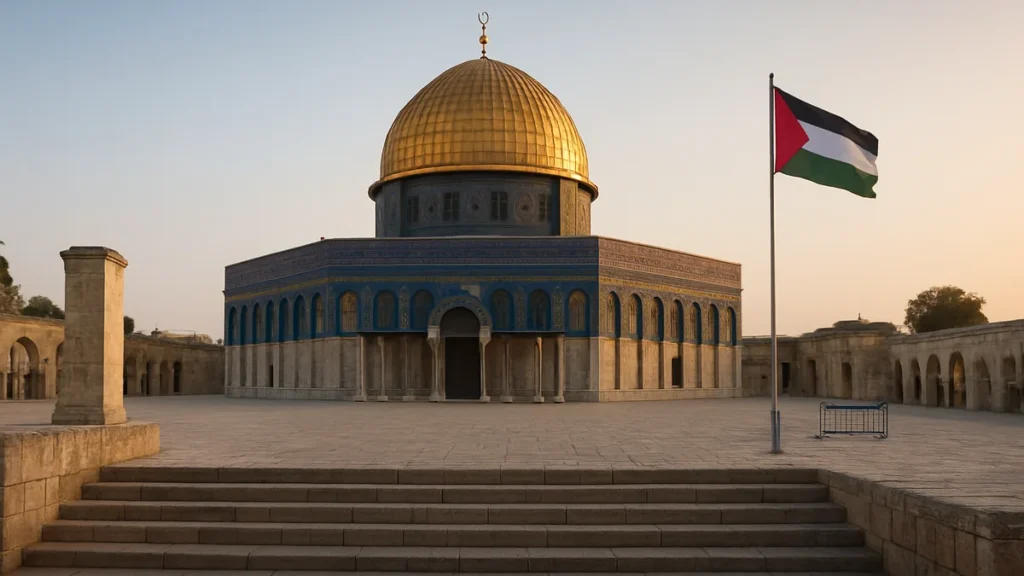
A Palestinian preacher who heads the Higher Islamic Council in Jerusalem has been kept out of Al-Aqsa Mosque for more than two years. His latest exclusion order extends that ban until April 2027, leaving him unable to pray or preach at the site in occupied East Jerusalem.
Sheikh Ekrima Sabri is one of many Palestinians facing Israeli restrictions at the mosque, which is the third holiest site in Islam and a national symbol for Palestinians. Rights monitors and local officials say the limits are part of a wider pattern that is tightening Palestinian access while Jewish religious activists gain more room to worship.
Repeated exclusion orders hit Sabri and other worshippers
Sabri has faced exclusion orders repeatedly since August 2024, when Israeli police detained him over a sermon in which he mourned Hamas political leader Ismail Haniyeh, who was assassinated by Israel. The most recent order, issued on October 20, bars him from praying or preaching at Al-Aqsa until April 2027. He has also been questioned by Israeli authorities several times.
Sabri told reporters that the latest extension is the fifth exclusion order Israeli authorities have issued against him. He called the decision unjust, illegal, inhumane and uncivilised, and said its purpose was to silence those who speak out about the mosque. He added that he would keep defending Al-Aqsa despite the restrictions, which he described as a matter of his Islamic faith.
Sabri also accused Israel of deliberately reducing the Palestinian presence at the mosque while allowing settlers to enter in large numbers. “Such actions represent an aggressive policy targeting the Al-Aqsa Mosque and the Islamic presence within it,” he said.
The Wadi Hilweh Information Center, a Palestinian human rights monitoring group, says Israeli authorities have issued more than 1,000 exclusion orders since the start of 2026. Those orders target not only ordinary worshippers but also religious figures and employees of the Islamic Waqf. The group said it recorded more than 40 orders over five days in early September, a rise it linked to Jewish holidays.
Arrests and a six-month order for Ibrahim al-Natsheh
Ibrahim al-Natsheh was released by Israeli police earlier this month after a week in detention. He had been arrested while attending funeral prayers for his cousin at Al-Aqsa.
According to al-Natsheh, officers took him to a police room and handed him a six-month exclusion order that bars him from the Old City of East Jerusalem. He said no specific charge was brought against him. The order, he said, warns that he could be arrested and face further penalties, including a fine or prison, if he enters the banned area.
Al-Natsheh said he has received so many exclusion orders that he has stopped counting. He traced the restrictions back about nine years, to an Israeli crackdown on Islamic study circles at the mosque. Palestinian students, teachers and activists linked to those circles have since faced arrests and exclusion orders, he added.
He criticised the reasons given in the orders. “The orders banning us from the mosque provide no specific reason; they simply cite ‘disturbing the peace’, even though we are there solely to pray,” he said. He also said that police have blocked him from entering Al-Aqsa even when no formal order applies. He further alleged that officers have repeatedly arrested him at the mosque’s gates and beaten him badly while he was in custody. These claims are his own and have not been independently confirmed.
Al-Natsheh described the approach to the compound as crowded with soldiers and settlers, making access difficult. Israeli authorities have not responded to a request for comment on the cases.
Waqf’s role shrinks as settler visits and proposals grow
Restrictions at Al-Aqsa have increased throughout 2026. After the United States and Israel launched their war on Iran on February 28, Israeli authorities closed the mosque to most worshippers for 40 days and reopened the compound on April 9. The Palestinian Authority’s Jerusalem Governorate recorded almost 28,000 visits by Israeli settlers to the site between July and September.
Ma’rouf al-Rifai, an adviser to the Jerusalem Governorate, said Israeli restrictions on Muslim worshippers intensified during recent Jewish holidays. Measures included closing the mosque for periods, preventing noon prayers on at least one occasion, and limiting access for Old City residents when settlers and Jewish religious activists visited. He said these moves have made it harder for the Islamic Waqf Department to manage the mosque’s affairs.
According to al-Rifai, the Waqf’s constraints include:
- Israeli police preventing Waqf officials from accompanying Jewish groups entering the site
- Restrictions on the authority of mosque guards, with fewer than 15 now on the morning shift compared with about 50 previously
- Arrests of several Waqf employees and orders barring them from the compound
- Blocks on restoration work at the Bab al-Rahma prayer hall and on maintenance of the compound’s trees and gardens
Al-Rifai said the 40-day closure during the war with Iran was carried out without consulting the Waqf or giving it advance notice, which he said showed its shrinking role. He also said settler activity had changed over the past three years, now including Jewish prayers and rituals, the raising of Israeli flags and attempts to bring in sacrificial offerings.
He warned that several proposals could alter the long-standing arrangement under which the Waqf manages Muslim religious affairs while Israeli police handle security and access. Those proposals include demands to allow Jewish visitors into the compound on Saturdays, plans advanced by Israeli politicians to divide access to parts of the site between Muslims and Jews, and a police recruitment drive for volunteers to escort settler visits. Al-Rifai said these developments could eventually change how worship and access are governed at the holy site.