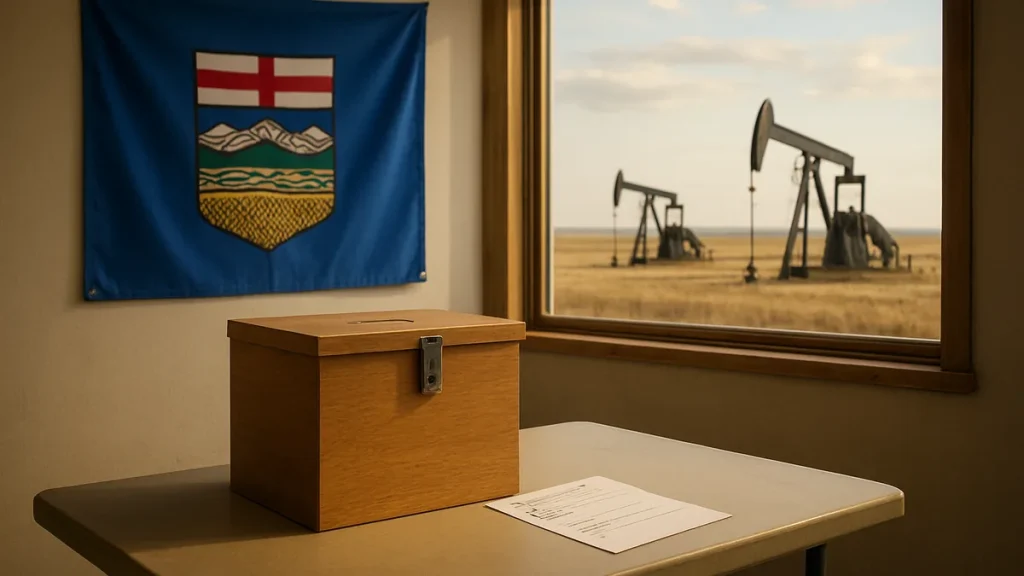

Albertans will vote on Monday on the question of independence, the first time the issue has reached the ballot in the oil-rich Canadian province. Cory Morgan, who has spent more than 25 years campaigning for Alberta to become an independent country, said he would accept a no vote but would not give up the cause.
“I would respect the will of the voters,” Morgan told an interviewer. “If they’ve decided it’s not time to go that route yet, then so be it. But that doesn’t mean I’ll stop.” Morgan leads Pathway to Independence, an advocacy group, and is one of several longtime separatists who have moved a once-fringe idea into the electoral process.
Strategic votes and a message for Ottawa
The ballot gives voters two options: stay part of Canada, or begin the legal steps toward a future binding referendum on separation. Choosing the second option would not make Alberta an independent country on the spot. Any province seeking to secede would first have to negotiate with the federal government in Ottawa, the other provinces and Indigenous peoples living in and around Alberta.
Some separatist organisers have used that distinction to urge people to vote yes even if they do not truly want independence. Jared Wesley, a political science professor at the University of Alberta, said leaders were exploiting the vagueness of the question to encourage voters to stay in Canada while signalling to Ottawa that Albertans want to be heard. He said that message appeared to be landing with some voters.
Data from Viewpoint Alberta, a research initiative based at the university, suggests that two-thirds of those backing the referendum are doing so for strategic reasons. Morgan describes these supporters as “reluctant separatists”, people who feel exhausted by the situation and mainly want the federal government to pay attention.
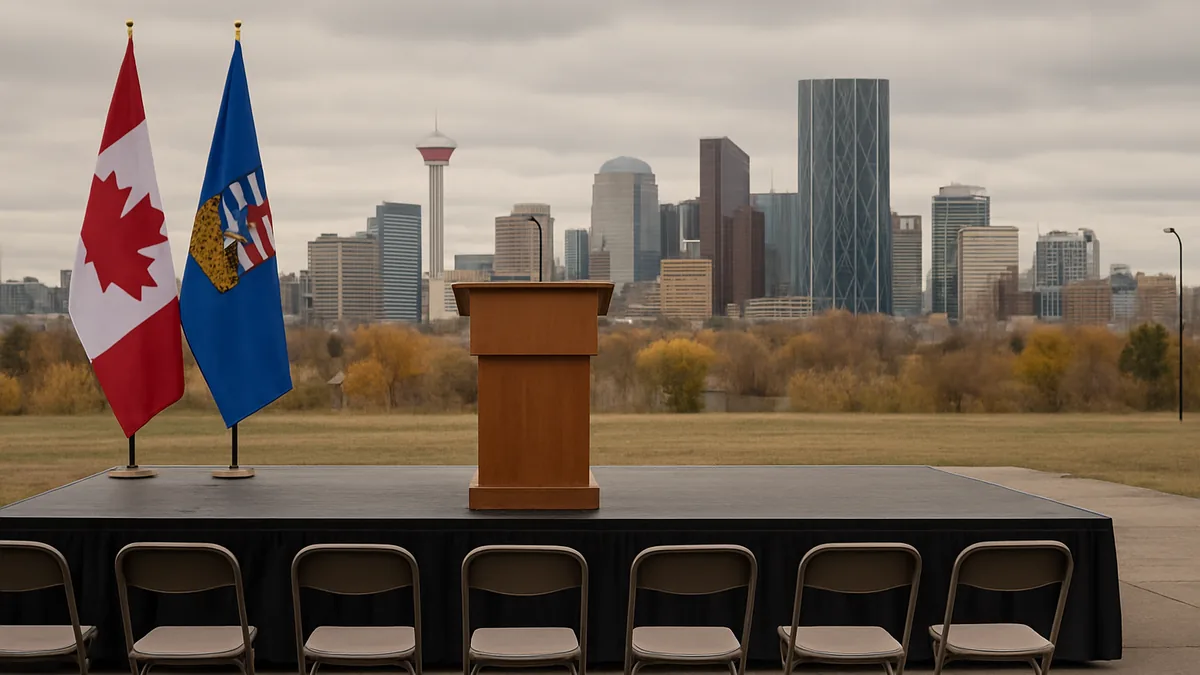
Prime Minister Mark Carney has cautioned Albertans against this approach. Speaking at a pro-Canada rally in Calgary on Thursday, he said: “Don’t be fooled by the idea you can ‘send a message’ with your vote.” He added that “This is not poker. A vote against Canada is a dangerous bluff that will lead to years of deep division and great uncertainty.”
Decades of grievances over oil and federal policy
Separatists have long argued that Alberta, which holds the world’s fourth-largest proven oil reserves, sends too much money to Ottawa and subsidises the rest of the country without getting enough back. They also object to federal energy rules that, in their view, restrict the growth of the province’s oil industry.
For Morgan, the anger goes back to the 1980s, when the National Energy Program was introduced by the government of Pierre Trudeau, the father of former prime minister Justin Trudeau. The programme used price controls, taxes and ownership rules to keep energy affordable across Canada, while shifting more of Alberta’s revenue to the federal government. It has since become a central symbol of “Western alienation”, a phrase describing the feeling of being shut out among residents of Canada’s western provinces.
Those tensions returned under Justin Trudeau, who took office in 2015. His climate measures, including a national carbon tax and a cap on emissions, angered the province’s oil sector. “We’ve been fighting about the same things for 50 years,” Morgan said.
Experts say the COVID-19 pandemic brought a new wave of conservative activists into politics through protests against health restrictions, giving fresh momentum to the separatist cause. Justin Trudeau later resigned as Liberal Party leader and prime minister in 2025 as his poll numbers fell, and Carney was chosen to replace him.
Smith’s referendum and the Brexit comparison
Last year, under mounting pressure from separatist groups, Alberta Premier Danielle Smith’s government made it easier to call referendums, which helped put independence on the political agenda. Wesley argued that the vote is driven less by rising public support for separation than by tensions inside Smith’s governing United Conservative Party, whose members are more supportive of separation than Albertans as a whole. “We’re having a referendum because Danielle Smith wants us to have a referendum,” he said. “She is looking to solve internal party matters by throwing a question to the broader public.”
Smith called the vote but says she opposes independence. On October 14 she said she had voted against secession. “In my view, now is not the time to give up hope in our country, not when we have fought so long and come so far,” she said in a social media video explaining her decision.
The move has drawn comparisons to the 2016 Brexit referendum in the United Kingdom, including from Carney. In that case, then-prime minister David Cameron called a vote on whether Britain should leave the European Union, hoping to settle a dispute within his Conservative Party. Voters chose to leave, a result that led to years of political turmoil.
Ian Cooper, a political scientist who grew up in Alberta and now lives in Ireland, said a 1975 UK referendum may be a better parallel. British voters then overwhelmingly chose to remain in what was then called the European Economic Community, but that result did little to discourage those who wanted to leave. “The activists who were in favour of Brexit — this is before anybody called it Brexit — they really played the long game,” Cooper said. “It took them 25 years, but they finally achieved it.”
Whether the separatist movement can hold together
Monday’s ballot contains 10 questions, and independence is only one of them. The others include limiting temporary residents’ access to healthcare and education, and letting Alberta choose its own judges. Smith has urged voters to back the other nine proposals, arguing they would strengthen her hand in negotiations with Ottawa.
“Many Albertans I speak with tell me they want to send Ottawa a message, and I would suggest the best way to do that is to give us a strong mandate on the other nine questions,” she said on social media. Cooper said that if those proposals pass but Ottawa refuses to make concessions, separatists would gain new arguments that change within the current system is impossible. “Buried in the nine other questions are the seeds for a future referendum,” he said.
Not all analysts expect the movement to stay united after the vote. Wesley said separatists have been drawn to the cause for different reasons, and that if independence looks unrealistic, little may keep the group together. Some activists could shift their energy to other conservative causes, such as immigration.
Other experts question whether a movement based more on economic grievances than on shared cultural identity can last as Quebec’s separatist movement has. Two weeks ago, the largely French-speaking province elected the separatist Parti Québécois, which has promised a third referendum on independence after Trump leaves office. Morgan argues that Alberta has its own culture, shaped by generations of people who moved there in search of prosperity. “The type of person drawn to do that is often an individualistic type of person,” he said.
Even if Albertans reject separation, Morgan believes the movement has already pushed Ottawa to take the province’s frustrations more seriously. “Hopefully some people understand that eventually something has to give,” he said. “So whatever the results are … I do hope, at the very least, they’ve served as a wake-up call to a lot of people.”