
Tunisian university graduates who lost hope of finding work are protesting across the country, and their march towards the capital has become a visible sign of an economic crisis that many say is worsening. One of them, Cherine Ghanmi, once believed her degree would lift her family out of poverty. More than a decade after graduating in 2012, she is still without a job and still depends on her parents.
Ghanmi grew up in al-Mazzunah, a marginalised town in the central Sidi Bou Zid governorate, where she walked 5km (3.1 miles) to school. Her parents made large sacrifices to pay for her education, hoping she would one day earn enough to support them. Instead, she said, her unemployment has added to the family’s burden.
Graduates march on Tunis over stalled public-sector jobs
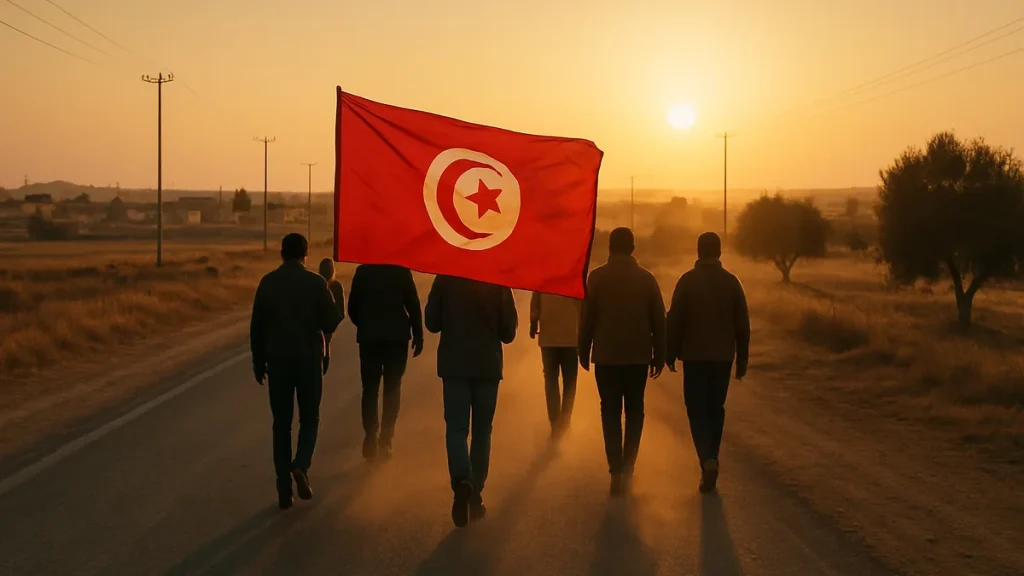
On September 27, unemployed graduates set out on a roughly 300km (186-mile) march from Menzel Bouzaiane, in central Tunisia, towards the capital. They were demanding jobs and the implementation of legislation meant to create a clear route into public-sector employment. Organisers said the march, known as the “Dignity March”, began with 23 participants.
More people joined along the way. The coordinating committee later put the number at more than 120. Participants stopped at times because of exhaustion and injuries before pushing on.
On October 6, police stopped the group from advancing in Borj Cedria, south of Tunis. Marchers said they were told they could travel as individuals but not as a group. They had intended to reach Carthage, the Tunis suburb where the presidential palace is located, to press their demands. Ghanmi described the march as an expression of the hardship and disappointment felt by graduates who have spent years looking for work.
On October 17, thousands of people gathered in Tunis to protest against President Kais Saied’s government, worsening living conditions and limits on freedoms. The demonstration was led by the Tunisian General Labour Union (UGTT), opposition groups and civil society organisations, and was among the largest against Saied in years. Participants spoke about joblessness and the difficulty many households have in meeting basic needs.
Unemployment figures and a stalled recruitment law
Official data show the scale of the problem. According to Tunisia’s National Institute of Statistics (INS), the overall unemployment rate was 14.9 percent in the second quarter of 2026. The figures for specific groups were:
- University graduates: 26.6 percent
- Women graduates: 35.6 percent
- Men graduates: 14.2 percent
- People aged 15 to 24: 35.4 percent
Cherif Khraifi, spokesperson for the Tunisian Union of Higher Education Graduates, said governments since the 2011 revolution had not made economic development and social issues real priorities. “Their biggest concern was ensuring they stayed in power,” he said. He added that measures meant to tackle the crisis had too often become “tools for letting off steam” rather than solutions.
Earlier efforts have also disappointed many. The 2022 Law No. 38 was meant to open an employment route for long-term unemployed graduates, but its implementation stalled because of financial constraints. The 2025 Law No. 18 later provided for the exceptional recruitment of such graduates into the public sector and civil service. It calls for a digital platform to register eligible applicants and sets criteria for prioritising candidates, with recruitment to take place in phases over no more than three years.
The law was dated 22 December 2025 and published in the Official Gazette on 23 December 2025, when it took effect. Its Article 6 sets the phased recruitment period at no more than three years from publication. The marchers want a clear process for applying the law, including practical arrangements and a timetable. For people who have already spent years without work, they argue, another pledge means little without concrete steps.
Growth, services and a generation considering leaving
Ghanmi is also doubtful about Saied’s community-based companies programme, which aims to promote local development and jobs through projects set up by residents. “The authorities insist on promoting community companies as a solution for jobs and development, yet none of these companies managed to do that,” she said.
Khraifi argued that public-sector hiring alone cannot solve a problem of this size, and that Tunisia also needs investment and businesses that can expand and take on staff. In poorer regions, where jobs are scarce and capital is hard to obtain, starting a company can be especially difficult.
Anis Ben Said, a tax adviser and university professor, said the country’s “problem is not a lack of skills, but the economy’s inability to turn skills into production, investment and job opportunities”. He said weak investment has restricted the creation of companies and jobs, and that poor infrastructure and unreliable public services make it harder for firms to operate.
According to the INS, the economy grew by 2.7 percent in 2025 and by 2.4 percent in the first half of 2026. The World Bank projected growth of 2.3 percent for the full year in September. Ben Said said the financial crisis explains part of the problem but not all of it, and he pointed to shortcomings in investment and in the management and upkeep of public infrastructure. “Infrastructure investment is not just a public expense, it is a productive economic investment,” he said.
Basic services have also been under strain. This summer, extreme heat coincided with electricity cuts and water shortages in several parts of Tunisia, disrupting businesses and adding to public anger. An international news agency reported that recurring power and water cuts were among the grievances raised at the October 17 demonstration. For small businesses, such interruptions can mean lost customers and income.
In L’Aouina, a northern suburb of Tunis, 20-year-old barber Khalil said he was waiting for a chance to leave the country by boat. “There’s nothing worth staying for in this country. Dying at sea would be a relief,” he said. Nearby, a grocery shop owner who asked not to be named said constant water problems had become exhausting, and said he saw no option other than handing the shop to someone else.
For Ghanmi, years without work have caused harm that goes beyond money. “The wound on the body heals, but the wound in the mind and heart does not heal,” she said. “It really does not heal.”