
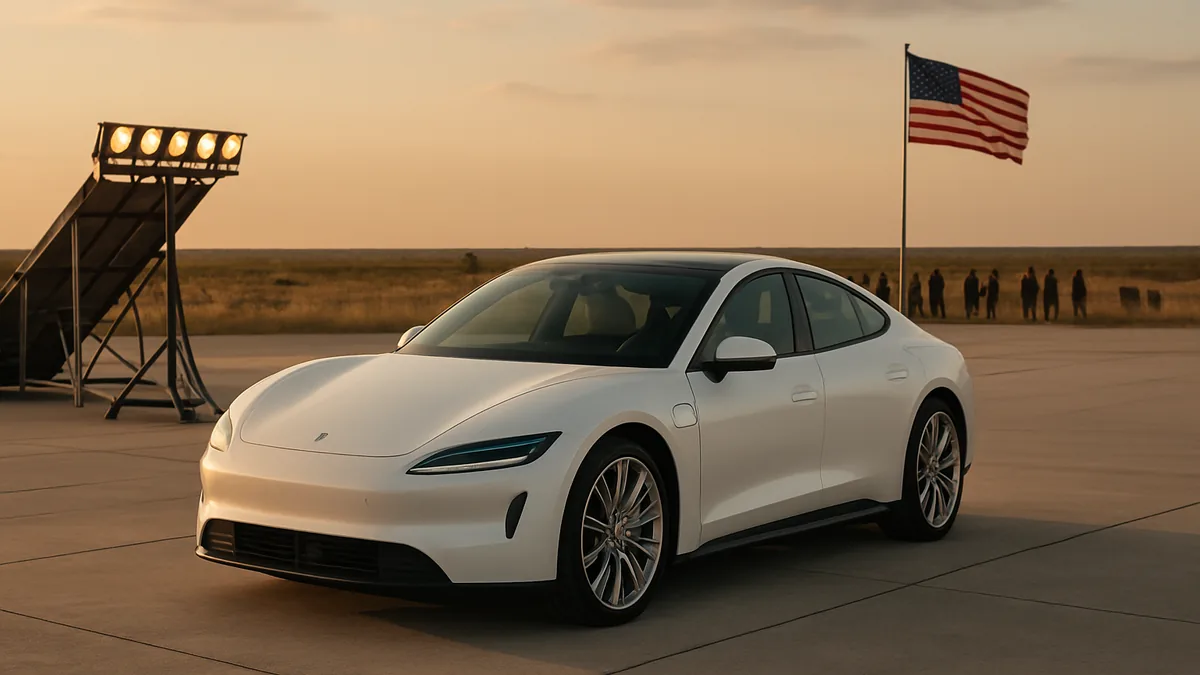
Tesla unveiled a redesigned Roadster powered by rocket-style thrusters on Thursday and said it would begin production in 2028. The announcement came more than a decade after the company first showed a next-generation version of its electric sports car. The white two-seater was developed in collaboration with SpaceX, the rocket company run by chief executive Elon Musk.
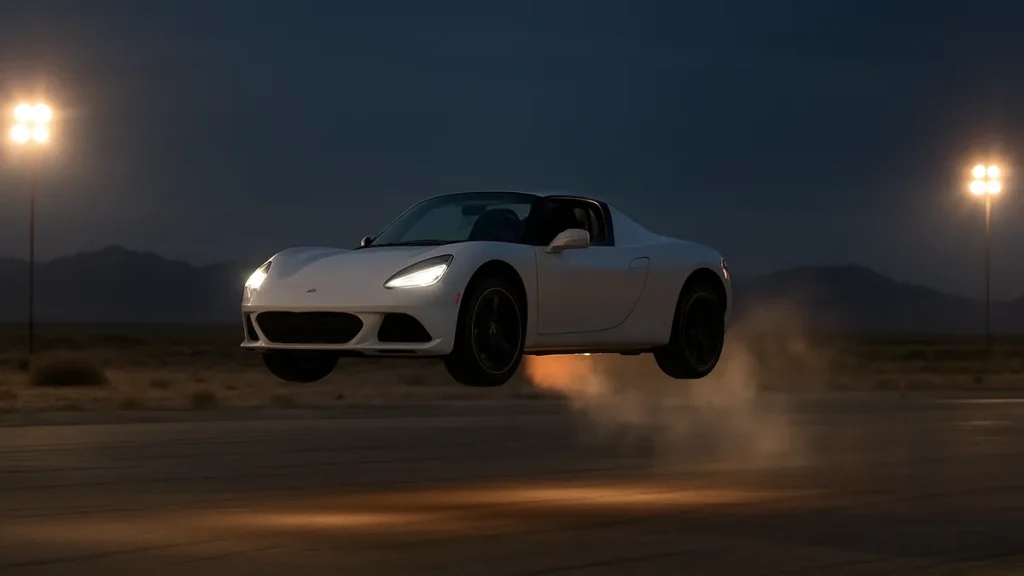
During the demonstration, the car drove upside down on a ramp using a suction system, turned in the air and landed using built-in thrusters. Later, it used the thrusters to leap over a truck and other vehicles, twisting in the air during the manoeuvre.
Launch event at a SpaceX test site
The event took place at a SpaceX test site in McGregor, Texas. It included many of the features of a classic Musk product reveal, including dramatic music, smoke, mechanical hissing sounds and a launch countdown. Musk, wearing a silver Western-style belt buckle with the Tesla logo, told a cheering crowd of enthusiasts and investors that the project was the result of work by Tesla and SpaceX engineers.
Viewers and witnesses praised the spectacle. Tesla fan and investor Sawyer Merritt wrote on X that it was “the most insane product demo I’ve ever seen.” He added that he was still asking how the demonstration was not artificial intelligence.
Not everyone was impressed by the commercial case. Gene Munster, managing partner at Tesla investor Deepwater Asset Management, said on X that the car was an “engineering flex” with no commercial value beyond embarrassing traditional carmakers. He also said the Roadster event was another sign of why Musk wanted to bring Tesla and SpaceX together.
Some observers saw the collaboration as Musk building interest in a possible merger of the two companies, which he controls. Musk has discussed the overlap between them. Tesla shares were up 5 per cent in premarket trading on Friday.
Pricing, deposits and performance claims
Musk and other executives did not specify target prices at the event. Tesla had quoted a base price of $200,000 for the vehicle nearly a decade earlier. After the event, Tesla’s reservation page listed a “Performance” version requiring a $50,000 deposit and a “Thrust” version with “acceleration thrusters” requiring a $250,000 deposit.
A “Rocket” variant is also listed. Tesla says it is “invite only” and describes it as a single-seat model with a “full flight system.”
Tesla vehicle engineering chief Lars Moravy said the Roadster can accelerate from zero to 60 mph (97 kph) in less than one second and reach a top speed of over 230 mph (370 kph). Musk said the car could be faster still, adding that it should “crack halfway to the speed of sound.” The Roadster can also travel more than 300 miles (480 km) on a single charge.
That range is less than half of what Musk promised in 2017, when Tesla first revealed a prototype of the second-generation Roadster and said deliveries would start in 2020. The company has missed several Roadster deadlines over the years.
A showpiece as Tesla shifts toward robotics
The original Roadster, released in 2008 and sold until 2012, was Tesla’s first electric vehicle and used a Lotus Elise chassis. The company has since become known for its Model Y and Model X SUVs and its Model S and Model 3 sedans. Morningstar analyst Seth Goldstein said in a note last month that the new Roadster would become Tesla’s “halo car,” a high-performance vehicle meant to showcase an automaker’s engineering. Musk had earlier played down the car’s financial importance, describing it in 2023 as a “small potato situation.”
The reveal comes as Tesla shifts its focus from manufacturing cars for human drivers toward artificial intelligence-led self-driving technology and robotics. This year, Tesla stopped selling Model S and X vehicles to free up production for its Optimus humanoid robots. It also launched the Cybercab, a two-seat robotaxi without manual controls such as a steering wheel, pedals or mirrors.
Tesla is due to report third-quarter results on October 21, a date analysts say matters more to investors than the reveal. Sales of the company’s ageing electric vehicle lineup have declined over the past two years, although high petrol prices helped lift deliveries in the third quarter. Josh Gilbert, lead analyst for Asia-Pacific at trading platform eToro, said margin and cash flow figures would carry far more weight with investors than anything shown at the event.