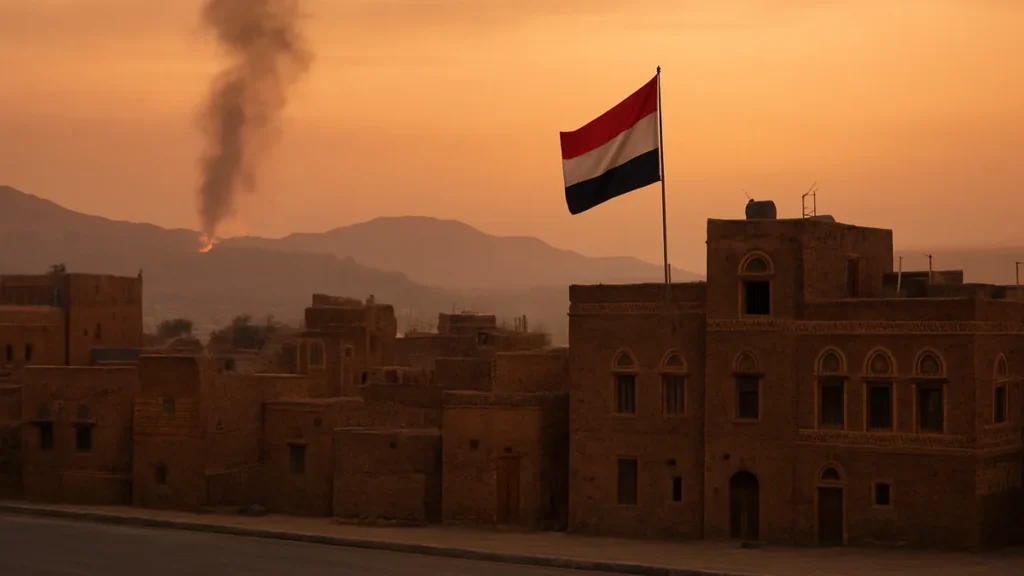
A month after Yemen’s internationally recognised government announced its Dawn of Yemen offensive, the fighting has settled into a grinding contest. The operation, which the government said would aim to retake Houthi-held territory including the capital Sanaa, began in early October. Residents of Sanaa say the initial sense of alarm has eased, although air strikes continue to recur.
Analysts and researchers now describe the offensive as the start of a new phase in a war that has lasted more than a decade. They say it shows no sign of ending soon, and that both sides are being pushed to absorb heavy losses.
Sanaa remains calm as fighting continues elsewhere
When the offensive was announced on October 5, Mohammed Ahmed, a 40-year-old Sanaa resident, began preparing for the worst. He said his family was overwhelmed by worry and uncertainty. His main concern was not which side would prevail, but what hostilities near or inside Yemen’s most densely populated city might bring.
Also read: Yemen's Al-Jawf becomes new front in government-Houthi war · Yemen Fighting Displaces 290,000 as Pregnant Women Face Risk
A month on, Ahmed said his anxiety had lessened because the capital remains largely calm, apart from recurring air strikes. Sanaa has been under Houthi control since 2014, when the group seized it during the early stages of the civil war.
Elsewhere the picture is different. The Houthis, an armed group also known as Ansar Allah, have made territorial gains in other provinces, including Taiz and Lahij in southern Yemen, where fighting has not stopped. Yemenis such as Ahmed say the early momentum around the offensive has faded, even as the wider struggle intensifies.

Experts see a shift toward a prolonged war of attrition
Turki al-Goblan, head of the Saudi Daimumah Center for Studies, said the Houthis had previously survived by adapting to strikes, using difficult terrain, running clandestine supply and concealment networks, and placing civilians among their forces. In his view, that strategy is now under strain. He said the offensive had dealt a blow to three pillars of it.
According to al-Goblan, the first pillar is the fuel and supply system that moves combat vehicles, carries ammunition and delivers reinforcements. The second is the group’s position in the maritime areas around the Bab al-Mandeb strait and the western coast, which he described as outlets for alternative external supply routes. The third is the support of some tribes around Sanaa, which have begun declaring mobilisation for the government, weakening the Houthis’ reliance on them.
Al-Goblan argued that the speed of attrition has outpaced the group’s ability to recover. He said repeated losses could eventually leave the Houthis unable to keep fighting, and described this as the scenario he considered more likely.
Abdulsalam Mohammed, chairman of the Yemeni Abaad Studies and Research Center, said the offensive had forced the Houthis to move their forces and equipment, exposing them to deadly attacks. He said many Houthi field commanders and hundreds of fighters had been killed in air strikes, particularly in Taiz and on the western coast. He warned, however, that territorial gains could prove short-lived if government air power and ground forces keep up coordinated attacks.
Yazeed al-Jeddawy, a research manager at the Sana’a Center for Strategic Studies, said the war appeared to be moving towards a prolonged attrition struggle, because the government offensive had not shifted the balance of power over the past 30 days. He said the conflict was no longer shaped only by dynamics inside Yemen, but was also tied to the wider regional confrontation and the war involving Iran. He described the approach of both sides as increasingly zero-sum.
Missile attacks and competing claims over losses
Since the offensive began, neither government-controlled areas nor Saudi Arabia has been safe from Houthi missile attacks, according to reports. The group has repeatedly fired missiles, occasionally causing damage, deaths and injuries. One of the latest attacks killed at least 70 government security recruits in Shabwah.
Yemen’s government said on Monday that its forces had killed or wounded 1,540 Houthis in 24 hours last month. Later, it said 16,100 Houthi operatives and commanders had been killed or wounded since October 5. The Houthis have not confirmed any death toll. They have also continued to fire missiles and drones daily into Saudi Arabia, hitting several airports and disrupting air traffic over the kingdom.
Houthi military spokesperson Yahya Saree said the total number of attacks by the Saudi-led coalition, including air strikes, in Yemen had reached 3,939 since the latest escalation began. On Monday, the Presidential Leadership Council reaffirmed its commitment to the offensive and its goals, which it said were ending the Houthi “coup”, restoring state institutions and extending state authority across the country.
Colonel Wadah al-Dubaish, spokesperson for the government-aligned Joint Forces on Yemen’s West Coast, said the Houthis had recently expanded their gains in Taiz, but at an extremely high price. He said the group had lost more over the past month than in previous years combined. Government forces said they had regained control of the Dhubab district in Taiz governorate and key positions near Bab al-Mandeb. Al-Dubaish also said the Houthis had used ceasefires over the past decade to prepare and mobilise for war.
Al-Jeddawy said the continued missile attacks showed the Houthis still have a functioning and resilient missile capability. He said the more important question was the scale of external support the group receives, whether in intelligence, targeting, components, technical expertise or weapons replenishment. He argued that the timing and volume of the attacks suggested a wider support network.
Al-Goblan read the same attacks differently. He said they did not necessarily reflect military strength or a coherent strategy, and could instead be an attempt to offset weaker ground manoeuvring with long-range firepower, maintain cohesion across fronts and project the appearance of retaining the initiative.