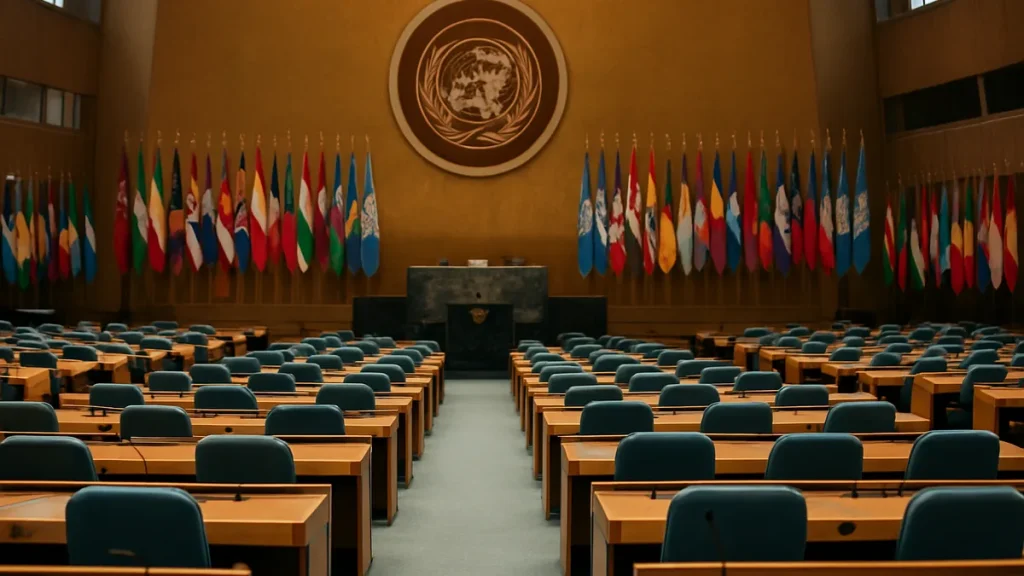
Pakistan has urged the United Nations to abolish or sharply limit the Security Council’s veto power. It also warned that adding permanent members would widen existing inequalities and raise the risk of institutional gridlock. The position was put forward at the UN General Assembly on Monday by Pakistani delegate Gul Qaiser Sarwani, according to the state-run Associated Press of Pakistan (APP).
Sarwani said that misuse of the veto weakened the Council’s effectiveness and damaged the credibility of the world body. He told the 193-member Assembly that the five permanent members wield influence across the UN system that no other state matches. His comments came during a debate on reforming the 15-member Council, which is responsible for maintaining international peace and security.
Pakistan rejects additional permanent seats
The five permanent members are the United States, Russia, China, France and the United Kingdom, and each can block substantive resolutions with a veto. Sarwani, a counsellor and political coordinator at Pakistan’s UN mission, said extending permanent membership and veto powers to more countries would reinforce existing imbalances. “Let us be clear: the problems cannot be the solution,” he said, restating Pakistan’s opposition to extra permanent seats.
His remarks follow a campaign by India, Brazil, Germany and Japan, known collectively as the Group of Four, for permanent membership. Pakistan, working with Italy-led partners in the Uniting for Consensus (UFC) group, opposes adding individual permanent members to an enlarged Council. Sarwani argued that such an expansion would keep historical privileges alive, create new centres of power and heighten the danger of paralysis. “We believe that the veto should be abolished or at least severely restricted; it must not be expanded,” he said.
Elected members and resolution 76/262 on the veto
Pakistan supports efforts to address veto use under General Assembly resolution 76/262, which was adopted in April 2022. The resolution requires the Assembly to convene within 10 working days whenever a veto is cast in the Council. Sarwani said any measures to restrict the veto must remain consistent with the UN Charter.
On the veto’s ability to block Council action, Sarwani said Pakistan believed the imbalance could be reduced by restricting the veto or by strengthening the role of elected Council members. He added that increasing the number of elected members and changing the threshold for approving Council decisions could make the body more democratic and provide a stronger check on the veto.
Assembly president calls for dialogue over vetoes
Opening the session, General Assembly President Khalilur Rahman of Bangladesh said the veto initiative had become an established mechanism for transparency, accountability and collective responsibility. He noted that the Assembly had held 21 such meetings since the initiative was introduced. Rahman commended the Council for submitting special reports to the Assembly after vetoes and welcomed the participation of permanent members in the debates that followed.
Rahman said the Council’s effectiveness has direct consequences for people facing conflict, insecurity and humanitarian suffering. He said the costs of inaction fell first on those most exposed to violence and instability. He expressed hope that the Council would reach the consensus needed to act decisively for peace, which would reduce the need for the veto initiative. He urged delegates to keep debates meaningful rather than repetitive. “No veto should bring an end to dialogue and diplomacy,” he said.
Delegates also pointed to the existing and potential effects of the veto system on regions and territories far from where Security Council decisions are made.