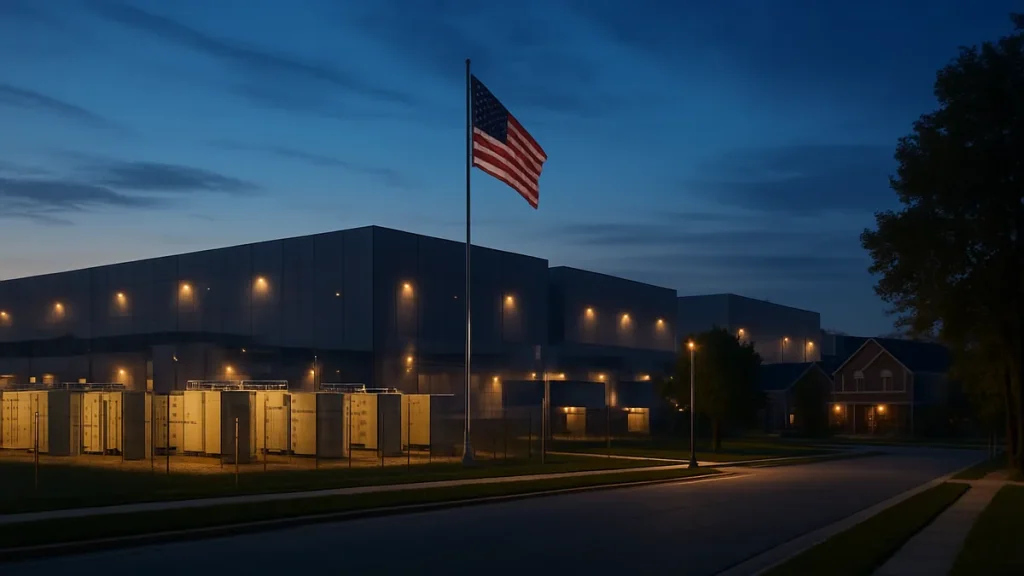

A year ago, a longtime US senator was not thinking much about data centres. Now, according to one of his advisers, he meets regularly with staff to track their impact and is working on new legislation to curb their rapid expansion across the country.
The senior policy adviser to the Democratic senator, who spoke on condition of anonymity because they are not permitted to talk to the press, said the shift had come quickly. “This happens sometimes, something starts slow and then it goes fast,” the adviser said.
Local opposition spreads across the United States
The senator’s change in focus was driven largely by a growing wave of public backlash that has left politicians across the country scrambling to keep up. Data centres are large warehouses that store the computing power needed for internet activity. They are now also the physical face of the rapid growth of artificial intelligence, and of the wide-ranging fears people link to it.
Indiana resident Angelita Soriano said she did not want to be a test case. “I don’t want to be the guinea pig for this,” she said. A new Amazon data centre is being built directly across the street from her home. When complete, the 26-building structure will cover more than a square mile of her neighbourhood and house 782 diesel-powered generators.
Some projects are far bigger. In Ohio, a joint effort involving OpenAI, Nvidia, SB Energy and the US Department of Energy is set to build a complex that will stretch for roughly six square miles, about the size of most US townships. According to a report by the Pew Research Center, around 3,000 data centres are currently operating in the US, and that number could double within the next few years.
Data centres are approved through very local rules and permits, which means federal lawmakers such as US senators have little direct say. Even so, opposition has grown so fast that politicians at every level are now almost obliged to take a position. Chloe Autio, an AI policy adviser, said the concern is not confined to one side of politics. “This isn’t just an issue on the left, there is huge pushback among conservatives to data centres,” she said.
That pressure has placed many lawmakers on Capitol Hill, including some Republicans, in direct conflict with President Donald Trump, who has championed the unrestrained growth of AI technology. Trump has described the backlash as a “sick conspiracy” and said people and towns trying to keep the buildings out are “backwards and poor”. Democrats looking to win over unhappy or undecided voters ahead of the midterms have used his remarks to their advantage.
Candidates in key races shift their positions
Residents interviewed in Indiana, Arizona, Michigan, Pennsylvania and Oregon, all of whom have been organising locally against data centre projects, raised concerns about their size, construction and operational noise. They also worried about the effects on air, water and energy resources, and about how quickly local authorities seem to approve them.
Arizona Governor Katie Hobbs was once a supporter of the industry, but public pressure moved her to the other side of the debate. In July, she enacted a three-year pause on any new tax break given to a company for a data centre project. Arizona is far from the only state where politicians have responded to the backlash.
In Michigan, Abdul El Sayed, a Democrat running for the Senate, made new rules and regulations for data centres a clear part of his successful primary campaign. In the race for governor of Georgia, a Democrat calling for a pause on data centre development is in a dead heat with a Republican who disagrees with him.
In Ohio, Republican Senator John Husted is fighting to keep his seat against Democrat Sherrod Brown, and he has also had to shift position. Recent polls have found that most Ohio voters oppose data centres, and Husted has softened his support, saying their arrival should be left to local citizens and elected officials. Brown, meanwhile, has campaigned on his opposition to new data centres and leads Husted in recent polls.
Husted’s difficulties led the National Republican Senatorial Committee, the main fundraising arm for Senate conservatives, to write in a private memo that Republican politicians needed to entirely reframe how they talk to voters about data centres. “This has become a sleeper issue for the entire election cycle,” the committee said.
Texas may be the clearest example of how the backlash has become an issue even for the most pro-business politicians. According to Pew data, the state currently has almost 300 operating data centres, with another 170 planned. At the end of last year, Republican Governor Greg Abbott called Texas “the epicentre of AI development”. Within months, he was backtracking, citing concerns about “safety and quality of life”. The issue could also play a part in the state’s Senate race, where Democrat James Talarico, who is pushing to end what he calls “sweetheart tax deals” for Big Tech, is seen as a frontrunner against Republican Attorney General Ken Paxton. In a late September interview, Paxton said there was still “plenty of open space in Texas that we can put data centres”.
Doubts over jobs, temporary measures and local tensions
Supporters of data centres often argue the projects will bring more and better-paid local jobs. However, recent research from the Brookings Institution, a non-partisan policy research group, found that a new data centre creates between 100 and 200 local jobs, which is “fewer than industry advocates claim”. The researchers also found that the projects have essentially no impact on local wages.
Many of the measures politicians have proposed or adopted are temporary. Most of the moratoriums, for example, will end in one to three years, and the political climate may have changed by then, leaving technology and AI firms free to build as they wish. For now, though, public feeling is strong. Data Center Watch, a firm that collects data for AI industry stakeholders and is part of the AI startup 10a Labs, found that community groups opposing data centres more than doubled to 833 in the first few months of this year, appearing in almost every US state.
Balaji Tammabattula, chief executive of Barupon, is developing a roughly 700-acre data centre and technology campus in Liberty, Texas. He said the buildings are designed to capture rainwater and generate their own energy, an increasingly common approach for major projects. Even so, he said residents oppose the project outright. “There’s just such a high level of tension from the jump that you can’t really even break through with the facts,” he said. At a recent community event, he said a woman who strongly opposed the project told him to leave the state.
Stephanie Maldonado, political director of LUCHA, a community organising group based in Arizona, described the pushback as “a David and Goliath story” that began several years ago. “People have been ready to put a stop to it,” she said. “Now, people are angry.”