
A proposal by the Waqf Board in Indian-administered Kashmir to introduce uniform Friday sermons at mosques across the region has triggered criticism from politicians and religious leaders. They accuse the government of trying to assert control over Muslim religious spaces. The board announced the move last weekend.
The Jammu and Kashmir Waqf Board is headed by Darakshan Andrabi, a local leader associated with the Bharatiya Janata Party (BJP) of Indian Prime Minister Narendra Modi. The region was stripped of its semi-autonomous status in 2019 and divided into two federally governed territories rather than functioning as a full-fledged state. The board oversees Muslim religious endowments, which Islamic law requires it to manage.
Waqf Board defends plan for pre-approved sermons
Andrabi defended the proposal in comments to a leading Indian newspaper. She said a proposed committee formed under the board’s auspices would be solely responsible for identifying the issue of uniform sermons. She argued the step was needed to address problems in the region, especially social evils, including drug abuse.
Andrabi also told the media that religious scholars would approve Friday sermons, with no role for any government official in the decision. On Sunday, the board had summoned about 1,500 top scholars and preachers from across Kashmir. Some attended in person, while others from remote areas joined the meeting virtually.
A scholar from the mountainous Rajouri district, about 180 kilometres from the region’s biggest city, Srinagar, attended the meeting online. He said Andrabi had issued instructions that only a pre-approved sermon, drafted by a committee of senior-most scholars, would be recited uniformly at mosque pulpits on Fridays. He said the scholars were not told exactly who would sit on that committee.
According to the scholar, he and others objected that they would not follow the directives if a sermon was found to violate Islamic teachings. He said Andrabi dismissed their concerns and did not allow them to speak. He spoke on condition of anonymity, saying he feared reprisals from the authorities. He quoted Andrabi as saying the decision was final because it had been four years in the making.
Religious leaders and politicians condemn the move
The region’s top Muslim scholars had earlier described the proposal as “irresponsible interference into the religious affairs of Kashmiri Muslims”. On Tuesday, Mirwaiz Umar Farooq, the region’s leading Muslim religious figure, warned that the move would amount to “direct interference”. The Mutahida Majlis-e-Ulema, a joint body of several religious organisations that he leads, said that determining sermon content was the responsibility of Islamic scholars and not of an administrative body.
Omar Abdullah, the region’s elected head and a member of the National Conference party, also condemned the plan. The National Conference supports accession to India but wants the autonomous powers that New Delhi removed seven years ago.
Nayeem Akhtar, a senior politician who served as Kashmir’s education minister under the previous elected government, said centralised sermons had existed in medieval times under a sultan or caliph, but that they had carried legitimacy because Kashmir was then an Islamic state. He said that today the region was expected to live in a secular state. Akhtar also said the new instructions came from an office bearer linked to the BJP, which explained the strong reaction. He argued that the board’s role was managerial and that it was exceeding its remit by guiding clerics on how to do their jobs.
Following the backlash, Andrabi retracted her statement. She said it would be left to “independent scholars, preachers (and) sermonists” to speak about social issues such as rising suicides, mental trauma and substance abuse.
A pattern of disputes over mosques and shrines
Kashmiri Muslim scholars have accused the BJP-led administration of trying to control local religious institutions before. Earlier in January, police distributed a four-page form titled “profiling of mosques”. Scholars said it sought intrusive details about imams, muezzins and preachers across the region, including their biometric information, and accused the government of discriminatory practices.
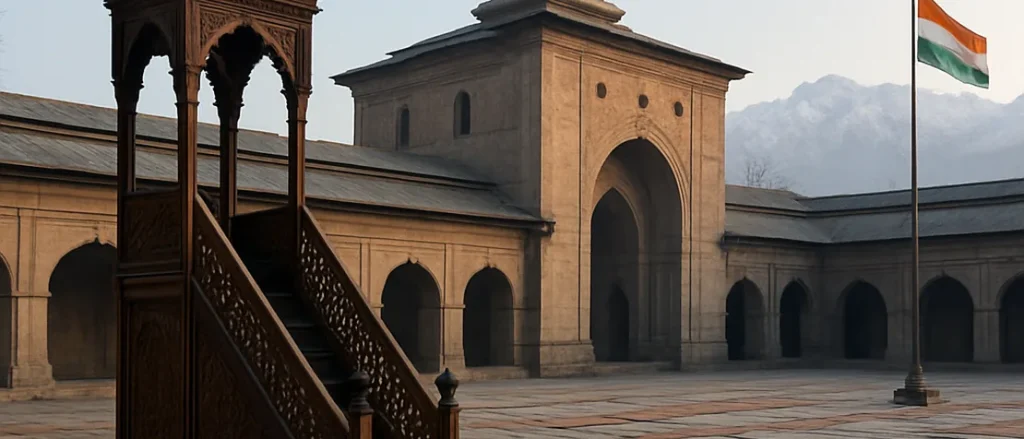
Muslim groups in the region have also faced long-running restrictions on prayer. Srinagar’s 600-year-old Jamia Masjid is often shut for important religious occasions, including Eid prayers and Laylat al-Qadr. The administration says such restrictions are meant to maintain peace, but religious leaders call them a “systematic assault on the religious identity, dignity, and fundamental rights” of Kashmiri Muslims. Farooq has himself often been barred from moving freely, which has stopped him from delivering Friday sermons on occasions when he was expected to speak on issues such as Israel’s genocide in Gaza.
The Waqf Board has previously moved to ban the distribution of yellow rice inside the compounds of major shrines, a centuries-old tradition linked to the Sufi missionaries who spread Islam in Kashmir. In 2022, it also banned the collection of voluntary nazr-o-niyaz donations from devotees. It cited newly applicable federal laws as the reason for taking direct control of all financial collections and routing offerings to the board.
The 2019 change also replaced the region’s indigenous legal arrangements for waqf, the charitable bequests Muslims make for the wider community, with those in force across India. The new system gave broad powers to the federally controlled bureaucracy over local religious boards. Noor Ahmad Baba, a veteran Kashmiri political scientist and historian, said religion has long been a factor in political mobilisation in Kashmir, which is why changes to traditional religious arrangements provoke political outrage. He said the standardisation would not have become an issue if it had come from clerics with public acceptance, adding that religious leaders could legitimately speak on topics such as drug addiction and climate change.
A Srinagar-based political analyst, who has written about the conflict for four decades, said such decisions reflected efforts to contain protests in Kashmir pre-emptively amid a rise in Hindu nationalism in India. The analyst pointed to recent mosque demolitions in cities such as Ujjain and Saharanpur in Uttar Pradesh. The analyst spoke on condition of anonymity, citing fear of retribution.