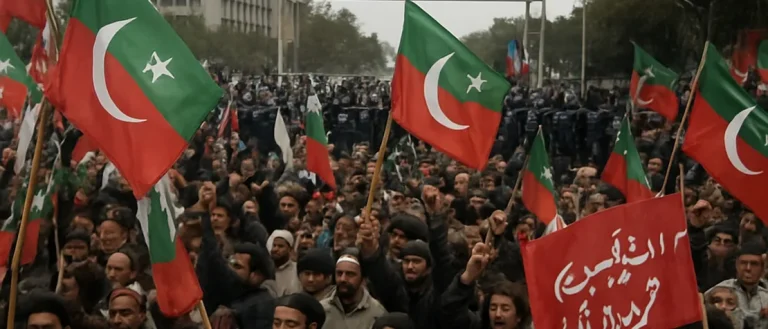

Jamiat Ulema-e-Islam-Fazl chief Maulana Fazlur Rehman has condemned the federal government’s decision to impose governor’s rule in Khyber Pakhtunkhwa, describing the move as an attack on democracy. Speaking at a press conference in Islamabad on Sunday, he said his party could stage a protest on its own or join forces with Pakistan Tehreek-e-Insaf (PTI).
The announcement followed a decision by President Asif Ali Zardari, who approved the imposition of emergency and governor’s rule in the province on Sunday, acting on the federal government’s recommendation. The step came amid heightened tension over security and PTI’s protest campaign, and it placed the provincial administration under a new arrangement backed by the federal authorities.
Fazl accuses federal government of undermining democracy
Fazl argued that the federal government was ignoring the democratic principles that those in power claim to uphold. He said the decision was inconsistent with those principles and that the government had no grounds to present itself as democratic while disregarding democratic traditions and values. He added that this was the third time governor’s rule had been imposed in a province.
To underline his point, Fazl recalled an earlier episode in the then North-West Frontier Province. His father, Mufti Mahmood, had stepped down as chief minister after the provincial governor was removed and replaced, a period in which the then governor, Arbab Sikandar Khan Khalil, was dismissed and succeeded by Aslam Khattak. Fazl said he did not want to reopen those old disputes and believed they should be left to history.
Asked about the motives of the policymakers behind the latest decision, Fazl said those questions should be put to them directly. He suggested that events between 6am and 10am on Sunday offered some indication of their intentions, but he did not explain further.
Doubts over the terrorism justification and Balochistan comparison
Fazl challenged the federal government’s justification for suspending the provincial government, which had cited the performance of the PTI-led administration in tackling terrorism. He asked whether the Balochistan government’s record was satisfactory, given the serious security challenges in that province. In his view, if poor counterterrorism performance justified action in KP, the same standard should be applied to every province.
When a journalist pointed to the federal claim that the Balochistan administration was cooperating with security agencies, Fazl questioned whether cooperation alone could be used to judge a government’s performance against militancy. He also said his party had backed the Constitution despite its reservations about successive military operations and their consequences. He added that political differences should not be used to punish parties.
Fazl did not fully defend the record of the former KP government. Asked whether he was satisfied with the administration of former chief minister Sohail Afridi, he said no government was flawless and that performance should be assessed across all governments rather than selectively.
JUI-F weighs joint protest, possible resignations and next steps
On whether his party would protest alongside PTI, Fazl said both joint and separate demonstrations remained possible. He said the party would reach a decision after consultations and announce its strategy through its organisational forums. On the prospect of lawmakers resigning from assemblies should PTI pursue that route, he said JUI-F would weigh the proposal only once it was formally put to the party.
Fazl clarified that the understanding with opposition parties centred on working together inside parliament. Contacts outside the legislature, he said, would continue according to circumstances and the needs of the country.
The JUI-F chief said the party would now consult internally before deciding its next steps. Those options include staging protests independently, coordinating with PTI, or considering proposals for parliamentary resignations.
Fazl says government has narrowed room for talks
Fazl said he remained committed to negotiations and a political settlement, but he believed the government had largely shut the door on further dialogue. He said his earlier assessment had been that little room for compromise was left. Government representatives later approached him, but he said any progress would depend on whether they showed a genuine willingness to keep talking.
Asked whether negotiations had entirely ended, Fazl said political actors should remain open to a solution, though the government would need to indicate whether further talks were possible. He also questioned Prime Minister Shehbaz Sharif’s independence in making the decision, saying the premier should be asked whether he had acted on his own judgment or under pressure from others. Fazl declined to disclose more details of the negotiations, saying some matters would be left for later.
Fazl also questioned the wording of the summary signed by Zardari to approve the measure. He argued that the document did not expressly state the president’s satisfaction, which he believed the Constitution required, and said the president should have made that satisfaction clear in writing before signing. Whether the wording meets constitutional requirements, however, would depend on the relevant legal provisions and official documents rather than on his assertion alone.
Fazl had recently been trying to mediate between the federal government and PTI as tensions rose over a planned protest march and the security situation in KP. Before Sunday’s decision, he had publicly opposed emergency or governor’s rule and urged political leaders to pursue dialogue.