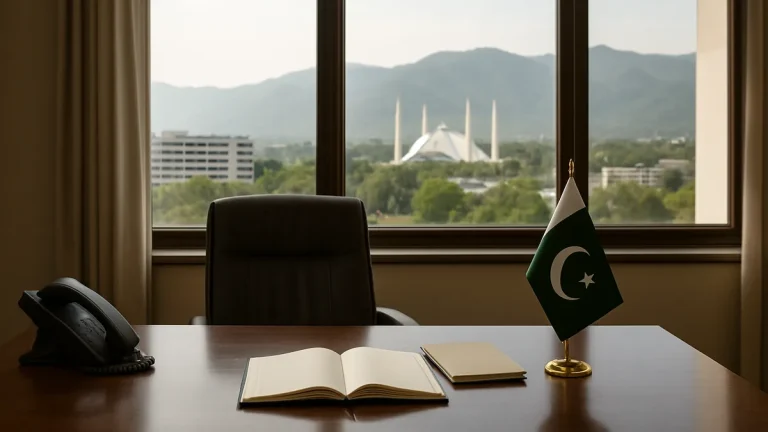
Bangladesh is contemplating joining the recently signed Makkah pact, a mutual defence agreement between Saudi Arabia, Turkey, and Pakistan, a move that could complicate its diplomatic relations, especially with neighboring India. The pact, established this month, commits members to collective defence, treating an attack on one as an attack on all.
Relations between Bangladesh and India have been tense, with Bangladesh accusing Indian border forces of forcibly pushing people across the border. Additionally, Bangladesh is seeking the extradition of former Prime Minister Sheikh Hasina, who has been living in exile in India since her removal from office following protests in August 2024.
Junior Foreign Minister Humayun Kabir indicated that Bangladesh views the security arrangement among Islamic nations in the Middle East positively and is considering participation. He noted that the leadership of Bangladesh, particularly Prime Minister Tarique Rahman, has been invited to join the pact.
Saudi Arabia extended the invitation to Bangladesh, although the timing of this offer remains undisclosed. The pact, signed in the holy city of Makkah, is modeled on NATO’s collective-defence principle and comes amid escalating regional tensions marked by Iranian missile activity.
Bangladesh, like Turkey, is a secular republic, despite over 90% of its population being Sunni Muslim. Responses from the embassies of Saudi Arabia, Turkey, and Pakistan in Bangladesh were not immediately available regarding the minister’s comments. Turkey, which hosts NATO’s second-largest army, has stated that the pact, involving nuclear-armed Pakistan and major oil exporter Saudi Arabia, is open to expansion.
Experts suggest that joining a military alliance would challenge Bangladesh’s traditional foreign policy of avoiding alignment with rival geopolitical blocs, a strategy that has helped attract investment, expand exports, and maintain economic relations with competing global powers. Bangladesh’s economy heavily depends on ready-made garment exports to the UK, EU, and US, alongside remittances from millions of workers in the Middle East.
Geopolitical analyst Kollol Kibria warned that formal membership could complicate Bangladesh’s relations not only with India but also with China, Iran, Japan, Kuwait, Oman, Qatar, Russia, the UAE, and the United States. While these ties might not break immediately, joining a military bloc would force Bangladesh to clarify its strategic alignments.
The invitation arrives at a sensitive time for Bangladesh-India relations under Prime Minister Rahman’s six-month-old administration. Despite efforts to maintain cordial ties, Rahman has yet to decide on a visit to India, pending New Delhi’s response to the extradition request for Hasina. Bangladesh has called for a favorable environment for such a visit, following Hasina’s recent media interactions in New Delhi, which drew criticism from Dhaka.
India’s foreign ministry stated it is closely monitoring developments in West Asia related to the pact. Analysts believe New Delhi would likely oppose Bangladesh joining a security alliance that includes its regional rival, Pakistan. Nonetheless, Dhaka must balance the economic and strategic implications of such a decision.
Asif Shahan, a development studies professor at Dhaka University, noted that joining the alliance could displease several countries, including India, potentially jeopardizing Bangladesh’s export-driven economy reliant on stable diplomatic and commercial relations. However, he emphasized that such concerns should not solely dictate Bangladesh’s decision.