Judges at the International Court of Justice are due to read out their verdict on Thursday in a genocide case that The Gambia filed against Myanmar seven years ago. If the court rules in The Gambia’s favour, it would be the first time an international court has found a state guilty of genocide.
The case concerns the mass expulsion of Rohingya people from Rakhine State in August and September 2017. The lawyer leading The Gambia’s case, Arsalan Suleman, has said a win would be a landmark moment and would give new force to the 1948 Genocide Convention and to the idea that states can be held legally accountable for crimes they commit.
How The Gambia’s case reached the ICJ
Dozens of individuals have been prosecuted for genocide in past conflicts, including in Rwanda and the former Yugoslavia. However, no state has previously been found guilty of the crime by an international court.
Also read: Fears of US sanctions on ICJ judges over Myanmar genocide case
The ICJ was set up in 1945 to settle disputes between states rather than to try international crimes. It was nonetheless chosen to hear the case because, according to the account, the Rohingya victims had few other routes to seek redress. Myanmar was not a signatory to the International Criminal Court, so a case could not be filed there against the officials accused of atrocities in Rakhine State.
The Gambia, backed by the Organisation of Islamic Co-operation, brought the case in November 2019. It argued that all states are bound by the Genocide Convention and therefore have an interest in upholding it. The case accused the state of Myanmar, not only its military, of genocide.
Myanmar objected that The Gambia had no standing to bring the complaint, since it was not directly affected by the alleged acts. The judges rejected that objection and ruled that The Gambia was entitled to file the case, a decision described as a novelty in international law.
Defence arguments and the high bar for proving genocide
The case drew wide attention when Aung San Suu Kyi, who then headed Myanmar’s elected government, personally led the country’s initial legal defence at The Hague. She was widely criticised for doing so. Her refusal to condemn the military’s actions in Rakhine State disappointed many who had previously admired her commitment to democratic principles. She was later deposed in a 2021 coup and placed under arrest, and the defence is now led by a team appointed by the military.
Proving genocide has historically been very difficult, and judges set a demanding standard. Where there is no explicitly genocidal programme, the judges need evidence that leaves genocidal intent as the only reasonable conclusion from the defendants’ actions. In a 1993 case brought by Bosnia-Herzegovina against Serbia, the court took 14 years to rule that the 1995 Srebrenica massacre amounted to genocide, but that there was not enough proof of genocidal intent by Serbia itself.
Myanmar’s lawyers and Suu Kyi have made a similar argument. Suu Kyi has said The Gambia’s team mischaracterised a complex conflict and military operation. She has accepted that war crimes may have been committed against the Rohingya, but argued that this does not prove genocidal intent.
Suleman has rejected that view. He told the court that the case rested on a long history of discrimination against the Rohingya, and that the policies linked to that history helped explain the language and propaganda used around the 2017 operations. He also pointed to the 1982 citizenship law and to restrictions on education, healthcare, livelihoods and travel, which he argued were among several indicators of genocidal intent.
What a ruling could mean for the Rohingya
A finding against Myanmar would place it alongside states and groups previously linked to the gravest crimes, and it would be a setback for Min Aung Hlaing, the general who now runs the country and was responsible for the military’s operations in 2017. He has been trying to improve Myanmar’s damaged international image in recent months.
There is no right of appeal against an ICJ verdict, but the court has no mechanism to enforce its rulings. Analysts have suggested the junta’s main focus is on rebuilding ties with neighbouring Asian countries, which are unlikely to pay much attention to the verdict, rather than with Western countries, which are more likely to care.
For the large Rohingya diaspora, however, the verdict carries significant weight. Mohammed Nowkim, a Rohingya who was driven out of the Rakhine town of Buthidaung in 2017 and now lives in Canada, described it as formal recognition of his community’s suffering. He said the Rohingya have waited for justice for decades, not just for this year.
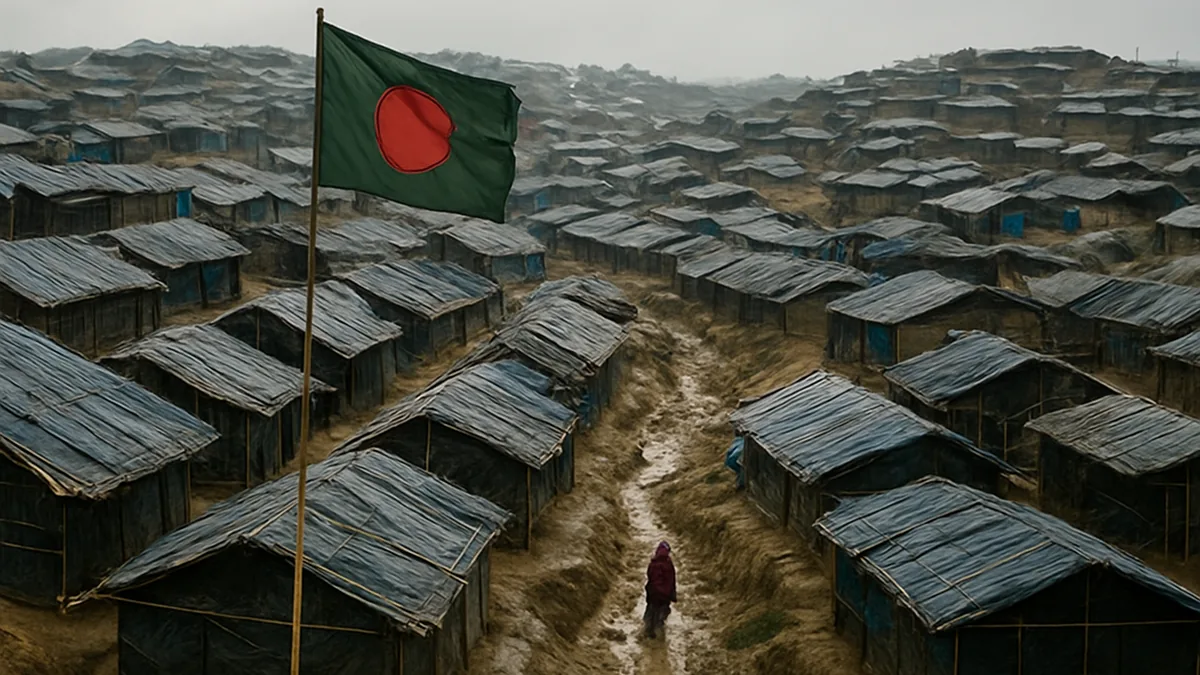
Rohingya activists hope a ruling in The Gambia’s favour will push other countries to act together on a solution that would allow Rohingya to return safely to Rakhine State. More than a million people remain in crowded camps in Bangladesh, barred from employment as international funding dwindles. Obstacles remain formidable, however. Rakhine State is torn by fighting between the military and the Arakan Army, which now controls most of the territory, and local Rakhine people are strongly opposed to the Rohingya returning. Many Rohingya villages have been destroyed, and international support for the community has faded over the years.