Rohingya refugees in Bangladesh are pinning their hopes on the International Court of Justice (ICJ), which is due to deliver its judgement on Thursday in a genocide case The Gambia has brought against Myanmar. For families who fled the 2017 military crackdown in Rakhine State, the verdict is seen as a possible route to formal recognition of the abuses they say they suffered.
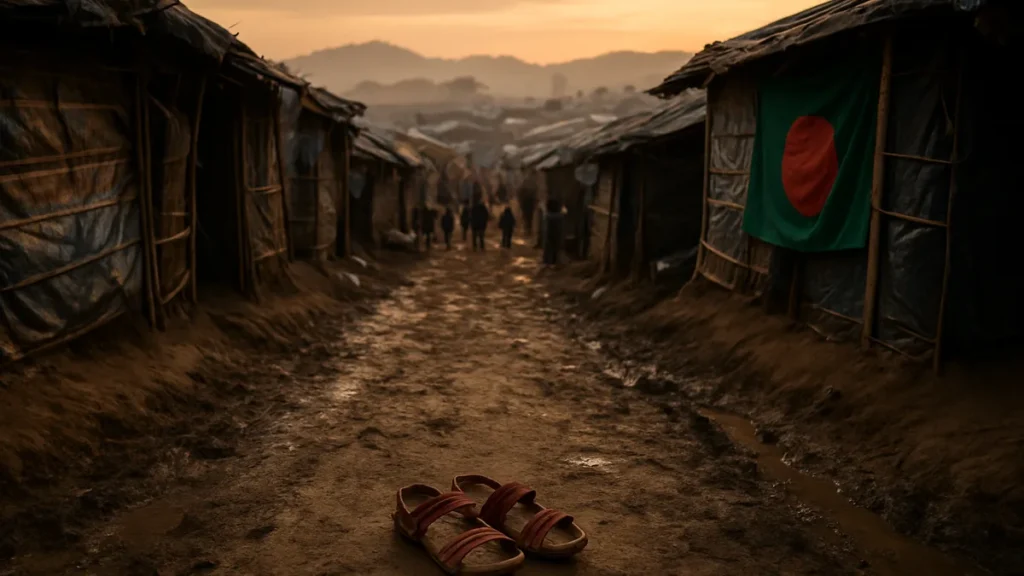
Dil Hossain and his wife, Alinnesa, escaped Myanmar during the crackdown with their newborn daughter, Ishara. Dil’s elderly parents could not get away and were killed as the family fled, along with several other relatives. Nearly nine years later, Ishara is growing up in a camp in Cox’s Bazar and has spent almost her entire life in exile, relying on humanitarian aid that has fallen sharply in recent years.
The case behind Thursday’s ICJ judgement
The Gambia filed the case on November 11, 2019. It alleges that Myanmar breached the 1948 Genocide Convention through acts carried out against the Rohingya by its military and other security forces. The allegations focus on so-called “clearance operations” that began in 2016 and escalated in August 2017, which The Gambia says amounted to genocidal acts aimed at destroying the Rohingya, in whole or in part.
The court has been asked to determine Myanmar’s responsibility as a state under the convention. Dil said he was confident the judges would acknowledge what happened. “The court will find the truth. We suffered, so we know,” he said.
More than 1.2 million Rohingya refugees remain in Bangladesh, most of them in camps in Cox’s Bazar. Many hope a favourable ruling would acknowledge their suffering and strengthen their claim to go home. However, even a legal win may bring little immediate change, because Myanmar is still caught up in civil war and the military accused of the crimes remains in power, making a safe return look remote.

Refugees describe lost homes and lasting trauma
Nurul Amin, 25, works with humanitarian groups in the camps. He said life in Myanmar was self-sufficient, with houses, farmland and gardens, whereas today people depend on others for almost everything. He compared the difference to the gap between heaven and earth, and said years of displacement have also damaged his mental wellbeing.
Mohammad Rehan, now 18, was a child when the crackdown began, but he still remembers it vividly. He recalled seeing houses burned, which left him frightened. “I was very young at the time, and those scenes left me traumatised,” he said. He hopes the court will recognise the Rohingya’s suffering and their right to equal treatment, and said a guilty finding would help the community return and reclaim its rights.
Mohammad Zubair, chairman of the Arakan Rohingya Society for Peace and Human Rights, said the community was confident the court would recognise what it had endured. He said Myanmar had refused even to recognise the Rohingya as a community, and that there was already enough evidence and testimony. He described life as a refugee as worse than prison and said he had been a respected teacher in Myanmar for about two decades. “We want to go back,” he said.
Nay San Lwin, a Rohingya activist and cofounder of the Free Rohingya Coalition, said meaningful justice would require more than a court verdict. He listed recognition of identity, restoration of rights, justice for victims and a safe return to their homeland. That would mean guarantees of citizenship and equal rights, recognition of the Rohingya as an ethnic community, and the right to return to their original villages.
Nay San Lwin said that if the court finds genocide, the international community, including the United Nations, must ensure the judgement is carried out without delay. He added that even without such a finding, the fight for justice would continue. “Our commitment to justice does not depend on a single verdict,” he said.
What a ruling could mean for international law
The ICJ has never found a state responsible for genocide, so a ruling against Myanmar would carry major implications for international law, according to Michael Kugelman, a resident senior fellow for South Asia at the Atlantic Council. The outcome would also affect Bangladesh, which has hosted the world’s largest Rohingya refugee population for years. Kugelman said a genocide finding would likely put more pressure on Dhaka to provide support and protection, while a ruling without that finding would reduce the pressure.
Nasir Uddin, a professor of anthropology at the University of Chittagong, said a favourable judgement would formally recognise the 2017 atrocities within an international legal framework. He said it would also give the community’s political demands a firmer legal footing, adding that a court judgement carries more weight than political rhetoric.
The case could also reinforce the principle that countries not directly affected by atrocities can still bring a case under the Genocide Convention, since The Gambia was not involved in the events in Myanmar. Uddin cautioned, however, that proving genocide requires specific intent to destroy a protected group, in whole or in part. Myanmar has argued that its 2017 operations were counterinsurgency measures, and he said he would not expect an entirely black-and-white ruling. He warned that rejecting the genocide allegation could strengthen what he calls the “politics of denial”.
Arakan Army control clouds prospects for repatriation
Even a favourable ruling would not guarantee a safe return. The Arakan Army, a rebel group, has taken control of nearly all of Rakhine State, including northern areas from which many Rohingya fled. Thomas Kean of the International Crisis Group said the group would be a necessary partner in any future repatriation talks.
Kean said relations between the Arakan Army and Rohingya communities have been badly damaged by the conflict. In 2024, Rohingya armed groups fought alongside Myanmar’s military against the Arakan Army, while the military also conscripted Rohingya into militias. The Arakan Army has since been accused of abuses against Rohingya civilians, and Rohingya armed groups have carried out attacks in northern Rakhine. Kean said rebuilding that trust could take years.
Kean also doubts that a genocide ruling would add much leverage over the military government. “I also fear that a genocide finding against Myanmar would only make Naypyidaw more recalcitrant,” he said, referring to Myanmar’s administrative capital. He warned it could also prompt a broader backlash and further restrictions on the work of the UN and other international organisations.
Myanmar’s authorities have said they are willing to allow the Rohingya to return once security conditions permit. They have also indicated they would grant citizenship, provided the refugees do not insist on being recognised as Rohingya.