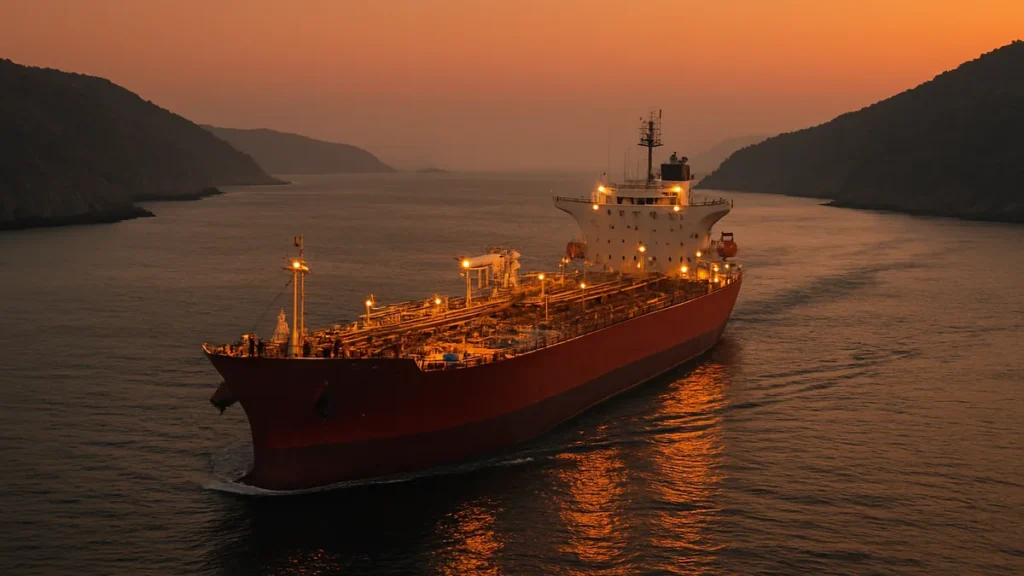
Acting US Navy Secretary Hung Cao has claimed that insurance costs for commercial ships crossing the Strait of Hormuz have reached $64m for a single transit. He made the remark on Tuesday during a Senate Armed Services Committee confirmation hearing, where lawmakers were questioning the cost of the war and its effect on freedom of navigation. The claim has not been independently verified.
The figure comes as US President Donald Trump says the military campaign against Iran is effectively over and that the US Navy is successfully escorting ships through the strait. New attacks on oil tankers and continuing shipping restrictions, however, have raised doubts about whether the waterway, which normally carries about one-fifth of the world’s oil, is genuinely open.
Cao’s insurance figure and the Senate exchange
During questioning from Democratic Senator Elissa Slotkin, Cao said insurance for commercial vessels had risen sharply since the conflict began. He first mentioned a cost of $54,000 for one crossing, then clarified that this was what insurance had cost before the war. He said the current cost stood at $64m.
Also read: Hung Cao Admits Iran War Strains US Navy at Hearing · Iran says two oil tankers hit mines in Strait of Hormuz
Slotkin blamed the war for the increase, arguing that merchant vessels no longer had the freedom of navigation they enjoyed before the conflict. Cao also described the pressure the war has placed on the US Navy, including long deployments, worsening conditions and strain on military resources. “This war, again, I know it’s a strain on our navy,” he told lawmakers.
Democrats accused Cao of being a Trump “yes man” on the war and of playing down its toll on sailors’ mental health, following eight suicide attempts on an aircraft carrier. Senator Kirsten Gillibrand, a Democrat from New York, pressed him on a sailor who went overboard. “Senator, that sailor was not trying to kill himself and he admitted that,” Cao replied, adding that the sailor had used a life preserver.
Gillibrand responded sharply. “What was he trying to do? Swim to Guam?” she asked. “I think you are minimising what mental health strain is on these service members,” she said, describing his response as “inhumane”.

Why the $64m figure draws scepticism
Analysts said the number looks unusually high, even by the standards of wartime shipping insurance. No independent evidence has confirmed that $64m is the current premium for an ordinary commercial vessel crossing the strait.
Michelle Bockmann, an analyst at maritime intelligence company Windward, said Cao had offered no context. “He gave no context. Is he talking about additional premiums for war risk insurance which are set as a percentage of hull value?” she said. “If so, it depends on the vessel type and the rate paid in order to get proper perspective.”
A July report from S&P Global said war-risk premiums had climbed to between 7.5 and 10 percent of a ship’s hull value, up from 1 to 3 percent earlier. On that basis, the report estimated that insuring a tanker carrying 270,000 metric tonnes of crude could cost about $21m. A news agency also reported in September that moving an oil cargo through Hormuz had risen to roughly $10m to $20m, citing an executive at Dubai’s Emirates National Oil Company (ENOC).
Whether the true figure is nearer $20m or $60m, premiums have surged because ships risk being hit by missiles, drones or naval mines while transiting the waterway. War-risk cover protects vessels against losses from armed conflict, and its price depends on the vessel’s value, the cargo and the likelihood of an attack. Higher premiums can also push up freight rates, fuel prices and the cost of goods shipped worldwide.
How open the strait really is
Technically, the strait is passable, but it is far from fully and freely open as it was before the war. According to the latest weekly report from the United Kingdom Maritime Trade Operations (UKMTO), traffic remains about 65 percent below pre-war levels. The agency recorded 308 vessel crossings in the seven days ending November 11, made up of 139 outbound and 169 inbound journeys.
Trump has repeatedly said Washington has secured shipping through the strait through naval escorts and a continuing US naval blockade of Iranian ports. Iran, for its part, insists it controls passage through the strait. Tehran has told vessels to use approved routes and coordinate with its forces, and has announced exemptions for ships from India, China, Iraq and Qatar. The route it approves keeps ships much closer to its own coastline than they previously sailed.
The dangers to ships that ignore Iran’s warnings were visible this week:
- On Monday, UKMTO reported two tanker attacks, one near Oman that left a vessel disabled with its engine room on fire.
- The following day, Iranian forces claimed that three more tankers had struck naval mines.
- On Tuesday, the US attacked targets on Iran’s Qeshm island, near Hormuz, after an Iranian drone attack aimed at US military installations in Bahrain in recent days.
Chris Beauchamp, chief market analyst at IG, said the strait could hardly be considered open under normal circumstances. “It is only open for business if mariners are prepared to take these risks, and it certainly isn’t open by any pre-war definition of the word,” he said. He added that “It remains a miracle that we have avoided an energy crisis, and the longer this goes on, the more the alternatives will be developed.”
Beauchamp said that resolving the crisis would force Washington to face the limits of its influence in the region. “I can’t see a way that doesn’t involve conceding that the US does not have the ability to order things in the Middle East as it would wish,” he said.