

Tehran has responded with coldness and open disdain to a speech by US Secretary of State Marco Rubio that invoked ancient Persia. The remarks drew criticism from across Iran’s political spectrum at a time when Washington is still fighting a war with Tehran.
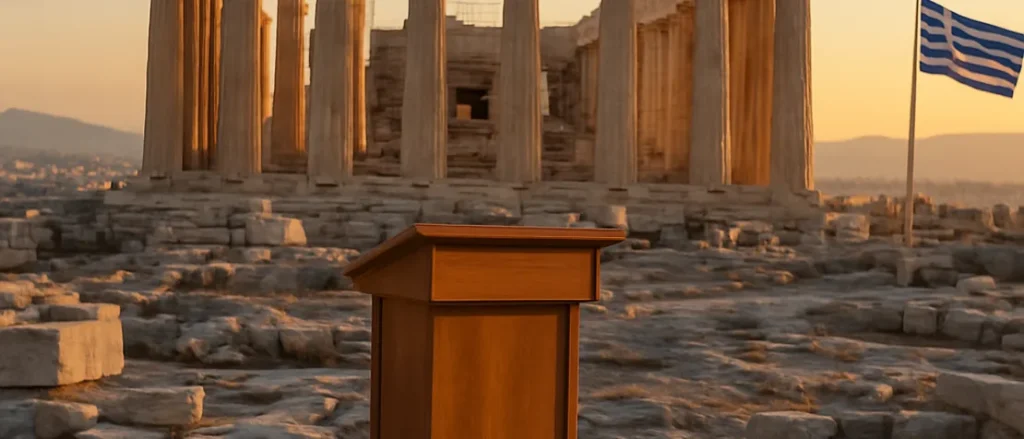
Delivering the speech with the Acropolis in Athens behind him, Rubio cast the United States, which he described as founded in the 18th century, as the heir to an ancient Western civilisation that stretched from Greece to Rome. He argued that Western countries today have lost confidence, weakened their industries and militaries, and need renewed ambition and power.
Rubio’s Acropolis speech and its use of ancient history
Rubio drew on the Greco-Persian Wars, pointing to the Persian destruction of Athens in 480 BC under King Xerxes I as an example of Western civilisation surviving an external enemy. He quoted his own description of the attack: the Persians plundered temples, burned shrines and razed the Acropolis. He then praised the return of the Athenians and the building of the Parthenon under Pericles.
The secretary of state also turned his language on Iran’s current leadership, which has held power since the 1979 Islamic revolution. He called its members “fanatics” who run a “death cult” that uses martyrdom to advance its political goals. He said the threats facing the United States were as real as those of antiquity, and described the Trump administration’s choice as an “unapologetic pursuit of national power”.
The speech came against the backdrop of an open conflict. The United States and Iran have been at war since the United States and Israel launched strikes on Iran on February 28. Fighting between the two sides has subsided, but the United States has kept a naval blockade on Iran, and shipping through the Strait of Hormuz remains disrupted.
Iranian officials answer with accusations and historical counterpoints
Iran’s security chief, Mohsen Rezaei, and parliament speaker and chief negotiator Mohammad Bagher Ghalibaf both responded by pointing to history of their own. They referred to the Roman Emperor Valerian, who was captured alive by the forces of Persian King Shapur I in battle in 260 AD. Rezaei warned that anyone who brings history into the debate “must be prepared for its repetition”.
The Ministry of Foreign Affairs went further, accusing Rubio of flattening Greek, Roman, Christian and modern history. It also said he had adopted an “America First” narrative to justify military escalation against Iran, at a time when fighting had eased relative to earlier months, since a memorandum of understanding was agreed in June and has since lapsed.
Foreign Ministry spokesman Esmaeil Baghaei said in a statement that Washington seemed to prefer dressing up its policy of coercion and force as a “philosophy of history” rather than admitting to what he called naked bullying. He said Rubio was resorting to “anachronism”, reviving long-buried events to win modern legitimacy. Culture Minister Reza Salehi-Amiri, for his part, urged Western politicians to speak about Iran with a “language of respect”, describing it as a living civilisation and a great nation rather than an enemy invented in political speeches.
The Foreign Ministry also recalled that after the 2020 assassination of Qassem Soleimani, a commander in Iran’s Islamic Revolutionary Guard Corps, Trump threatened to hit 52 Iranian sites “very hard”, including places important to Iran and its culture. Since February, the United States has faced criticism for damaging Iranian historical and cultural sites during its bombing campaign.
Historians, residents and analysts weigh in on the rhetoric
Iranian historian Touraj Daryaei told local media on Friday that Rubio’s account of the sack of Athens was accurate but incomplete. In his view, he left out a key motive cited by the Greek historian Herodotus and others, namely that the Persian attack was driven in part by a desire for retaliation. Daryaei noted that Athenian forces had burned Sardis, a Persian provincial capital in western Anatolia, in 498 BC, an event that may resonate with Iranians who see the recent US and Israeli strikes as an unprovoked attack.
Shima, a 26-year-old Tehran resident, said she did not appreciate Rubio using a conflict from 2,500 years ago to build support for the current war. “They want to continue the war, and they will say whatever they think will work in the moment,” she said.
Rubio’s stance is not new. During his January 2025 Senate confirmation hearing, he had praised Iranians as a people of an ancient civilisation with great pride in their Persian heritage. He also said there was no country where the gap between people and government was larger, and that the clerics who run Iran did not represent its people or its history.
Analysts quoted in the coverage were less focused on the history than on the strategy behind it. Vali Nasr, a professor of international affairs and Middle East studies at the Johns Hopkins School of Advanced International Studies in Washington, DC, said he believed Rubio wanted to name a common enemy around which the United States and Europe could rebuild their ties. In Nasr’s reading, Iran had been chosen to replace Islam as the civilisational adversary, and the speech also reflected US frustration that Europe had played little part in the war.
Rubio’s remarks came on the same day that Trump announced a deal with Russian President Vladimir Putin to sell diesel fuel to the United States and global markets despite sanctions on Russia. Trump said the agreement would lower diesel prices, which have hit record levels because of the Iran war. Nasr argued that the announcement and the speech together could signal that Iran, rather than Russia, should be the West’s focus. He added that Washington’s approach showed no distinction between Iranians and the Islamic Republic.