
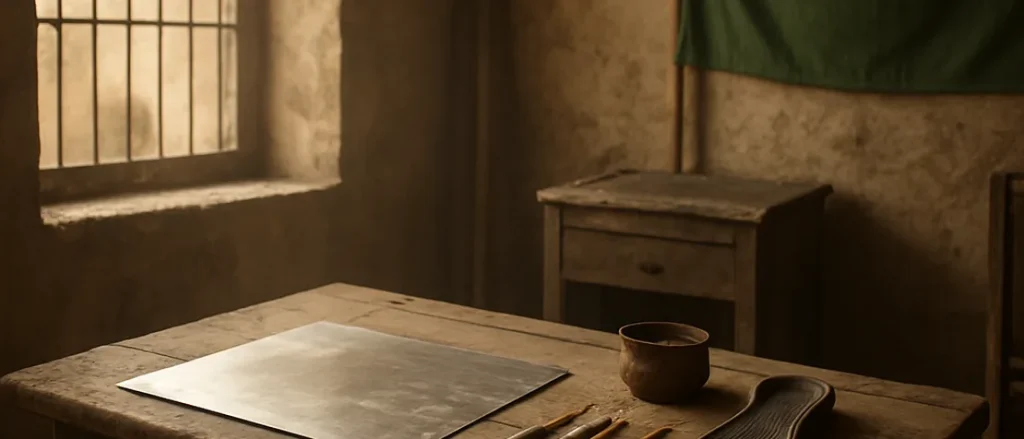

In Lucknow, the capital of Uttar Pradesh, 55-year-old craftsman Azhar Hussain sits at the bench where he has spent years making decorative silver footwear. His tools are still in place, but his customers are not. Demand for his work has fallen sharply as silver prices have climbed over the past year.
His small workshop sits beside Chowk Bazaar, one of Old Lucknow’s oldest and busiest markets and a well-known destination for wedding shopping. The bazaar is full of silver jewellery and handicrafts, but many of the traditional wedding items that once sold there are now harder to find buyers for.
How silver nagras are made in Chowk Bazaar
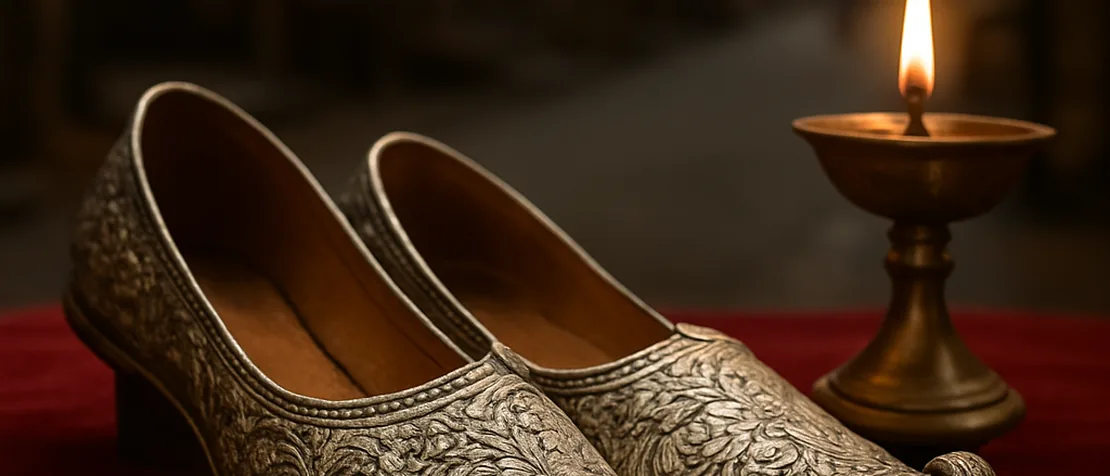
For three decades, Hussain has been one of the bazaar’s busiest craftsmen, making a distinctive form of silver slip-on shoe known locally as the nagra. He begins by cutting a thin silver sheet into the outline of the shoe and sketching floral and leaf motifs onto the metal. He then places the sheet on heated lac, a soft natural resin that cushions the metal while he taps intricate designs into place with a hammer and engraving tool.
Next, Hussain bends the silver around a foot-shaped mould known as a furma and fits it over a base of cardboard, rubber and velvet. The pieces are soldered together and the pair is polished. Craftsmen have used this process to make silver nagras since the 1600s.
The shoes were originally made for daily use by the Nawabi, the Muslim rulers of the former kingdom of Awadh. “Silver nagras used to be the most important part of a nawab’s attire,” said 68-year-old Nawab Masud Abdullah, an eighth-generation descendant of Nawab Muhammad Ali Shah, the ninth Nawab of Awadh, who ruled from 1837 until his death in 1842. “They were not just footwear; they represented our culture and heritage,” he added.
Over the last century, the nagra has become a cherished wedding tradition embraced by Lucknow’s middle and upper classes. Abdullah said that brides across the city now treat it as their own, and that a bride is considered incomplete without one. There are two main types, open-toed chappals and closed-toed jutis, and customers can choose from different patterns, ornamentation and designs.
Hussain’s family has been making nagras since the early 1900s, and the trade once provided a comfortable living. He said he typically made about 10 pairs a month before each wedding season, priced between $105 and $230 (10,000 and 22,000 rupees) a pair. “We lived with dignity,” he said. “We never imagined that one day we would struggle even to run our household.”
Why silver prices have risen so sharply
Hussain said the metal was already costing more before the U.S.-Iran war began in February, owing to tight supplies and growing investor demand. The conflict added another jolt, as uncertainty in global markets pushed investors towards silver and put the metal, and the nagras made from it, out of reach for many shoppers. Economists quoted in the article said prices for precious metals began rising with Russia’s invasion of Ukraine in early 2022, but surged significantly after the US and Israeli attacks on Iran.
According to the figures cited, silver in India traded mostly between $725 (70,000 rupees) and $830 (80,000 rupees) per kilogramme in 2023 and rose to around $985 (98,000 rupees) in 2024. This year, silver briefly soared to as high as $4,670 (450,000 rupees) per kg before easing after a ceasefire. Prices are now hovering around $2,600 (250,000 rupees) per kg, more than three times their levels a few years ago.
Dr. Salahuddin Ayyub, an economist and international trade expert with India’s Ministry of Commerce and Industry, said geopolitical conflicts had triggered unprecedented volatility in global commodity markets. “When stock markets become volatile, investors move their money into safer assets, such as gold and silver,” he explained. “This sudden surge in demand pushes the prices of precious metals sharply upwards.”
Ayyub said the effects were especially severe in India, where gold and silver are closely tied to weddings, cultural traditions and family savings. As prices rise, many households are turning to cheaper alternatives such as artificial jewellery. He warned that artisans, silversmiths, jewellery shopkeepers and traditional craftsmen have far fewer options than consumers. “Entire communities whose incomes depend on these metals are now facing shrinking demand and growing economic uncertainty,” he said.
Ayyub also said governments often respond to sharp rises in demand for imported precious metals by curbing imports to protect foreign exchange reserves. “India depends heavily on imported silver,” he said, adding that the government tries to discourage excessive imports through tariffs and other restrictions. He said these duties feed into the final price: “As tariffs increase, the landed cost of silver rises.” According to the article, silver in India is currently priced above global levels, which stood at $2,100 (201,000 rupees) per kg, and India relies on imports for more than 80 percent of its domestic silver demand.
The article said India more than doubled its effective import taxes on gold and silver in May. In that month, silver imports fell by 87 percent to $75.6 million, down from $566.2 million the previous year, the lowest level in over three years.
Brides in Lucknow weigh tradition against cost
For 28-year-old Uzma Siddique, who is due to marry in December, wearing silver nagras on her wedding day has always been a priority. “My mother wore silver nagras at her wedding in 1992. So did my grandmother and so did my great-grandmother,” she said. “It was never just footwear; it was an emotion and a family tradition.”
When she visited the market to order a pair, she was stunned by the price. “A pair that cost around $156 to $208 (15,000 to 20,000 rupees) just a few years ago is now selling for nearly $673 (65,000 rupees),” she said. Determined to buy them, she cut back on other wedding expenses, choosing a lighter lehenga and buying fewer suits. “They have become incredibly expensive, but our emotions are attached to them,” she said.
Her friends have not been as fortunate. Siddique said some had dreamed of wearing silver nagras but could not afford them and were deeply hurt by the loss.
Safiya Khan, 25, is also getting married in December, but she has not been able to buy silver nagras. From a lower middle-class family, she said soaring prices had put the tradition out of reach. “My entire wedding shopping budget is around $1,250 (120,000 rupees). I simply cannot spend more than half of it on a pair of shoes,” she said. She added that her mother had been forced to sell her own pair last year because of financial difficulties. “Had we known silver prices would rise so dramatically, we would never have sold them,” Khan said.
Naseem Jahan, in her late seventies, still treasures the silver chappals her mother gave her for her wedding in 1972. She recalled that her mother paid around $2.50 (250 rupees) for the pair, which took nearly seven months to be made. When she recently went to buy a similar pair for her granddaughter, the price was out of reach. She has decided instead to give her granddaughter her own pair. “Let these slippers adorn her feet now,” she said. “I only wish silver prices would come down again so that more people could experience this tradition.”
Chowk Bazaar artisans face empty shops
Jabbar Hussain, 48, is a fourth-generation craftsman and shopkeeper who makes nagras and sells them in Chowk Bazaar. Between June and September, his shop is normally crowded with customers placing orders. Over the past three months, he said, he has not sold a single pair. He blamed the unprecedented rise in silver prices for turning handmade footwear into a luxury few can now afford.