

Hundreds of demonstrators have reportedly been detained in Delhi during the latest protest staged by the Cockroach Janta Party (CJP), a Gen-Z-led movement campaigning for electoral reforms. Delhi Police have not publicly commented on the arrests.
The group said its founder, Abhijeet Dipke, was detained together with other leaders shortly after his flight touched down in the Indian capital. The CJP has said that the detentions came as the group prepared to press its demands in the city.
Founder Abhijeet Dipke and two colleagues held on arrival
According to the CJP, Dipke and two other leaders, Saurav Das and Ashutosh Ranka, were stopped on their flight from Mumbai on Saturday. The group claims the three men have since been moved to a location it has not disclosed. Police have offered no comment on where they are being held.
Ajinkya Shinde, who has been named the CJP’s new designated leader while the others remain in custody, then released a video addressed to protesters. In it, he told them that any spot where police halted them would effectively become Jantar Mantar, the landmark where the protest had been planned. Student activist Neha Bora, who was also detained by Delhi Police, urged demonstrators to stand firm.
Dispute over voter rolls and the election commission chief
The CJP is not registered as a political party in India, yet it is pressing for changes to the electoral system only months before important state elections. Among its demands is the resignation of Chief Election Commissioner Gyanesh Kumar, whom the group accuses of manipulating voter lists. The Election Commission has rejected that allegation.
Under Kumar’s leadership, the commission has carried out a large-scale effort to update electoral rolls across the country. The commission has described the work as routine, aimed at removing dead, duplicate or ineligible entries. In several states, however, the process has drawn sharp criticism, and tens of thousands of people say they were wrongly struck off.
The CJP and opposition parties allege that Kumar has tilted the process in favour of Prime Minister Narendra Modi’s Bharatiya Janata Party (BJP). Both the Election Commission and the BJP have denied this claim.
Security clampdown keeps protesters away from Jantar Mantar
Authorities had refused permission for the demonstration to take place at Jantar Mantar, and tens of thousands of security personnel were deployed ahead of the event. Roads were barricaded, yet the CJP insisted that the protest would go ahead regardless.
Large crowds that had been expected to converge on Delhi were unable to get anywhere near the site because of the heavy security presence and road blocks. Announcements broadcast across the city urged people to cooperate with police. Several trains to and from major stations were cancelled, and dozens of metro stations were shut from Friday night.
Protester Sabika Muzaffar told reporters that she and her mother expected to be detained. She said that, on their way to the protest, they had spent the journey memorising their lawyer’s phone number rather than reciting prayers as they normally would. She described taking part in the demonstration as her way of defending the country and its democracy. A few minutes after she spoke to reporters, police took her away.
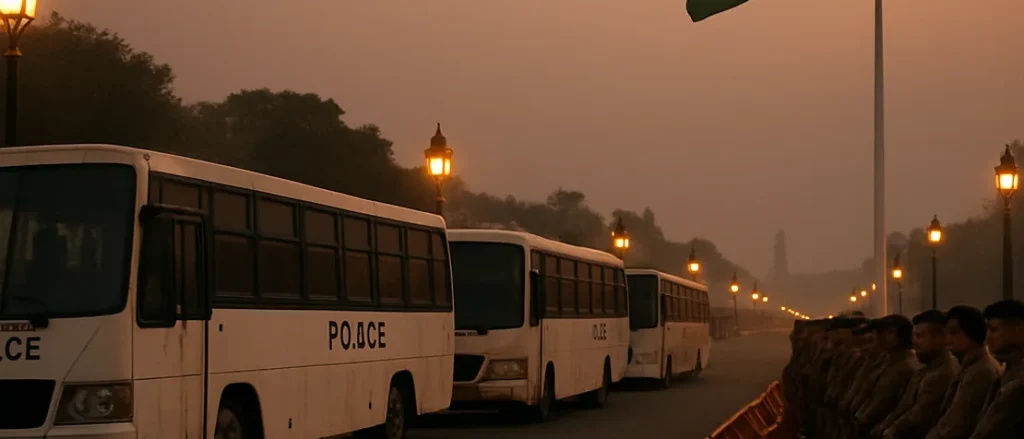
Buses carrying detained protesters were seen leaving the site, with officers escorting them away.
How a viral post by Dipke launched the movement
The CJP first rose to prominence during several weeks of demonstrations over the summer, when protesters demanded education reforms and the resignation of Education Minister Dharmendra Pradhan. The movement grew out of a joke Dipke made in response to remarks by India’s Chief Justice, Surya Kant, who had compared jobless young people to cockroaches. Kant later said his comments had been misinterpreted.
Dipke had previously worked with the opposition Aam Aadmi Party (AAP) and had just completed a master’s degree at Boston University when he posted a question on X in May asking what would happen if all cockroaches came together. The post spread widely, and the CJP was born. The movement drew on public anger over unemployment, leaked exam papers and what it sees as weak government accountability.
In July, Dipke watched from the stage as the five-week protest ended in celebration after India’s education minister resigned.