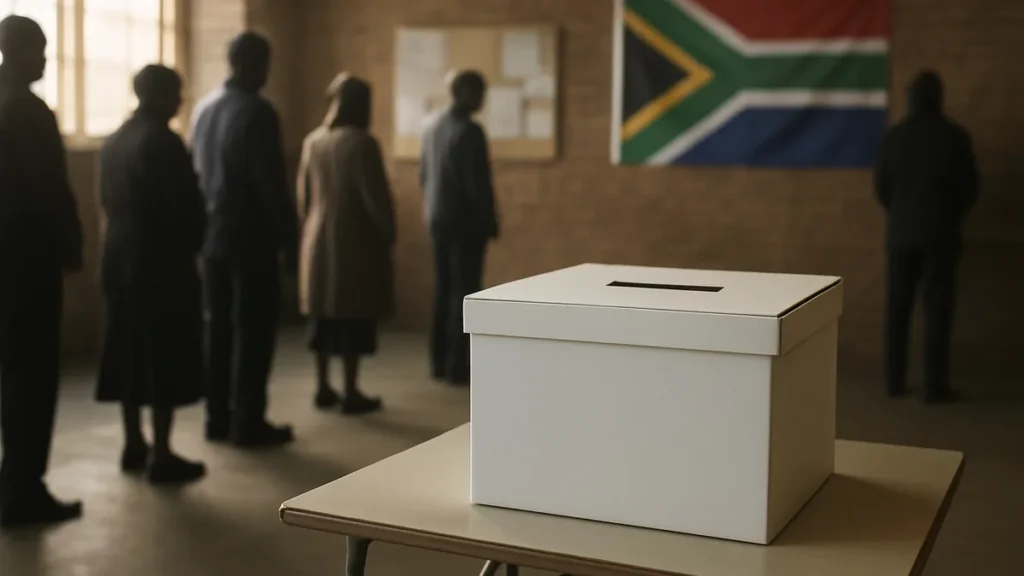
South Africa’s African National Congress (ANC) has recorded its worst-ever showing in local elections since Nelson Mandela led the country out of apartheid and into democracy more than 30 years ago. The party has described the outcome as “catastrophic”.
The ANC still won more votes than any other party, but its share of the overall vote fell to 31%. That is down from 46% in 2021 and well below the 65% it gained 20 years ago.
ANC loses ground in provinces and major cities
The decline is visible across the country’s provinces and cities. The ANC won a majority in only one of the nine provinces, Limpopo, compared with six provinces in 2021. It also won the most votes in just two of the eight cities, down from six at the last local elections.
Also read: ANC set for major setback in South Africa local elections
The Democratic Alliance (DA) came second overall with 25% of the vote and kept control of Cape Town. The MK party, led by former president Jacob Zuma, finished third with 10% and took Durban from the ANC. The Economic Freedom Fighters (EFF), led by Julius Malema, came fourth with 6%. The EFF was once seen as a serious challenge to the ANC.
ANC secretary-general Fikile Mbalula said on Saturday that the result was a severe blow. “This has been a very catastrophic outcome for the ANC,” he said. He added that the party had seen the disaster coming, and blamed the high cost of living, saying the middle class had turned against the ANC in large numbers.
Speaking at the count centre on Sunday night, President and ANC leader Cyril Ramaphosa said the party accepted the verdict of voters. He said the people had spoken in towns, cities and metros across the country, and that the party accepted the result “with humility”. He described the decline as concerning.
Long-term decline and shifting voter loyalties
The local vote fits a wider pattern of decline for the ANC. The party lost its parliamentary majority in the 2024 national elections, the first time it had done so since the end of apartheid in 1994. It then formed a coalition government with several other parties, known as the Government of National Unity (GNU).
The DA made significant gains in the cities, but its overall vote share rose only slightly, from 22% in 2021. That is still below the 27% it won in 2016. Voter turnout was 52%, up from 46% in 2021, when the elections were held during the Covid pandemic.
Political analyst Susan Booysen said the results sent a clear message to the ANC. “This election is delivering a devastating message to the ANC,” she said. She added that the party was in decline at municipal and metropolitan level, and that its support was falling sharply when results were viewed by province and nationally.
Booysen linked the decline largely to poor service delivery and infrastructure, including water, power and sanitation. “These are huge problems,” she said, adding that they had affected ordinary people in the suburbs and townships in very dramatic ways.
The election also showed a notable shift in voting patterns. The DA, traditionally known as the “white party” because it draws mainly white voters, attracted more black voters this time. Political analyst William Gumede said: “We’re moving towards a post-racial voting pattern in South Africa.”
Coalition talks and leadership questions for the ANC
South Africa now faces several days of coalition building at local level. The three metropolitan municipalities in Gauteng, the country’s economic heartland, are under particular scrutiny. The ANC may even be shut out of governing the cities of Johannesburg and Pretoria.
Parties have 14 days from the announcement of results to negotiate coalitions. Gumede said voters were sending a clear signal. “We are now in a coalition country,” he said, arguing that voters no longer want dominant parties at national, provincial or local level and want parties to work together.
The party’s leadership is also in question. Ramaphosa is due to be replaced as ANC leader next year, when the party elects a new leader. He is due to remain president until the next national elections in 2029, but few candidates have lined up to succeed him in either role.
Gumede said the result could mark the end of an era. He described it as “sort of the end of the liberation movement era” and said the ANC could become the second-biggest party by 2029 rather than the largest. He warned that it could also fall into a long period of infighting, adding that the result marks a new era for both South Africa’s politics and the ANC.