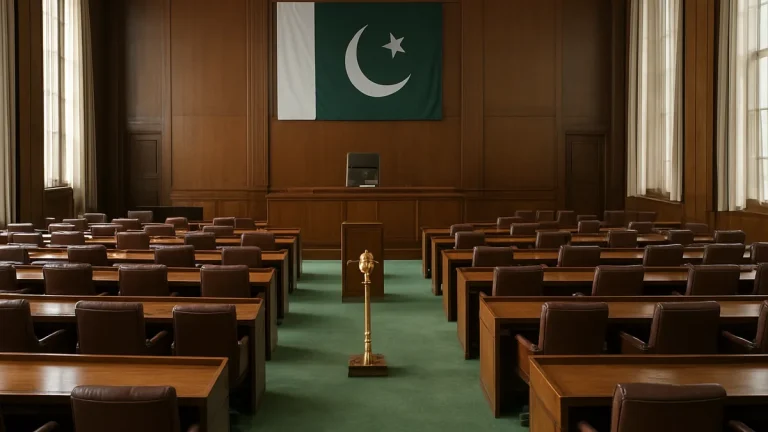
In a significant development on Thursday, the Sindh Assembly passed a resolution firmly opposing any proposals or constitutional measures aimed at dividing the province, altering its boundaries, or creating new administrative units. This move came despite a boycott by the Muttahida Qaumi Movement-Pakistan (MQM-P).
The resolution was introduced by Pakistan Peoples Party (PPP) lawmaker Nisar Ahmed Khuhro following extensive debate triggered by an adjournment motion he presented against any attempts to divide Sindh. A total of 137 lawmakers from across party lines participated in the discussion, reflecting the assembly’s strong stance on the issue.
The resolution referenced Article 239(4) of the Constitution, which mandates that no constitutional amendment affecting provincial boundaries can be submitted to the President without approval by a two-thirds majority in the province’s assembly. It emphasized that the Sindh Assembly neither consents to nor will permit any such territorial changes.
Highlighting Sindh’s civilizational heritage and its historic role as the first provincial legislature to support Pakistan in 1943, the assembly declared unequivocally that Sindh remains a single, united province. The House, where the PPP holds a two-thirds majority, also rejected any plans to detach districts, divisions, or regions or place any part of Sindh under federal or separate administrative control, affirming that all current regions are integral and inseparable components of the province.
The resolution urged the federal government, Parliament, and all political parties to honor the democratic will of Sindh’s people and avoid entertaining any proposals threatening the province’s unity. It further directed the provincial government to send official copies of the resolution to the President, Prime Minister, Senate Chairman, and National Assembly Speaker to formally record Sindh’s constitutional position at the national level.
Concluding the debate, Chief Minister Syed Murad Ali Shah reiterated that Sindh joined Pakistan as a unified province and that its territorial integrity cannot be altered against the wishes of its people or their elected representatives. He explained that the PPP initiated the debate in response to recent statements by some political leaders advocating for new provinces or separate administrative entities within Sindh.
Murad Ali Shah also criticized contradictory stances by MQM-P leadership and other parties, who publicly oppose dividing Sindh yet simultaneously propose separate assemblies, chief executives, and governance for various divisions. He recalled Sindh’s historic defense of its identity and constitutional rights, including opposition to Karachi’s separation in 1948 and resistance to the One Unit scheme, which he described as fundamentally flawed and unrepresentative of Sindh’s people.
On the opposition side, Ali Khurshidi, Leader of the Opposition in the Sindh Assembly and member of MQM-P, condemned the PPP for exploiting sensitive issues to divert attention from administrative shortcomings. Before boycotting the session, Khurshidi questioned the need for the resolution, noting that similar measures had been passed previously. He accused the ruling party of repeatedly raising the issue to exploit emotional sentiments while masking their poor governance record.
Khurshidi highlighted Karachi’s current status as one of the world’s worst-managed cities, attributing this to administrative collapse and lack of ministerial authority. He clarified that MQM-P supports administrative empowerment and decentralization rather than division, emphasizing that the 18th Amendment should have devolved powers to local levels to grant true autonomy to administrative units.