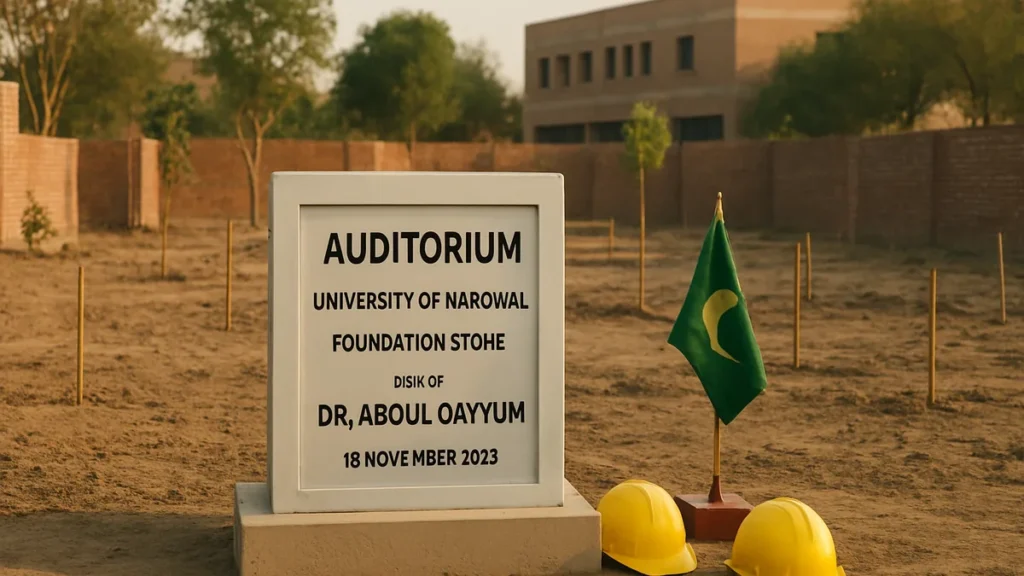
Federal Minister for Planning, Development and Special Initiatives Professor Ahsan Iqbal laid the foundation stone of a Rs850 million auditorium at the University of Narowal. The event took place in Narowal, where the minister also attended several university functions.
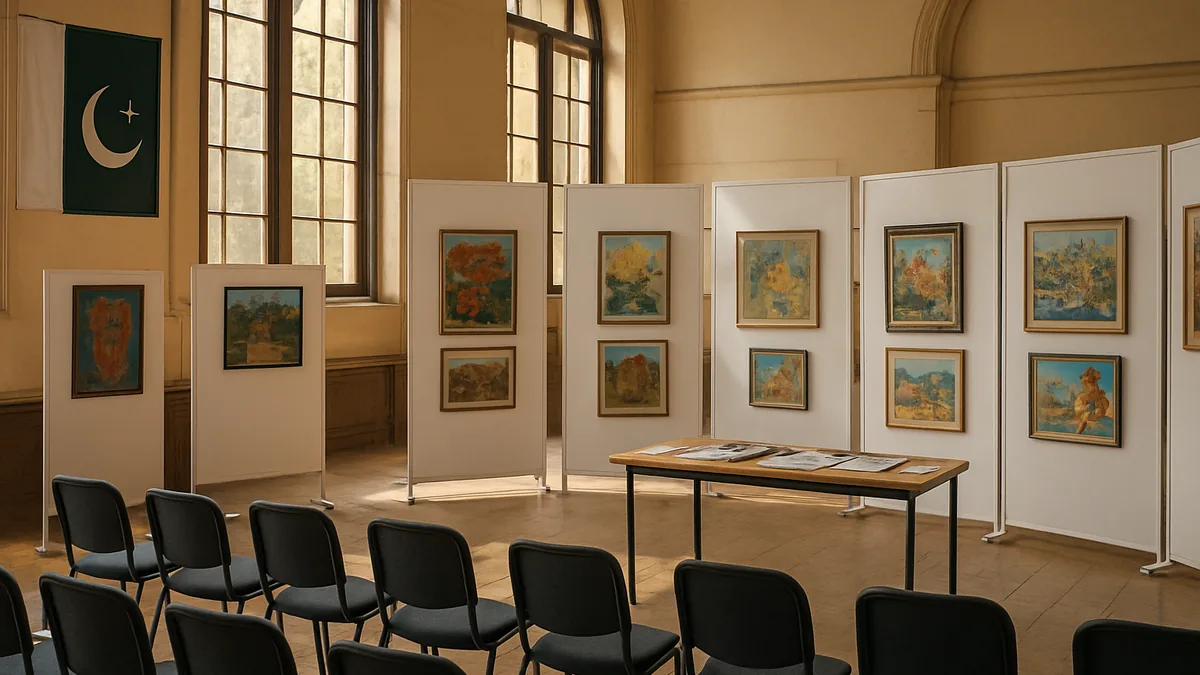
During his visit, Iqbal viewed student artworks at an exhibition organised by the university’s Department of Fine Arts. He later attended the closing ceremony of the University of Narowal Research and Innovation Strategy Development Workshop, where he addressed students and faculty.
Research goals and academic reform at Narowal university
Speaking at the workshop, Iqbal said universities should become centres of innovation, research and practical solutions to pressing national problems. He argued that academic institutions should focus on work that responds to social concerns and supports national development, rather than relying mainly on traditional theoretical research.
The minister said the architecture of the new university building drew its inspiration from Andalusia. He linked this to a period when Muslim scholars made important advances in several scientific fields, and he stressed the need to revive that scientific and intellectual heritage. He also said the decline of the Muslim world was mainly caused by its departure from its educational traditions.
Iqbal called for a wider scope of academic research and for Key Performance Indicators to assess university faculty in research and innovation. He said students must be prepared to become lifelong learners and effective problem-solvers.
Youth, technology and Pakistan’s 2047 goals
Iqbal said the technological landscape was changing rapidly and that artificial intelligence was set to transform the world. He said the coming years were expected to bring unprecedented innovation, and that Pakistan must prepare its young people through modern education, advanced technology and market-relevant skills.
The minister said a young person’s future should depend on talent and ability rather than on where they live. He said he had often asked whether Pakistan’s geography or the capabilities of its youth would shape the country’s future, and that he firmly believed individual potential and competence were the deciding factors.
Referring to Vision 2025, Iqbal said the government had set up a network of universities in some of the country’s least developed regions. He said the aim was to let students from disadvantaged families pursue higher education without being held back by transport costs, hostel expenses or the need to leave home.
Iqbal said education, rather than wealth, had been the foundation of his own progress. He added that the people of Narowal had elected him on the basis of his educational qualifications, and that he had met his responsibility by bringing world-class opportunities to their doorstep. He expressed confidence that international students would one day study at the University of Narowal.
He also stressed that development should not be limited to major cities. He said people in less developed areas had an equal right to modern educational, recreational and sporting facilities. Recalling his own past, he said he had once been imprisoned for providing Narowal with a major sports facility. He announced that national-level coaches from several sporting disciplines would be invited to Narowal Sports City in the coming months to train local students to international standards.
Describing the university as an example of women’s empowerment, Iqbal pointed to educational achievements in the district. He said Narowal Medical College had ranked first across Punjab, with a 100 per cent result in the annual examinations conducted by the University of Health Sciences.
Warnings on misinformation and drug use on campus
Addressing students, Iqbal urged them to pursue excellence through dedication, hard work and continuous learning. He said universities were laboratories of ideas where students should question, experiment and acquire knowledge beyond textbooks, and he encouraged them to develop independent thinking and contribute to society through research.
The minister described fake news as one of the greatest threats of the present era. He warned that social media was increasingly being used to spread hatred, intolerance and division. He urged educated young people to think critically, separate facts from misinformation and counter hateful narratives through constructive engagement.
Iqbal said that in 2018 he had been the target of an assassination attempt, which he attributed to hatred and negative propaganda. He stressed the need for tolerance, peace and responsible communication. He also invited students to join the Young Peace and Development platform at the university.
Iqbal recalled that students and young leaders in Lahore had supported Quaid-i-Azam Muhammad Ali Jinnah’s struggle for Pakistan in 1940 despite having few resources. He said the present generation, often called Generation Z, must now become what he called “Generation 47”, ready to mark the centenary of Pakistan’s independence in 2047. He asked students to commit the next 20 years to hard work, perseverance and national progress, with the aim of making Pakistan one of the world’s leading economies by 2047.
As he concluded, Iqbal instructed the university administration to take firm action against the growing use of drugs on campuses. He said the university should be made drug-free so that students could learn in a safe and healthy environment.