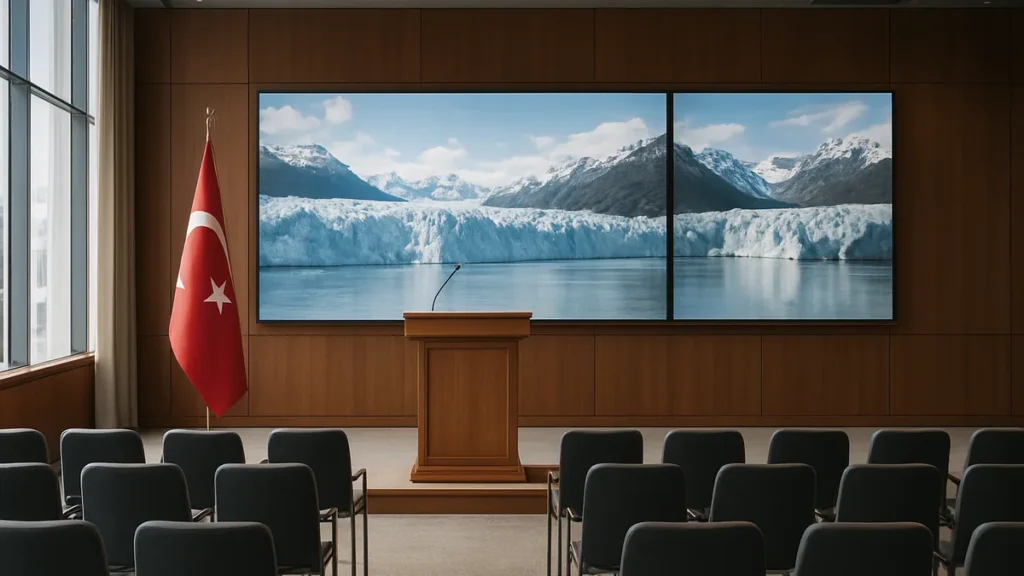
Pakistan has proposed building a virtual green university through international academic cooperation, along with a dedicated fund to support climate innovations led by young people. The proposals were put forward by Dr Musadik Malik, the federal minister for environmental coordination and climate change, at the UN Climate Change Conference (COP31) in Antalya, Turkey.
The minister spoke at a session titled “From Learning Campuses to Climate Solutions: Advancing Climate Resilience Through Education, Innovation and Partnerships”. The event was organised in association with the Islamabad Electric Supply Company (IESCO) on the sidelines of the conference. Malik said the focus must shift from adopting resolutions to achieving concrete results.
A virtual green university for joint climate research
Malik said Pakistan wanted to build an international platform where academics, researchers and students could cooperate on climate issues and develop solutions useful to their own societies. Under the proposed framework, he invited foreign academic institutions to join Pakistan in joint research programmes, faculty and student exchanges, seminars and virtual research centres.
Also read: PM Shehbaz leaves for Turkiye to attend COP31 climate summit · Musadik Malik to represent Pakistan at SCO forum in New Delhi
He said the initiative could bring together scholars, experienced researchers and graduate students, particularly from developing countries. The aim, he said, is to generate knowledge and build locally relevant answers to climate challenges.

Glacier data and mountain research offer
Malik also offered Pakistan’s research facilities, glacier-related data and support for primary research to international scientists studying mountain ecosystems and the changing cryosphere. He said mountain regions were among the first to feel the effects of these changes. Developments there, he warned, could affect downstream plains in the years ahead.
The minister invited overseas researchers to work with Pakistani institutions on glacier studies. He said the country was ready to facilitate collaborative research and make relevant data and academic resources available.
Greenfield fund to back young climate entrepreneurs
The second proposal was the Greenfield fund, which would provide financial support to innovative ideas and climate-related ventures developed by young people. Malik said the fund had already been announced and a board set up. The proposed five-member team would include private-sector and investment expertise to assess promising ideas and help finance their development.
Malik described access to risk capital as a major requirement for encouraging young innovators. He argued that many promising ideas fail to reach commercialisation because they lack adequate financial backing. He said Pakistan needed to invest in young scientists, entrepreneurs and graduates rather than relying only on conventional institutional approaches.
“Place your bets on your children, not on conferences and resolutions,” he said, urging institutions to give young people the resources and opportunities needed to turn new ideas into viable solutions.
Malik said innovation should not be limited to science and technology, adding that ideas could come from literature, history, arts, music, drama and business models. Combining these fields, he said, could produce solutions with economic and social value. Referring to China and Finland, he said environmental pressures and rising public expectations could open doors for innovation, citing China’s solar technology development and Finland’s environmental technology sector as examples.
Partnerships needed to make proposals work
The minister also stressed the need to connect each stage of innovation, from generating ideas and incubation to acceleration and commercialisation. He said collaboration among academic institutions, businesses and governments was essential to that process. Pakistan, he said, was seeking partnerships that would give young people access to current scientific knowledge, research opportunities and investment.
The proposals could provide a framework linking climate education, research and entrepreneurship to practical climate solutions, but only if they are carried out through institutional collaborations and sustainable funding structures. Malik said Pakistan was open to international cooperation and had invited scholars, researchers and innovators to work with the country on common environmental problems.