
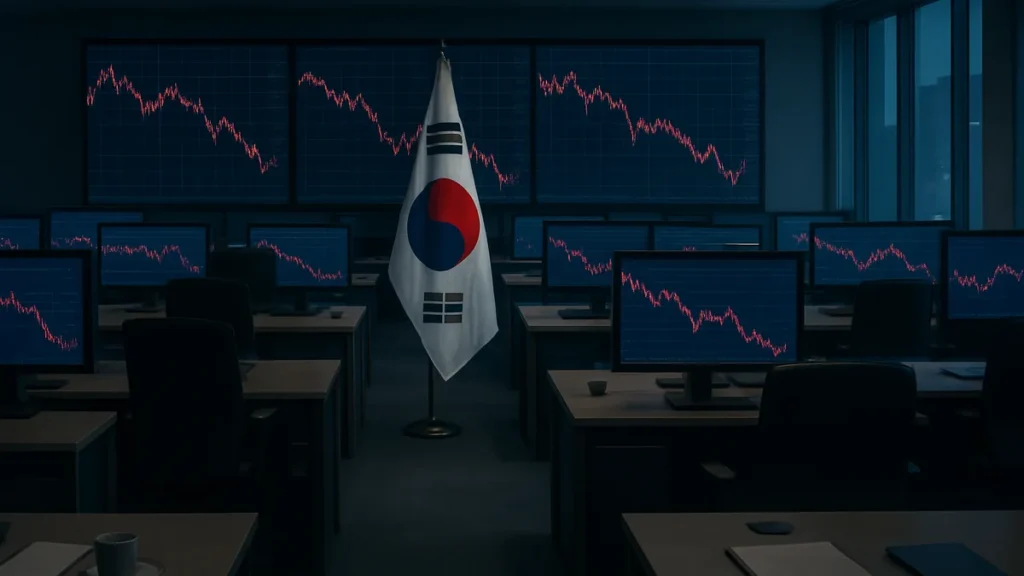
Asian stock markets opened sharply lower on Monday as mounting concerns about the sustainability of the AI boom weighed on investors. Markets in South Korea, Taiwan, Hong Kong and mainland China sank further into negative territory, extending a tech-led sell-off that began on Friday on both sides of the Pacific.
The Kospi in Seoul slid as much as 5.5 percent in morning trading, the steepest fall among the indexes cited. Hong Kong’s Hang Seng Index dropped 1.8 percent, while the CSI 300 in Shanghai fell more than 1.3 percent. Taiwan’s Taiex swung between losses and gains after an early drop of more than 1 percent. Japan’s markets were closed for Labour Thanksgiving Day.
Wall Street correction and Nasdaq losses
Following Friday’s rout in Asia, Wall Street’s benchmark S&P 500 closed 3.7 percent lower, entering a correction. Investors use that term when a market falls 10 percent or more from its recent high.
Also read: Asian stocks fall as Anthropic debut fails to ease AI fears
The tech-focused Nasdaq Composite, roughly half of which is made up of the “Magnificent Seven” AI-oriented firms, dropped 5.3 percent. That decline erased all of its gains for 2026. The Kospi, Nikkei 225 and Taiex each ended the weekend between 5.1 and 6.2 percent lower, while the Hang Seng finished down 1.9 percent.
Wall Street looked set for a rebound on Monday, with S&P 500 futures up 2 percent and Nasdaq futures up 2.4 percent.

Analysts question whether the selloff has gone too far
Rajat Agarwal, an Asia equity strategist at Societe Generale, said investors were trying to assess whether the market correction has “gone too far”. He described the US sell-off on Friday as a more than three standard deviation event in tech indices, and said markets were now trying to find some ground.
Investors have long worried that tech firms may struggle to sustain the multi-trillion-dollar investments they have poured into the infrastructure needed to train and run AI. Gartner, a technology insights company, expects global AI-related investment, much of it fuelled by debt, to reach $2.7 trillion in 2026 and $3.6 trillion in 2027.
Calls for greater oversight of the sector are also growing. The Democratic Party’s sweeping victory in the US midterm elections is expected to slow data centre construction in US states. Meanwhile, an alleged espionage scandal involving chip giant Nvidia and its former CEO Jensen Huang has prompted a push for tighter restrictions on China’s access to advanced chips.
Khoon Goh, head of Asia research at ANZ, said AI-related concerns would continue to dominate the week as investors try to determine whether the bottom is near. He pointed to some encouragement, noting that US equity futures were higher and that South Korea reported very strong exports for the first 20 days of November. Semiconductor exports, he said, were up 294.4 percent year on year.