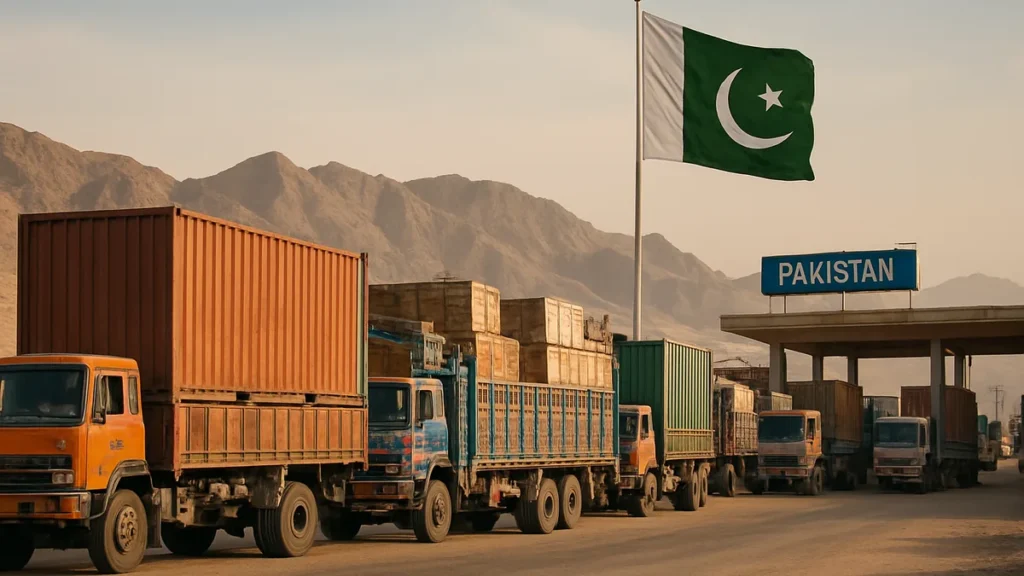
Pakistan and Iran are moving closer to a comprehensive free trade agreement that could lower customs costs and push bilateral commerce beyond its current estimated value of $6 billion, an Iranian trade official said on Saturday. Mehrdad Siyadat-Nasab, deputy director of the East Asia and Subcontinent Office at Iran’s Trade Promotion Organisation (TPO), said the negotiations had reached their final stages.
The agreement is expected to be completed by the end of the current Persian year, which ends on March 20, 2027. Speaking to an Iranian news agency, Siyadat-Nasab said talks had advanced and both sides had exchanged lists of goods to be covered. “The free trade agreement is underway, and after progressing in negotiations and exchanging the lists of covered goods, it has reached its final stages,” he said.
Joint trade committee sets $10 billion goal
The push follows the 10th Pakistan-Iran Joint Trade Committee meeting held in Islamabad in August 2026. At the session, both countries reaffirmed their aim of raising annual bilateral trade to $10 billion and welcomed progress on the proposed FTA. The same target was also backed during Iranian President Masoud Pezeshkian’s visit to Pakistan in August last year, when both sides pledged to deepen economic cooperation.
The meeting was co-chaired by Commerce Minister Jam Kamal Khan and Iranian Minister for Industry, Mine and Trade Mohammad Atabak, who signed the agreed minutes at its close. Technical work covered rules of origin, tariff-reduction arrangements and the lists of products to be included. Discussions also touched on expanding barter trade, strengthening business-to-business ties, promoting industrial cooperation and investment, and widening private-sector involvement.
Both countries agreed to improve customs coordination, transport, logistics and border infrastructure so that commercial cargo, particularly perishable goods, can move more smoothly. They also discussed reviving joint border markets.
Iran eyes key sectors and Pakistani ports
Siyadat-Nasab said implementing the new agreement would reduce customs costs and significantly increase bilateral trade. He put the current volume of formal and informal commerce at roughly $6 billion, adding that the two economies could take that figure above $10 billion. He named industry, agriculture, mining, and technical and engineering services as priority areas for expanding cooperation.
He said Iran’s main export products with potential in Pakistan include:
- Petrochemicals
- Liquefied petroleum gas (LPG)
- Steel
- Tiles and ceramics
Siyadat-Nasab also stressed the value of using Pakistani ports to open new routes for Iranian imports and exports, which he said could give Tehran wider access to regional and international markets. He urged Iranian exporters to understand Pakistani market requirements and to offer quality goods at competitive prices. The official further called for greater private-sector participation, better logistics infrastructure and stronger provincial cooperation, particularly with Iran’s southern province of Bushehr.
Existing preferential deal and border market plans
Islamabad and Tehran currently trade under a Preferential Trade Agreement (PTA), which provides reduced import tariffs on a designated list of goods. The proposed FTA is expected to replace this arrangement with broader trade concessions. The two countries share a border of approximately 900 kilometres.
The PTA was signed on March 4, 2004, and became operational on September 1, 2006. Under it, Pakistan offered tariff concessions on 338 product lines, while Iran extended concessions on 309 lines.
On the border front, Pakistan has moved to reactivate the Mand-Pishin joint border market, which resumed operations on July 30, 2025. Work is continuing on operationalising two other markets, at Chaghi-Kouhak and Gabd-Reemdan.