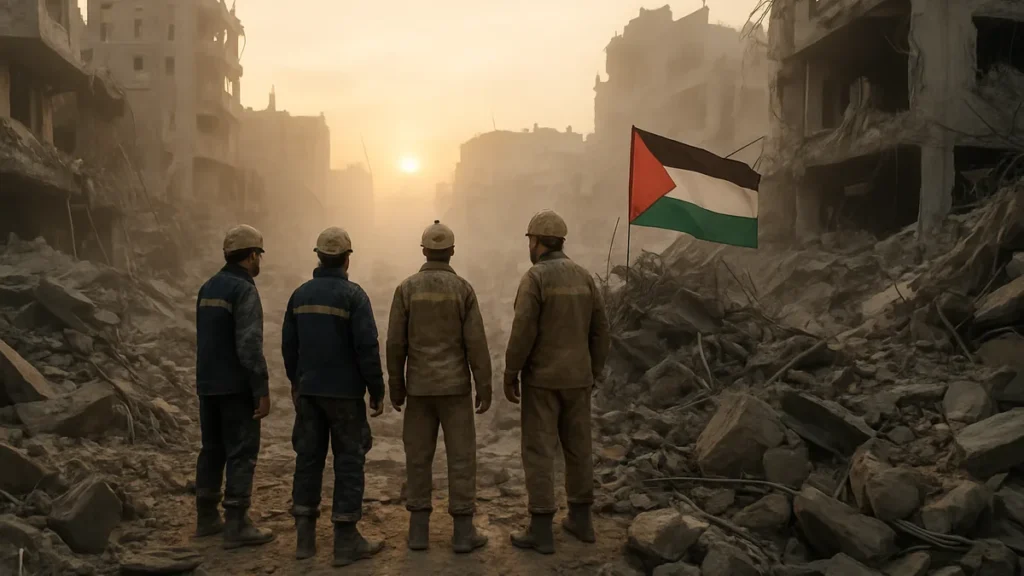
A man in his sixties from Bir an-Naaja in northern Gaza has finally buried his relatives after waiting more than three years for their remains to be recovered. Mahmoud Nabhan’s family members were found under the rubble of his home, which Civil Defence teams reached on Sunday, allowing a burial to take place after years of searching.
Nabhan said 17 members of his family were killed when their home was targeted 20 days after the war that began in October 2023. The dead included his seven children and several grandchildren, among them a 45-day-old baby. Nabhan said there were no fighters, Israeli soldiers or captives inside the house when it was struck.
Families wait years as bodies remain under rubble
Thousands of bodies are still believed to be trapped under the wreckage left by the war in Gaza. Continued attacks by Israeli forces have often made it too dangerous for families or Civil Defence teams to go in and retrieve them. Nabhan had tried for three years to help recover his family’s remains, but harsh conditions kept him from doing so.
A truce agreed between Israel and Hamas in October 2025 has allowed some bodies to be taken from the rubble that covers much of Gaza, although Israel has repeatedly broken the arrangement. In recent days, Civil Defence teams have recovered the remains of 69 Palestinians from locations in the Jabalia refugee camp and Beit Lahiya.
The Palestinian Civil Defence estimates that more than 8,000 bodies are still to be recovered across Gaza. The total number of missing Palestinians is put at more than 10,000, although that figure also covers people whose whereabouts are unknown for other reasons, including those believed to be buried under rubble, detained, or buried without identification. Civil Defence teams work with limited resources under the ongoing Israeli siege, and digging by hand is often the only option.
According to Palestinian authorities cited by the United Nations, more than 630 bodies and human remains were recovered from destroyed buildings across Gaza between November 2025 and September 2026.
Fatima al-Masri waits two years for husband and son
Fatima al-Masri, 47, said her husband and 18-year-old son were killed in an Israeli attack in the Safatwi area of northern Gaza in October 2024. Their remains had lain beneath the rubble of their home for two years. She said her family repeatedly asked Civil Defence to act, and was told that heavy equipment was needed to lift the house because several floors had collapsed onto them.
“Every month, every two months, sometimes every week or every two weeks, we would follow up with Civil Defence,” she said.
After a long delay, the recovery work finally began. Workers dug through the debris with machines and by hand, finding bone fragments and her son’s mobile phone. They also recovered the bodies and belongings of others who had been with her husband and son.
“Thank God, we found their remains and everything that was with them,” al-Masri said.
She described the two years of delay as a time of constant anxiety, with the same questions returning to her every day. “I was always tense and worried. Every day, the same question was in my mind: ‘When would they recover them? When would we be able to bring them out?'” she said. Once the remains were recovered, she said she felt relief that her husband and son could finally be laid to rest.
Ramiz Hassouna lays brother Montaser to rest
Ramiz Hassouna, a lecturer at Israa University, said the recovery of his brother Montaser’s remains ended nearly two years of uncertainty for his family. Montaser disappeared on November 8, 2024, during the Israeli military siege of the Jabalia refugee camp. He was last known to be in the al-Faluja area, where he had been trapped with a group of friends.
For almost two years, the family heard conflicting accounts of what had happened to him. Some said he had been killed, while others believed he had been detained.
The question was settled when Civil Defence teams recovered his remains from a destroyed building in al-Faluja and informed the family. He was identified through his personal belongings, including a wristwatch, a miswak (a traditional teeth-cleaning stick) and a prayer booklet, as well as distinctive marks on his front teeth.
Hassouna said he could not bring himself to identify his brother’s body, so he asked his younger brother to go in his place.
“I personally could not bear to look at my brother in that condition. I left it to my younger brother to identify him,” he said.
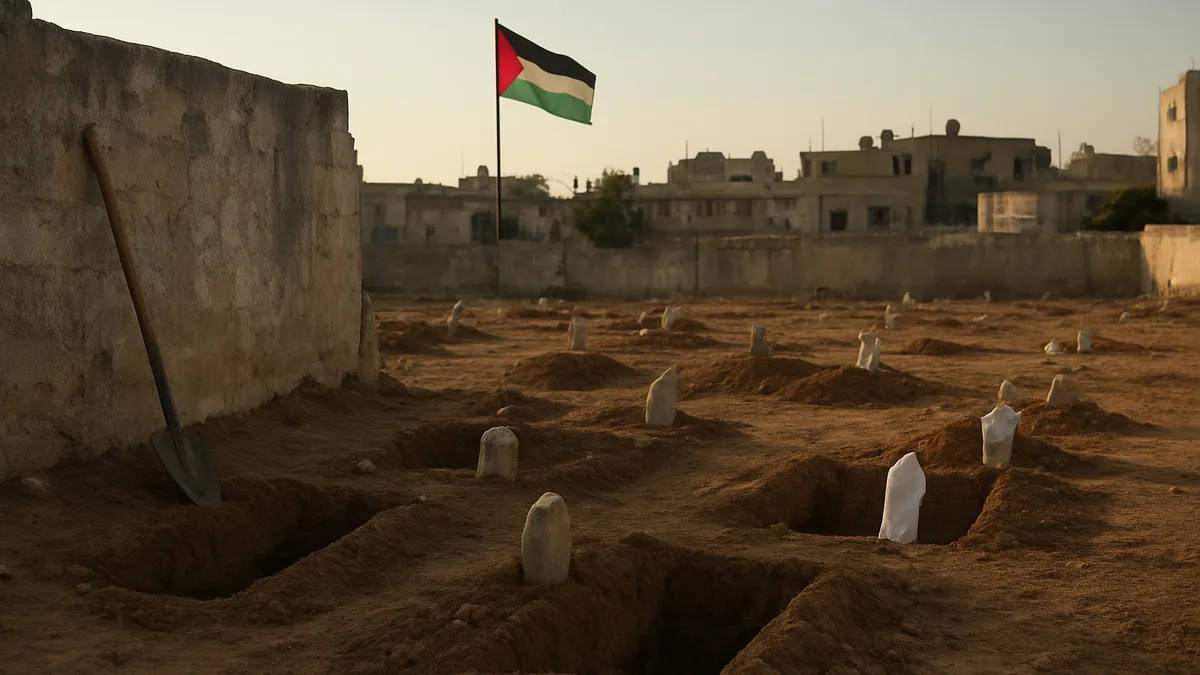
The remains of the friends who were with Montaser when he died were also recovered together and buried in the same grave. Hassouna said the men had shared their lives and would now share the afterlife too. “As they accompanied one another in this life, they will accompany one another in the afterlife,” he said.