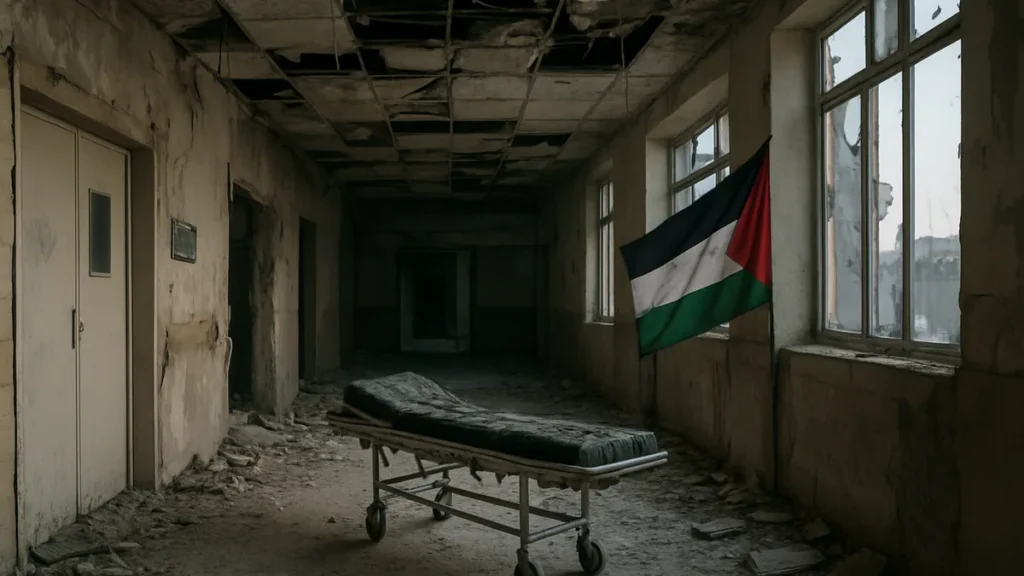
An Israeli strike on the Nasser Medical Complex in southern Gaza killed at least six people in the early hours of Thursday, including Dr Rizq Abu Shuaira, who was on duty in the hospital’s surgery department, and a child.
Zaher al-Waheidi, spokesperson for the Gaza Ministry of Health, called the attack “a horrific crime” and said Israel had targeted the surgery department. He described Abu Shuaira’s death as a loss to the medical profession in an enclave already struggling to cope with the large-scale destruction of health facilities since Israel launched its war on Gaza on October 7, 2023.
Health ministry describes damage at the hospital
Al-Waheidi said Abu Shuaira was “martyred while on duty providing services to patients.” He added: “He did not deserve to meet his demise while among the patients in the hospital corridors.”
A correspondent in Gaza said the Nasser Medical Complex had been attacked for the seventh time, and that it serves at least 500,000 people in southern Gaza. Al-Waheidi said the strike caused widespread destruction in the surgery departments and operating rooms, and major damage to outpatient clinics, the radiology department and the laboratory.
The Gaza Government Media Office said it holds Israel and the United States directly responsible for the strike, noting that the victims included a 13-year-old child. Health authorities say 44 percent of essential medicines are out of stock, as Israel has continued to block the supply of medicines into the enclave of 2.3 million people. Of the enclave’s 37 hospitals, 20 are partially functioning and 17 have been rendered nonoperational.
Attacks on health workers across Gaza and the West Bank
The Gaza Government Media Office has documented 793 Israeli attacks on healthcare services. A report by Insecurity Insight, published last month on ReliefWeb, recorded at least 3,508 attacks on healthcare across the occupied Palestinian territory between October 2023 and September 2026. It said 95 percent of all incidents were attributed to Israeli forces.
During the same period in Gaza, 399 health workers were detained, according to the report. The source material also notes that the Ministry’s figures show at least 1,725 medical workers killed in the past three years. Despite a ceasefire signed between Hamas and Israel in October 2025, the report said attacks had not stopped in Gaza.
Israel has also been accused of expanding attacks on medical infrastructure in the occupied West Bank. A World Health Organization report covering hostilities from January to August 2026 documented 124 distinct attacks on healthcare in the territory, with four deaths and 40 injuries confirmed by WHO data.
A monthly report by the Independent Palestinian Doctors Association in October 2026 documented 23 violations against the healthcare system in the West Bank during that month alone. It highlighted Salfit Government Hospital, which Israeli forces stormed twice on October 14 to confiscate surveillance camera recordings. A nearby ambulance centre was also violently raided, the report said.
Eid Dwaikat, media director of the Palestinian Red Crescent Society, described the conditions facing aid teams. “The work of the Red Crescent teams is in a highly dangerous and complex field environment, amid the continuation of the siege, closure, and restrictions imposed on movement and access to the affected areas, which constitutes a direct threat to the safety of paramedics,” Dwaikat said.
He warned of the human cost of such obstacles. “Preventing teams from reaching the injured and detaining them reflects directly on delaying the provision of life-saving first aid,” he said, adding that this increases the risk of death or worsening injuries because patients do not receive timely care.
Detained doctors and the case of Husam Abu Safia
Physicians for Human Rights Israel (PHRI) has highlighted the cases of 14 detained Palestinian doctors, including hospital directors and specialised surgeons, who are held without formal charges. Al-Waheidi said holding doctors for nearly two years under what is called the ‘Unlawful Combatants Law’ without charge or trial was wrong.
“If the Israeli authorities have any evidence, they should present it in a fair public trial,” he said. “But detention without charge and refusing independent medical examination under security pretexts is an arbitrary deprivation.”
The case of Dr Husam Abu Safia, director of Kamal Adwan Hospital, has become a focal point of these concerns. He was detained in 2024 and has spent more than 500 days in Israeli custody. On Wednesday, PHRI said an independent medical review of his records showed a weight loss of 14kg (31lb) in four months, a significant drop in haemoglobin levels and chest pain.
The same day, the Israeli Supreme Court dismissed a petition seeking his release and refused to allow an independent physician to examine him. Tirza Leibowitz, executive director of PHRI, said the organisation had heard directly from the lawyer who visited him, describing “severe beatings, loss of consciousness, and a feeling by Dr Abu Safia that if this continues unchecked, his life is in danger.”
Leibowitz said the abuse had reached a level where PHRI drew conclusions that it was “a policy that has been implemented by the Israeli Prison Service against Palestinian detainees.” She pointed to some 10,000 Palestinians held in Israeli detention under various categories, saying conditions and daily abuses were “appalling.”
Elias Abu Safia, the doctor’s son, described the toll of the separation. “Unfortunately, we haven’t spoken with my father for the past 685 days. We only know about our father through the lawyer,” he said. “The information that we are receiving about the health conditions of my father and how he is being arrested is very concerning.”