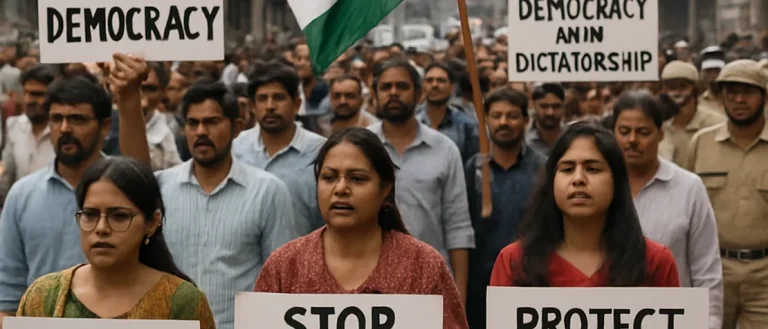

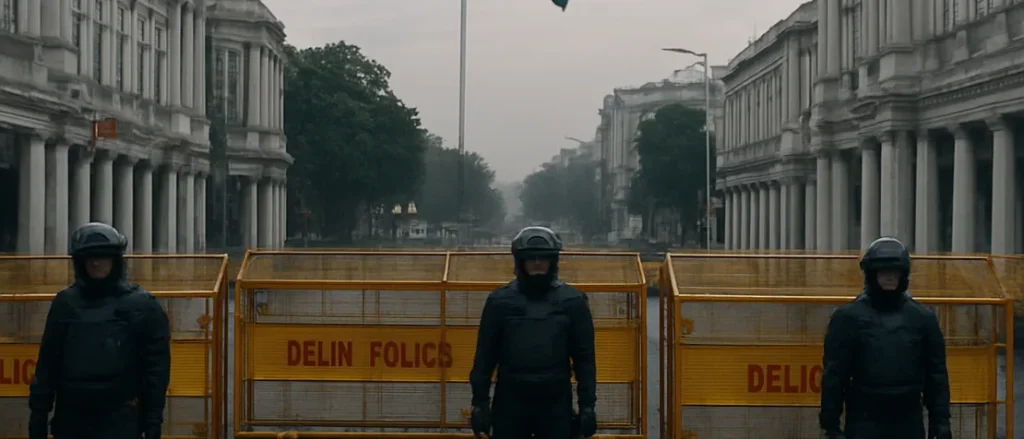

New Delhi has been placed under a strict lockdown as authorities prepare for planned protests against recent changes to the voter list. The demonstrations, scheduled for Saturday, are organized by the Gen-Z movement and the Cockroach Janta Party (CJP), who are calling for the resignation of India’s election chief amid controversy over voter eligibility.
Police have deployed nearly 30,000 personnel across the city, erecting barricades around key areas such as Connaught Place and Jantar Mantar. Several protest leaders, including the founder of the Cockroach Janta Party, Abhijeet Dipke, have been detained upon arrival in the capital. Other CJP leaders, Saurav Das and Ashutosh Ranka, were also detained after landing in New Delhi.
Government crackdown on protesters and students
In an unprecedented move, the government canceled all trains to New Delhi on Friday and locked down over 50 metro stations. An internet shutdown was imposed, and security forces were dispatched to local communities to warn students against participating in the protests.
Police have detained numerous students traveling to New Delhi from various states, with some placed under house arrest far from the capital. The Cockroach Janta Party claims thousands have been detained nationwide as the government intensifies its crackdown. Despite these measures, protesters have vowed to continue their demonstrations.
The current restrictions and detentions have drawn comparisons to the 1975 Emergency period in India, when civil liberties were suspended and political opponents jailed. Dipke described the situation as “Narendra Modi just made EMERGENCY official,” adding that “the youth of this country are no longer scared of you.” Neha Bora, a Gen-Z protest leader and president of the All India Students’ Association, likened the government’s actions to colonial-era repression and urged mass participation in the protests.
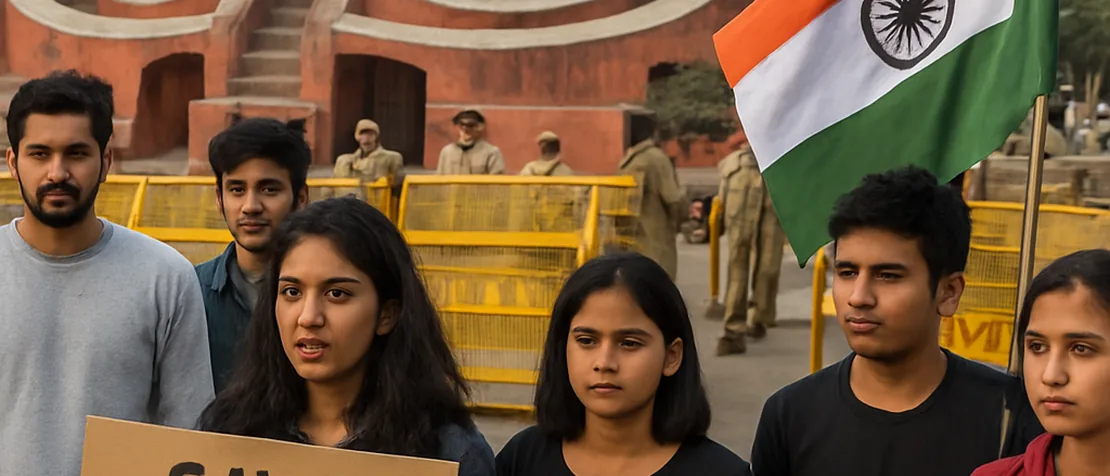
Protesters and citizens voice frustration over restrictions
Despite the heavy police presence, young people attempted to gather in central New Delhi on Saturday morning. Santosh Kumar, a street sweeper near Connaught Place, expressed frustration at the detentions, saying, “How can you stop these kids? They are detaining 10; 50 more are coming.” He predicted the current government’s tenure would not last until the next elections in 2029.
Sameer Irshad, an engineer from Gurugram, approached the barricades with his elderly mother, Sheeba Abdi, in a wheelchair. Abdi criticized the government’s crackdown, stating, “This sort of crackdown, where we cannot peacefully express our dissent, is unseen in Delhi. Why has government turned this place into a fortress? Why are they so scared of citizens like me?”
Controversy over voter list revisions sparks protests
The protests center on a contentious voter revision exercise that has removed 130 million names from the electoral rolls. Critics argue that the process disproportionately targets Muslims, economically disadvantaged groups, minorities, and other vulnerable populations. The Election Commission chief, Gyanesh Kumar, has been accused of overruling concerns from other commissioners about the integrity of these changes.
Arif, a 24-year-old district coordinator for the Students’ Federation of India, reported being detained under police watch in Saharanpur, nearly 200 kilometers from New Delhi. Police reportedly threatened him with criminal charges to prevent his participation in the protests.
Arif said, “I really wanted to be in Delhi, to fight and reclaim our democracy. The time for Modi is over.”
Political implications and government response
Prime Minister Narendra Modi and his Bharatiya Janata Party recently marked 25 years in office, including his tenure as Gujarat’s chief minister and as India’s prime minister since 2014. However, analysts suggest Modi’s political standing is weakening amid growing public dissent.
Previous protests led by the Cockroach Janta Party in July disrupted key New Delhi streets and resulted in the resignation of the education minister. This time, Modi’s government has taken more extreme steps to prevent protesters from assembling in central areas, aiming to maintain an image of invincibility.
Author and Modi biographer Nilanjan Mukhopadhyay said Modi is at a low point in public perception despite controlling important institutions and bureaucratic wings. He noted that Modi is “fast losing people’s perception of being a leader who leads them out of livelihood pits.”
Senior Supreme Court lawyer and rights activist Prashant Bhushan, who planned to join the protests, described the government as “quite scared of the people.” He added, “People in India are rising and demanding answers. And when the government gets scared, they adopt draconian measures to stay in power. But only more and more people will rise from repression.”