

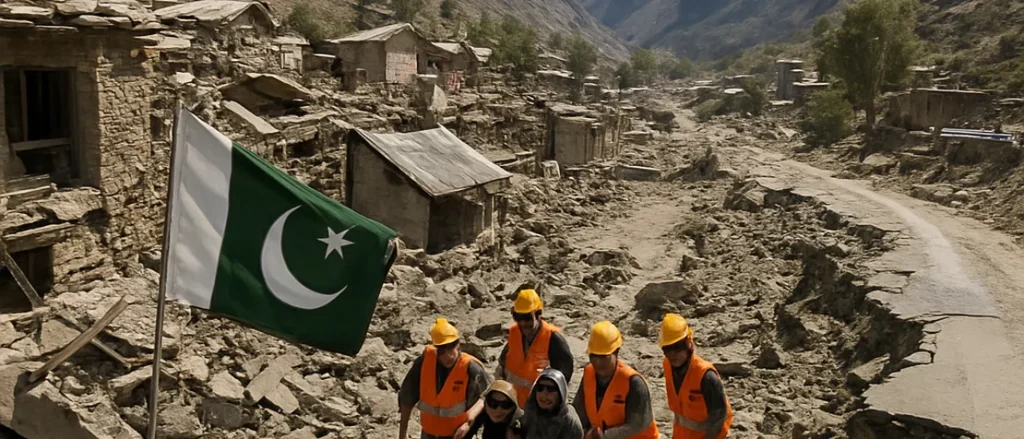

Twenty-one years after a powerful 7.6-magnitude earthquake struck northern Pakistan, the catastrophic event continues to resonate deeply across the nation. On October 8, 2005, at approximately 8:50 a.m., the earthquake’s epicenter near Muzaffarabad in Azad Jammu and Kashmir (AJK) unleashed widespread destruction, killing over 80,000 people and affecting millions more.
The US Geological Survey located the epicenter about 21 kilometers north-northeast of Muzaffarabad and confirmed the magnitude at 7.6. The quake devastated large portions of AJK and the then North-West Frontier Province, now Khyber Pakhtunkhwa, including Muzaffarabad, Bagh, Neelum Valley, Balakot, Mansehra, and Battagram. Entire villages were razed, and critical infrastructure such as homes, schools, hospitals, government buildings, roads, and bridges collapsed within minutes.
Thousands of landslides further isolated communities and complicated rescue efforts. Official figures vary, but the National Disaster Management Authority (NDMA) estimates the death toll at 73,338, with over 128,000 injured and approximately 3.5 million rendered homeless. Other international assessments place fatalities above 86,000. The destruction extended to roughly 600,000 houses, more than 5,800 educational institutions, hundreds of health facilities, thousands of kilometers of roads, and numerous bridges.
Muzaffarabad and Balakot were among the hardest hit, with the collapse of schools and public buildings causing significant loss of life. The disaster prompted one of Pakistan’s largest relief and reconstruction campaigns, involving the government, armed forces, local communities, international organizations, and foreign governments. The Earthquake Reconstruction and Rehabilitation Authority (ERRA) was established to coordinate rebuilding efforts, supported by extensive international aid including emergency relief, medical assistance, helicopters, search-and-rescue teams, and financial resources.
AJK commemorated the 21st anniversary with prayers and ceremonies, including a main event at the University College Ground in Muzaffarabad attended by AJK Prime Minister Barrister Iftikhar Gillani. Special prayers honored the victims, and tributes were paid to those who lost their lives. A separate ceremony in Athmuqam, Neelum Valley’s district headquarters, also paid homage to the earthquake victims.
Gillani described the earthquake as an unforgettable tragedy in AJK’s history, expressing gratitude to the international community for its assistance and acknowledging the Pakistan Army’s critical role in relief operations. He emphasized the disaster as a symbol of national unity and called for ongoing efforts to enhance disaster preparedness in the region.
President Asif Ali Zardari also paid tribute to the victims and thanked countries including Saudi Arabia, the United States, China, Türkiye, Iran, Japan, and Cuba for their support. Highlighting the challenges posed by climate change and environmental degradation, he stressed the importance of strengthening disaster preparedness to safeguard future generations. Zardari noted the integration of technology and artificial intelligence in the National Disaster Management Authority’s early-warning systems and advocated for embedding risk reduction into development planning.
Prime Minister Shehbaz Sharif echoed these sentiments, honoring those lost and expressing solidarity with survivors. He highlighted the resilience and cooperation demonstrated during the 2005 response and underscored the need to bolster Pakistan’s capacity to manage climate-related and other natural hazards. The government is focused on enhancing disaster management through modern data, technology, and early-warning mechanisms.
National Assembly Speaker Ayaz Sadiq reflected on the unity and sacrifice shown by Pakistanis after the earthquake, calling for proactive planning, effective disaster management, and institutional coordination. He emphasized that safeguarding lives and infrastructure must be central to national strategies and that early-warning systems are crucial to minimizing future casualties and damage.
Punjab Chief Minister Maryam Nawaz expressed solidarity with victims and survivors, praising the nation’s spirit of sacrifice and cooperation during the crisis. She stressed the importance of policies addressing earthquakes, floods, smog, and other disasters, noting that timely preparedness can significantly reduce losses. She also commended the Pakistan Army, Navy, Air Force, and rescue agencies for their vital roles and highlighted the modernization of the Punjab Disaster Management Authority to meet contemporary needs.
The 2005 earthquake exposed Pakistan’s vulnerability to seismic hazards, especially in densely populated mountainous regions with fragile infrastructure and limited access. It spurred increased focus on earthquake-resistant construction and disaster risk reduction, leading to the development of the Building Code of Pakistan’s Seismic Provisions in 2007, a key measure to improve resilience.
The NDMA continues to warn that areas such as Muzaffarabad and Mansehra remain at risk due to proximity to active fault lines, unplanned urbanization, construction in high-risk zones, and weak enforcement of building codes. The anniversary of the earthquake is observed as National Resilience Day, serving as both a day of remembrance and a call to action for improved disaster awareness, preparedness, and risk mitigation.