
Forces aligned with Yemen’s government said on Thursday that they had intercepted a drone heading toward Medina in Saudi Arabia, as well as a missile fired at Riyadh. The interceptions came as fighting with the Houthi group escalated.
The clashes between Saudi-backed government troops and the Iran-aligned Houthis have intensified along Yemen’s western Red Sea coast. The Houthis have also widened their attacks on oil facilities and airports in neighbouring Saudi Arabia.
Attacks on Dhahran and Riyadh target Saudi energy sites
On Wednesday, Yahya Saree, the military spokesman for the Houthis, who are also known as Ansar Allah, said the group had carried out a precise operation aimed at Aramco in Dhahran. He said strikes had also hit Riyadh airport and a refinery in the capital.
Saree warned that the operations would keep going in the coming days and would target Saudi airports and oil facilities. A Saudi Ministry of Energy official confirmed that a building belonging to Aramco in Dhahran had been struck. The official described a “limited fire” and said there were “no casualties or fatalities”. Dhahran is home to Aramco’s headquarters, a large complex that includes many buildings and residential compounds.
The Saudi-led coalition, meanwhile, launched strikes on the Houthi stronghold in the Yemeni capital, Sanaa. The Houthis seized the city in 2014 and have held it since. The coalition had fought the group, which also took large amounts of Yemen’s military equipment, until a ceasefire was agreed in 2022. That truce has collapsed in recent months.
Airport closures and rising costs for Saudi Arabia
Recent Houthi strikes on Saudi Arabia have mostly hit key infrastructure on the edges of Riyadh. Reports suggest the attacks are moving closer to the city centre.
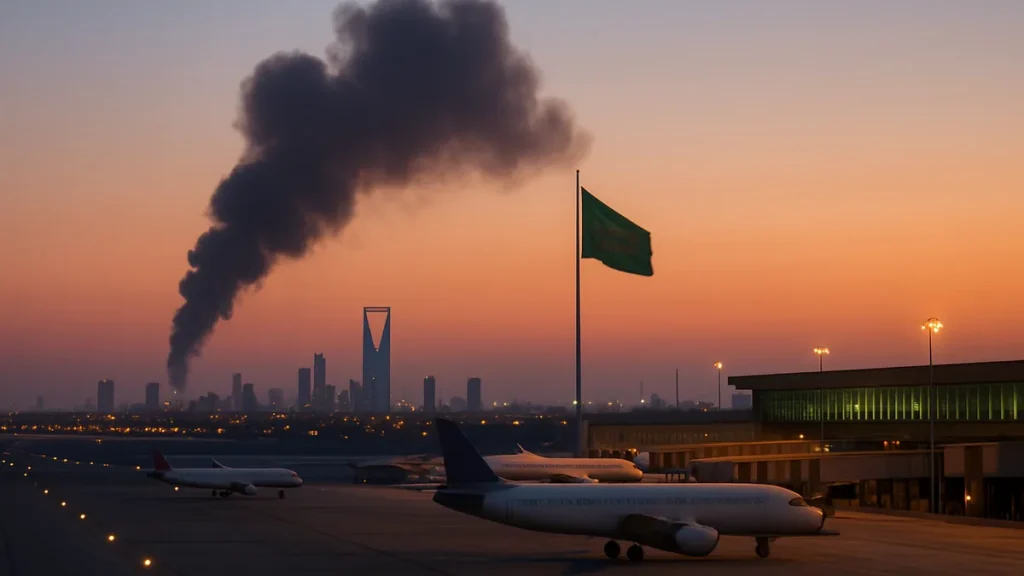
Attacks on King Khalid International Airport in Riyadh over the weekend killed 14 people and wounded more than 300 others. Other airports have also been targeted, including Abha International Airport in southern Saudi Arabia, where two people were killed. Saudi Aramco energy facilities have also been hit.
Authorities said Riyadh airport would stay shut at least until Saturday. Several airlines cancelled flights, leaving the skies over the capital largely empty.
‘s correspondent Yousef Mawry, reporting from Sanaa, said Saudi Arabia had far more to lose from the tit-for-tat attacks, which disrupt air traffic. Sanaa International Airport has been closed for years because of damage sustained during the civil war, and no Yemeni airliners are currently based there.
Analysts quoted in the report said the Houthis were also signalling that disrupting security would bring growing economic costs for Saudi Arabia’s role in Yemen. Earlier this year, the Houthis began targeting Saudi-linked shipping in and around the Bab al-Mandeb strait at the mouth of the Red Sea. The report said Saudi Arabia had increasingly relied on this route for oil exports since Iran closed the Strait of Hormuz in March, under fire from the United States and Israel.
The kingdom is due to host a major investment conference in Riyadh later this month, dubbed “Davos in the desert”. It is now unclear whether the event will go ahead. Organisers of the Six Kings Slam tennis tournament, which had been set to begin next week in Riyadh, have moved the event to December. Saudi Arabia is also preparing to host the FIFA World Cup in 2034.
‘s Zein Basravi, reporting from Doha, said the Houthi strikes were designed to build pressure that was also producing economic knock-on effects. He warned that if the attacks continued, the international consequences for the global economy would remain negative.
Ground battles around Taiz and the Bab al-Mandeb coast
Yemeni government forces are carrying out a large counteroffensive, called “Dawn of Yemen”, to retake coastal territory that the Houthis seized in recent weeks near the Bab al-Mandeb strait. The strait is a vital chokepoint for maritime trade.
The Saudi cabinet, meeting this week under Crown Prince Mohammed bin Salman, said the kingdom would not allow threats to its security or to freedom of navigation in the Red Sea and Bab al-Mandeb strait.
On Wednesday, government forces said they had carried out 2,309 targeting operations against the Houthis under the campaign. Their spokesperson, Majeed al-Nuzaili, said the strikes used combat aircraft, drones, artillery and rocket launchers. He said they destroyed 460 Houthi military vehicles.
Government forces said they had recaptured areas in Sabr al-Mawadim and al-Sarari in Taiz governorate. They also said they had repelled a large Houthi attack west of Taiz city, which Houthi fighters had besieged earlier this month. The governorate includes the flat western coast on the Red Sea, home to the port city of Mocha and the Bab al-Mandeb, while much of its land lies in the highlands.
Mawry said the fighting was so intense because of the area’s strategic value. Quoting the situation on the ground, he said whoever holds the high ground controls the surrounding landscape, including the Red Sea coastline and Taiz city itself.
The internationally recognised government has asked for more reinforcements, along with Saudi air attacks on positions the Houthis recently took in the Misrakh and Turbah districts. Those districts lie south of Taiz and act as gateways to the city.
Mawry reported that Saudi-led air strikes were forcing the Houthis to pull back, letting government forces advance, but that they had not secured some of those positions fully. He said the Houthis typically counterattacked to retake ground, a pattern he described as routine since early September.
The Houthi siege of Taiz has caused civilian casualties and severe shortages of fuel, gas and other supplies. On Wednesday, the United Nations World Food Programme said wheat flour stocks had almost run out. The Red Cross said front-line hospitals in Marib, Taiz and the Red Sea coast were treating unprecedented numbers of weapon-wounded patients, with some facilities admitting more than 700 casualties in a single week.