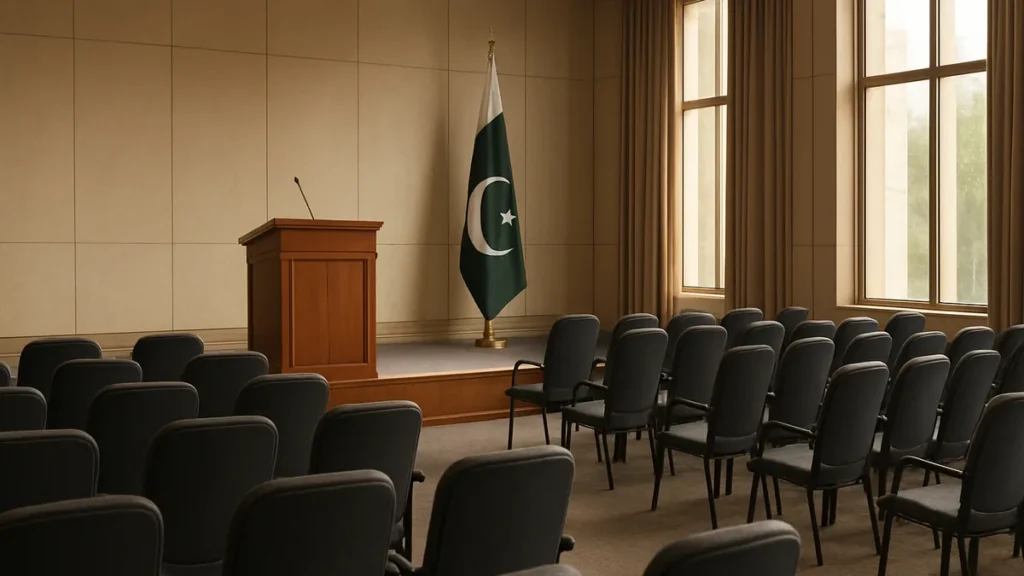
Prime Minister Shehbaz Sharif said on Sunday that Pakistan needs national solidarity and difficult decisions to free itself from its growing debt. Speaking to participants of the National Security Workshop in Islamabad, he argued that political parties and every section of society working together could help the country reach economic self-reliance.
The prime minister said Pakistan’s debt had kept climbing over the past 80 years. He stressed that the burden could be overcome if the nation came together and took the decisions required, rather than relying on temporary fixes.
Subsidies, state enterprises and tax evasion
Shehbaz linked some of the country’s economic troubles to subsidies, saying the money behind them was drawn from taxpayers. In his view, Pakistan could have progressed without depending on that kind of financial support.
Also read: Shehbaz Sharif says economy stabilising, eyes 6% GDP growth
He also pointed to large sums spent on state-owned enterprises that are losing money, along with the problem of tax evasion. According to the prime minister, the aim of the discussion was not to apportion blame but to pinpoint the root causes and identify workable solutions.
Defence of PWD and Utility Stores closures
Reviewing the government’s record over the past two and a half years, Shehbaz said it had resolved several problems with the support of political parties in parliament, although more work lay ahead. He acknowledged that the government’s decision to shut down the Pakistan Public Works Department (PWD) had drawn criticism. He nevertheless claimed that the move had halted corruption worth Rs100 billion.
The prime minister also defended the closure of the Utility Stores Corporation. He said the body had been badly affected by large-scale corruption, and that ordinary people had been forced to queue for substandard food items. Instead, the government had introduced digital wallets to send assistance directly to beneficiaries, a step he said was saving the country hundreds of billions of rupees previously lost to corruption.
Diplomacy with Washington, Tehran and Riyadh
Turning to foreign policy, Shehbaz highlighted Pakistan’s efforts to bring the United States and Iran to the negotiating table in Islamabad, a development he described as taking place after 47 years. He praised the contributions of Chief of Defence Forces and Chief of Army Staff Field Marshal Syed Asim Munir, as well as Deputy Prime Minister Ishaq Dar, in making this possible.
He said Pakistan maintained strong relations with the United States and Gulf countries, particularly Saudi Arabia. The prime minister referred to the defence agreement signed with Riyadh last year and to trilateral defence cooperation between Pakistan, Saudi Arabia and Turkiye. He insisted these partnerships aimed to advance peace, security and prosperity in the region and were not directed against any country.
Shehbaz also referred to Marka-e-Haq, saying Pakistan had inflicted a severe blow on India during the brief conflict. He added that Pakistan had to convert its diplomatic and strategic gains into economic benefits, warning that such opportunities should not be wasted.
Growth targets, exports and agriculture concerns
The prime minister said the Federal Board of Revenue (FBR) had recovered Rs900 billion through enforcement measures in the 2025-26 fiscal year. He identified indirect taxes, particularly sales tax, as the largest source of tax evasion within the revenue authority.
Recalling a meeting with the managing director of the International Monetary Fund in the United States, Shehbaz said she had described Pakistan as a changed country. He credited the progress to sincerity, hard work and sustained effort. He noted that GDP growth had been projected at 3.5%, but said the country must lift it to at least 6% as soon as possible.
Shehbaz said Pakistan’s foreign exchange reserves were at their highest level in history. He asked whether the country wanted to keep depending on outside assistance or instead build a future based on dignity and self-reliance, adding that the second path demanded hard work and honesty. He said exports had risen by 8% in the first quarter of the current financial year and that IT exports had reached $4.6bn in the previous fiscal year. He nonetheless stressed that far more was needed to strengthen export performance.
The prime minister expressed disappointment at the lack of progress in agriculture, saying the sector had not received the attention it needed. He maintained that meaningful improvements could be achieved within six months, with hard work as the key requirement. Highlighting the potential of young people, he said the government was working with provincial administrations to expand technical, vocational and skills training opportunities across the country.