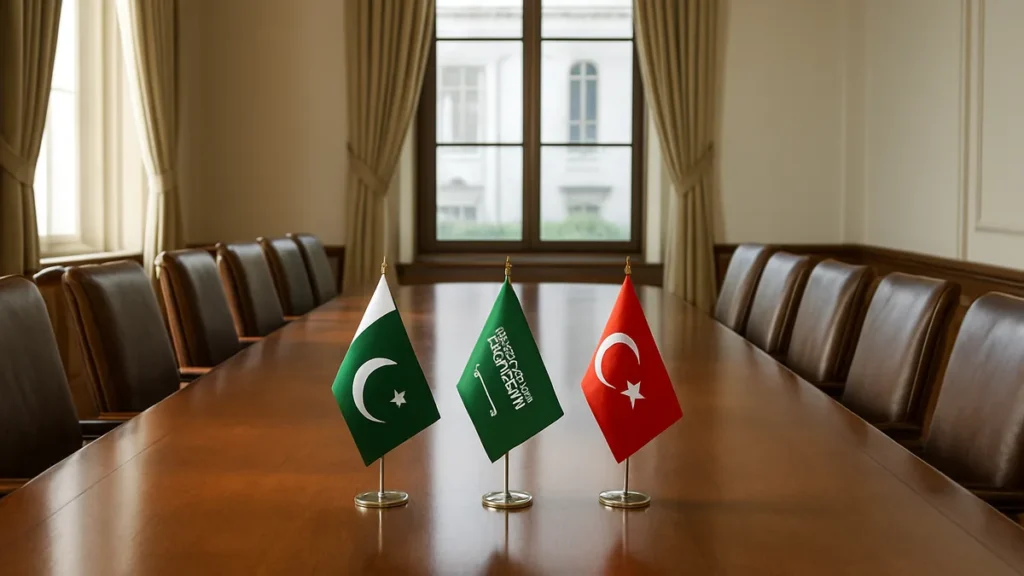
Ishaq Dar, who serves as deputy prime minister and foreign minister, announced on Monday that Pakistan is likely to welcome a gathering of the top-level security committee of the Makkah Joint Defence Agreement (MJDA) to Islamabad before the month ends. The body in question is the Strategic Political and Defence Committee (SPDC), a central decision-making forum under the accord.
The SPDC brings together the foreign and defence ministers and senior military officials from Pakistan, Saudi Arabia and Turkiye. Earlier in October, Pakistan and Turkiye agreed to speed up the deployment of troops and capabilities inside Saudi Arabia under the MJDA, following an emergency SPDC session in Riyadh. The move was intended to turn the three countries’ shared defence commitments into practical action, given the security threats facing the kingdom.
Dar outlines plans for the Islamabad session
Speaking at a press conference that closed the two-day Economic Cooperation Organisation (ECO) summit, Dar said the committee would meet in Islamabad, hopefully toward the end of this month. He added that Pakistan had offered, during the committee’s first gathering, to host its next formal session.
Also read: Dar defends Makkah Joint Defence Agreement amid tensions · Makkah pact moves to practical phase after Saudi attacks
The three countries’ leaders signed the defence pact in August, at a time of heightened regional tensions involving the United States and Iran, as well as Houthi rebel attacks on Saudi infrastructure carried out from Yemen. Under the agreement, an assault on any one of the three nations would be regarded as an assault on all of them. Dar maintained that the pact was designed for collective self-defence and fits within the principles of the United Nations Charter. “It doesn’t violate the international charter, the UN Charter Article 51 that also allows individual and collective defence,” he said.
Regional instability and Pakistan’s position on Saudi Arabia
The proposed meeting comes amid ongoing instability across the region, including the conflict involving the United States and Iran and rising hostilities in Yemen. Pakistan has repeatedly expressed solidarity with Saudi Arabia and restated its commitment to protecting the kingdom’s territorial integrity and sovereignty. Islamabad has also called on the Houthis to return to negotiations and halt attacks on Saudi civilian infrastructure without delay.
ECO summit priorities and Iran ties
Describing the ECO summit, Dar said it was an honour for Pakistan to host the gathering and that regional cooperation is essential for peace, economic development and stability. He said Pakistan will chair the organisation for two years and remains committed to implementing the ECO Charter and advancing its Vision 2035. According to Dar, discussions centred on regional connectivity, transport links and economic partnerships, and also covered human resource development, environmental protection and disaster management. He thanked Kazakhstan for its chairmanship in 2025 and welcomed Iran’s plan to host the next ECO summit.
On regional security, Dar said Pakistan wants all disputes resolved peacefully through dialogue. He referred to his discussions with Iranian Foreign Minister Abbas Araghchi and voiced hope for a peaceful resolution of tensions between Iran and the United States.
Afghan border concerns and recognition policy
Dar reaffirmed Pakistan’s support for a stable and prosperous Afghanistan but said cross-border incursions remained a serious worry. “We are in favour of a stable and prosperous Afghanistan, but the process of infiltration continues,” he said, questioning how long Pakistan would keep burying soldiers killed in attacks. He added that Pakistan’s stance on recognising Afghanistan’s interim government had not changed, and that the country had not recognised the administration.