
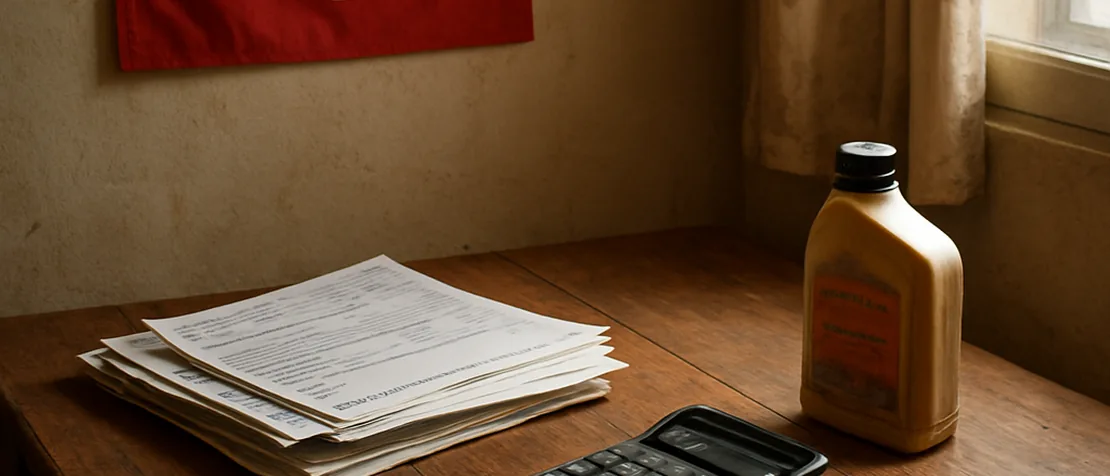
Nearly seven years into Kais Saied’s presidency, Tunisians are weighing whether the country’s economic changes have improved their daily lives. For taxi driver Houssam Oueslati, the rising cost of inflation is measured in the price of engine oil. In 2018 he paid about 35 Tunisian dinars ($13) for it. Today the same purchase can cost close to 100 dinars ($34), so he has been driving longer hours to keep his income level.
Saied came to power amid public anger at the political establishment and promised a fairer, more accountable state. Since then, Tunisia has absorbed the economic effects of the COVID-19 pandemic, volatile global food and energy prices, and geopolitical turmoil. Those shocks have made recovery harder, but they do not by themselves show how well the government has responded.
Rising prices squeeze households and small businesses
According to figures Oueslati provided, the price of the engine oil he buys has risen by roughly 186%. For a taxi driver, that is not a one-off expense but a growing part of the cost of staying in business. The pressure reaches far beyond transport.
The National Institute of Statistics said annual inflation reached 5.6% in September 2026, up from 5.4% in August and 4.8% in January. Food and beverage prices were 8.4% higher year on year. Poultry rose by 16.5%, fruit by 16.3% and lamb by 14.6%. Core inflation, which excludes food and energy, stood at 4.9%.
Economist Ridha Chkoundali says the headline rate can hide how much households have lost. Inflation measures how fast prices rise, not whether they are affordable, and when wages lag behind prices, purchasing power shrinks. Even when inflation slows, prices generally stay high unless they fall, so families do not regain what they have already spent.
Chkoundali estimates that average annual inflation was 6.8% between 2015 and 2021, compared with 8.1% between 2021 and 2026. He describes the latter period as one of stronger inflationary pressure. The Central Bank cut its key interest rate twice in 2025, bringing it down to 7%, but Chkoundali notes that cheaper borrowing alone cannot restore purchasing power already eroded by higher prices.
He also argues that tighter access to credit has reduced the ways households can manage expenses. Loans, banking facilities and cheques once let some families spread payments over time, he says, but changes in financing conditions and cheque rules have narrowed those options.
Growth figures and youth unemployment tell different stories
The National Institute of Statistics reported that Tunisia’s economy grew by 2.3% year on year in the second quarter of 2026, and by 1.4% compared with the previous quarter. The 2026 Finance Law had projected annual growth of about 3.3%. For Chkoundali, that gap points to a deeper issue: growth only matters to households when it becomes more production, investment, employment and income.
The labour market shows the same problem. The National Institute of Statistics put overall unemployment at 14.9% in the second quarter of 2026, down from 15.3% a year earlier, after reaching 17% in 2020. The headline figure, however, masks a harder situation for younger people. Unemployment among those aged 15 to 24 reached 35.4%, and among university graduates it stood at 26.6%.
For many young Tunisians, the difficulty is not only finding work but finding a job that offers steady pay, stability and a route to independence. Chkoundali identifies weak investment and declining production as major constraints. He also warns that heavy reliance on domestic borrowing could make it harder for private firms to get credit, expand and hire.
Debt, subsidies and energy costs strain public finances
Chkoundali cited figures showing domestic borrowing of about 7 billion dinars ($2.3bn) in both 2024 and 2025, and 11 billion dinars ($3.7bn) at the start of 2026. His concern is that state financing needs could compete with private businesses for available credit. Borrowing does not automatically harm growth, he acknowledges, since its effects depend on its terms and how the money is spent.
According to Finance Ministry data, public debt rose from 67.8% of gross domestic product in 2019 to 84.9% in 2024, before falling to 82.1% in 2025. The 2026 Finance Law projects a ratio of about 83.4%. Debt servicing competes with public-sector wages, social spending, subsidies and investment, and substantial financing needs can leave the state less room to respond to new shocks.
Energy prices add to the strain. The 2026 Finance Law assumed a Brent crude price of about $63.30 per barrel, but by the end of June the average had reached approximately $92.60, according to figures cited in the report. The government’s fuel subsidies totalled 2.427 billion dinars in the first half of 2026, equal to $826m and 48.6% of the allocation under the Finance Law. Public investment spending over the same period came to 1.665 billion dinars, or about $566.6m.
- Fuel subsidies: 2.427 billion dinars in the first half of 2026 (about $826m)
- Public investment: 1.665 billion dinars over the same period (about $566.6m)
- Brent crude: assumed at about $63.30 per barrel, averaging about $92.60 by end-June
A larger energy import bill increases demand for foreign currency and could put pressure on the dinar and foreign-exchange reserves, particularly if export earnings and domestic output do not offset the added costs. Chkoundali also points to trade imbalances with partners including Algeria and Egypt. He recommends that policymakers model several scenarios for financing needs and subsidy costs rather than rely on a single oil-price forecast.
Supporters and critics divided over Saied’s record
Saied’s supporters argue that his economic record cannot be judged without considering the problems that existed before he took office. Houssam Ben Ahmed, a political activist who backs the president, says Saied inherited a country already in serious decline across several sectors. He calls the measures taken on July 25, 2021 “an absolute necessity to save the state”, pointing to what he sees as the fragmentation and deterioration of political and economic life.
Saied has also made fighting monopolies and speculation a central plank of his economic agenda, framing it as a way to protect consumers and advance social justice. Critics, however, argue that the authorities have not always distinguished clearly between speculative stockpiling and the storage needed to keep essential goods available. They warn that restrictions which disrupt warehousing and distribution without offering alternatives could worsen shortages rather than lower prices.
The Democratic Current party said in a statement that the government was refusing to confront economic realities, and that blaming failures on conspiracies would deepen the country’s problems. For Oueslati and other workers, the consequences are immediate. When costs climb faster than earnings, longer hours can mean simply keeping pace rather than getting ahead.