The commander of the Quds Force of Iran’s Islamic Revolutionary Guard Corps, Esmail Qaani, has travelled to Iraq in an effort to defuse mounting friction near Jurf al-Nasr, a town considered a stronghold of the pro-Iranian armed group Kataib Hezbollah. An Iraqi official said the visit is aimed at securing a settlement.
According to the official, Qaani met Prime Minister Ali al-Zaidi and also held meetings with forces within the Coordination Framework, an umbrella grouping of Shia parties in the Iraqi parliament. The talks are intended to reach an agreement as tensions rise over an investigation into suspected oil smuggling.
Qaani’s talks with Prime Minister al-Zaidi
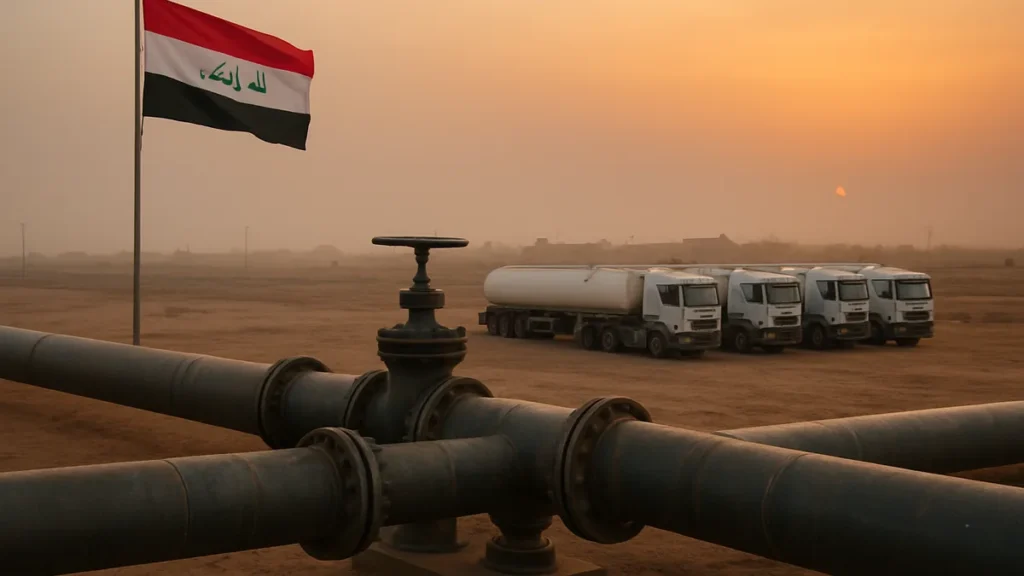
The visit follows a leaked intelligence report last week which said two strategic oil pipelines running through Jurf al-Nasr, a town located near Baghdad in the centre of the country, had effectively been tapped into.
The official’s account places the diplomatic push at the centre of a dispute that has grown quickly, with Iraqi authorities pressing ahead with an investigation while the armed group pushes back.
Anti-corruption crackdown centred on the town
Iraq has recently launched a sweeping anti-corruption crackdown focused on the town, which is alleged to harbour illicit oil refineries. Officials describe the operation as an effort to protect public funds from a widespread smuggling network.
Some analysts, however, believe the move is a carefully calculated strategy to cut off the financial lifelines of pro-Iranian armed groups that refuse to join the state’s institutions. The Iraqi source said the judicial committee has not yet reached an agreement with the factions to enter the area.
A correspondent in Iraq said at least three leaders of the Coordination Framework have rejected any armed clash or any entry of federal forces before a political understanding is reached with Kataib Hezbollah.
Government orders and Kataib Hezbollah’s defiance
On Monday, al-Zaidi told military and security commanders to deploy additional forces around the town and to prepare for government troops to enter. The order could bring state forces into direct confrontation with the armed group.
Security agencies have also been instructed to stop tankers carrying oil or petroleum products from leaving the area. A senior Iraqi official had earlier said Kataib Hezbollah has until Friday to leave Jurf al-Nasr.
A Kataib Hezbollah commander told AFP: “I can state decisively and with absolute certainty that the dream they dream of the Kataib withdrawing [from Jurf al-Nasr] will not come true, not even over our dead bodies.”
Kataib Hezbollah, one of dozens of armed groups with semi-official status in Iraq, denied the allegations on Sunday and said an inspection had found no interference with pipelines. The group has recently issued several statements criticising the prime minister, accusing him of corruption and threatening his government.
It also accused the government of “fabricating lies” about oil smuggling and of waging “the largest blackmail operation aimed at forcing” it to abandon its weapons. Since taking office, al-Zaidi has pledged that armed groups will hand their weapons over to the state.