
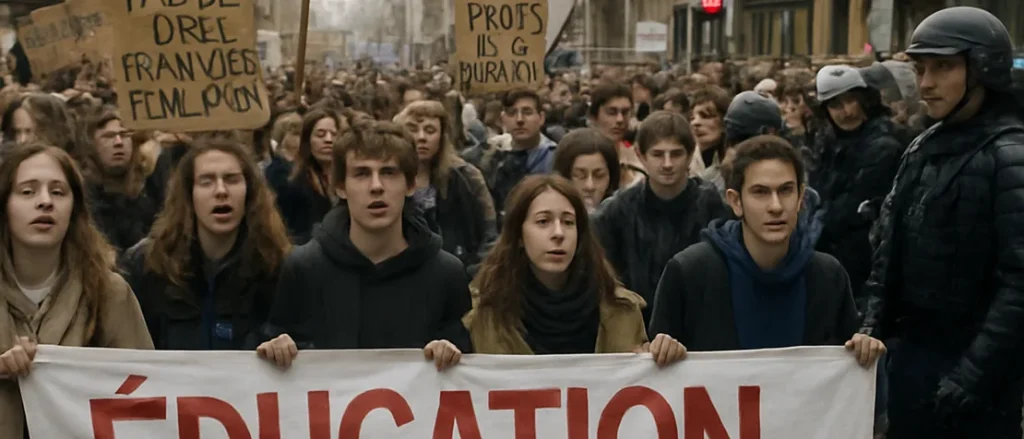

In France, high school students have been blockading schools and marching through cities for three weeks, demanding urgent improvements to teacher shortages and deteriorating school infrastructure. Despite government assurances to address these issues, few concrete measures have been announced, highlighting the tension between public demands for investment in education and fiscal constraints faced by the government.
In Marseille, high school teacher Diane Di Sciullo joined the protests, emphasizing the need for decent education in adequate conditions. She described overcrowded classrooms, noting that she currently teaches 37 students and often has to ask them to find spare chairs and desks from neighboring rooms. Di Sciullo carried a placard stating, “I’m a teacher and my students help me catch cockroaches in class,” underscoring the poor state of school facilities.
Education ministry data indicated a gradual decline in the number of school blockades, with 224 schools closed in the morning and 157 by midday, meaning 96% of schools remained open. However, clashes between police and protesters occurred at some sites in Paris. Demonstrations took place nationwide, including in Lille, Rennes, Nantes, Paris, Toulon, and Marseille.
Education Minister Edouard Geffray met with students and teachers in Reims, announcing an emergency plan to ensure long-term replacement of absent teachers and a review of heavy school timetables, which can extend from 8 a.m. to 6 p.m. with substantial homework. He also mentioned efforts to improve Parcoursup, the national university application portal criticized for its complexity and stress on applicants.
Prime Minister Sebastien Lecornu promised by late October “concrete, quick and fully funded responses” to the protests but did not provide specific details. A significant grievance among students concerns the police’s harsh response, with slogans like “Too young to be listened to, old enough to be tear-gassed” reflecting widespread criticism. Hundreds of arrests and numerous injuries have been reported since the protests began, prompting the government to suspend the use of stun grenades after a teenager lost a hand.
With a presidential election six months away, political reactions to the protests have been sharply divided. Far-right candidate Marine Le Pen condemned the damage caused by some protesters and suggested that they or their parents should pay for repairs, while also proposing cuts to public spending if elected. In contrast, left-wing contender Jean-Luc Melenchon praised the protesters and condemned police brutality. A recent poll showed that 72% of French citizens view the students’ demands as legitimate, though 55% believe the protests should end.
The government has tried to balance condemnation of violent acts, including arson and injuries to staff, with sympathy for some student concerns.
Meanwhile, student protests also erupted in Belgium, with demonstrations in Brussels, Ciney, and Liège focusing on rising costs, overcrowded classrooms, limited resources, and increased teacher workloads. In Liège, where nearly 200 arrests related to student protests have occurred this month, authorities have banned public gatherings of more than three people until October 16. However, a protest in front of the city’s university was authorized.