
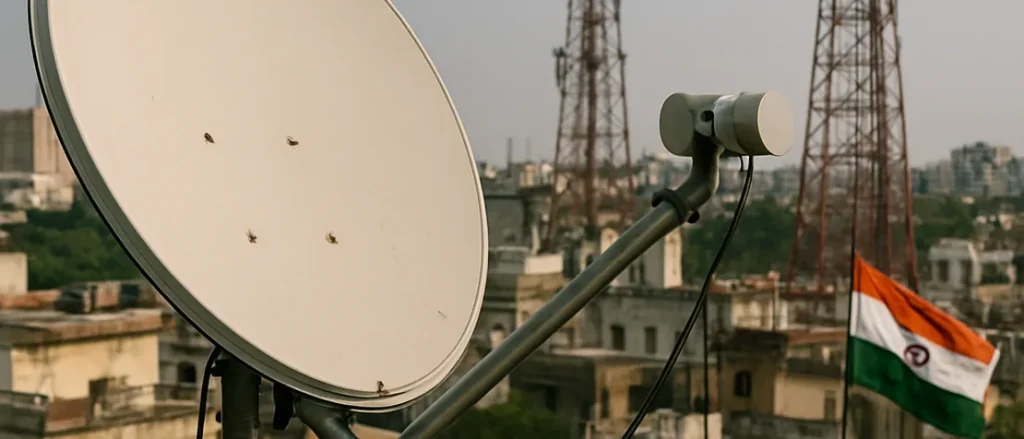

India has firmly denied any bias or unfairness in its satellite internet approval procedures, responding to accusations made by billionaire Elon Musk. Musk recently claimed on social media that unnamed ‘oligarchs’ were obstructing the launch of his company Starlink in India to preserve their monopolistic control over the market.
Starlink’s entry into the Indian market has been delayed for four years amid detailed scrutiny concerning security protocols and spectrum access. In response to Musk’s allegations, India’s telecommunications ministry clarified that three companies, including Starlink, are currently at similar stages in the regulatory process, with security assessments ongoing for each. The ministry did not disclose the names of the companies involved or directly reference Musk.
“The suggestion that the framework or its application is unfair or discriminatory is baseless and misconceived,” the ministry stated, emphasizing the impartiality of the approval process.
India’s telecom sector is largely dominated by Mukesh Ambani’s Reliance Jio and Sunil Mittal’s Bharti Airtel. Both companies, along with Musk’s Starlink, have received preliminary approvals to operate satellite internet services but are still awaiting final spectrum allocation and regulatory clearances.
Airtel and Jio have not provided comments on the matter. The dispute between Musk and the Indian telecom giants is not new; previously, Musk had clashed with Ambani and Mittal over spectrum allocation policies. However, in 2025, the three parties reached agreements to distribute Starlink devices within India, setting aside earlier differences.
India represents a significant opportunity for Starlink, with market forecasts estimating the satellite broadband sector could reach $1.9 billion by 2030. The issue also carries diplomatic weight, as the United States has promoted Starlink’s market access as a goodwill gesture in ongoing trade discussions with India, which have yet to culminate in a finalized agreement since a framework was established in February.
Security concerns have further complicated the situation. Indian authorities reported recovering Starlink equipment during two separate operations in late 2024: a police drug seizure in the Andaman and Nicobar Islands and a military search in Manipur state. Following these incidents, Musk claimed that Starlink’s satellite signals were “turned off over India” and insisted they “were never on in the first place,” statements he reiterated recently.