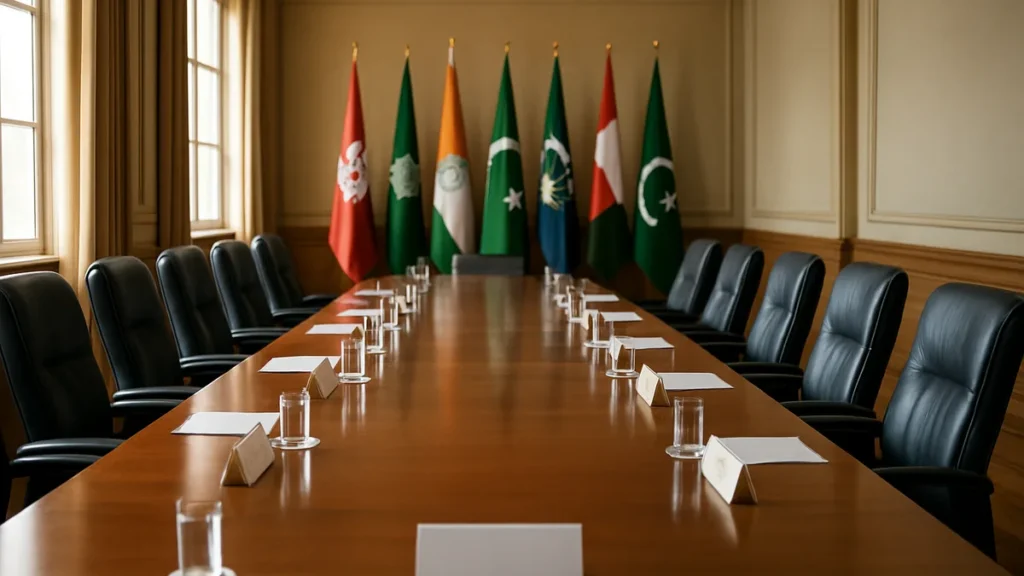
Iranian Foreign Minister Seyed Abbas Araghchi has reached Islamabad to take part in the 30th Economic Cooperation Organisation (ECO) Council of Ministers meeting, now in its second day. Pakistan, which holds the grouping’s chairmanship for 2026–2027, is using the gathering to push for stronger regional trade, economic integration and connectivity.
Araghchi is leading a political and economic delegation and is expected to address the meeting. He is also scheduled to hold bilateral talks with senior Pakistani officials and with counterparts from other member states. According to the Foreign Office, he was welcomed on arrival by Additional Foreign Secretary Muhammad Tariq Wazir and other ministry officials.
Ministerial talks chaired by Ishaq Dar in Islamabad
Deputy Prime Minister and Foreign Minister Ishaq Dar is chairing the meeting. It follows preparatory discussions held on Sunday, which reviewed the organisation’s activities and worked on proposals for participating countries to consider.
Also read: ECO Council of Ministers to meet in Islamabad on November 15-16
Pakistan is hosting the two-day event under the theme “Reviving Regionalism for a Resilient ECO”. Discussions are focusing on regional supply chains, transport links, trade facilitation and economic partnerships.
Several member states have sent senior officials, including Turkiye’s Deputy Foreign Minister Musa Kulaklikaya, Azerbaijan’s Deputy Foreign Minister Elnur Mammadov and Kazakhstan’s Deputy Foreign Minister Arman Issagaliyev. Organisation of Islamic Cooperation Secretary General Ismail Ould Cheikh Ahmed and Shanghai Cooperation Organisation Deputy Secretary General Ahmad Saidmurodzoda are also attending.
ECO Vision 2035 and Pakistan’s chairmanship priorities
The meeting is expected to consider ECO Vision 2035, a proposed long-term framework meant to strengthen regional economic integration, connectivity and sustainable development. Pakistan wants to position itself as a regional trade and transit hub by improving transport and logistics links between Central Asia and international markets.
According to the Foreign Office, Pakistan’s chairmanship will concentrate on better regional connectivity, stronger economic cooperation and wider partnerships among member states. The government also aims to ease cross-border trade, improve supply chains and attract investment in transport infrastructure.
The ministerial meeting comes ahead of the ECO leaders’ summit scheduled for Tehran on December 3 and 4. The organisation was established in 1985 by Pakistan, Iran and Turkiye, expanded in 1992, and now has 10 member states, including Afghanistan, Azerbaijan and five Central Asian republics. This is the third time Pakistan has hosted the Council of Ministers, after earlier gatherings in Quetta in 1993 and Islamabad in 2017.