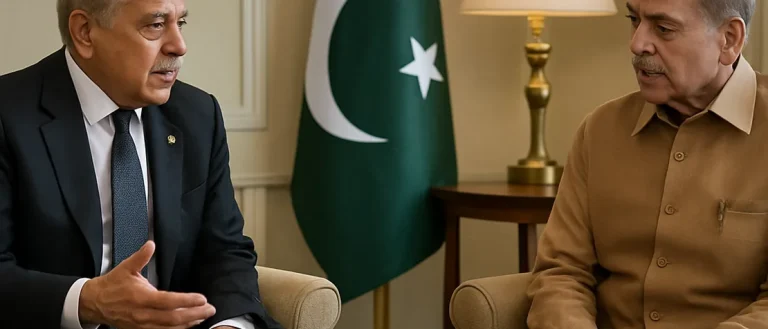



Deputy Prime Minister and Foreign Minister Ishaq Dar announced on Friday that more than six countries have shown interest in joining the Makkah Joint Defence Agreement. Speaking at a press conference in Islamabad, he emphasized that the pact is purely defensive and not designed for offensive operations.
Pakistan, Saudi Arabia, and Turkiye signed the Makkah Joint Defence Agreement on August 7, shortly before Yemen’s Houthi militants launched attacks on Saudi Arabia. The pact, later named the Makkah Defence Alliance, operates similarly to NATO’s Article 5, declaring that an attack on any one member will be considered an attack on all three nations.
Dar revealed that the first meeting under this agreement took place on August 31, with the alliance’s headquarters set to be established in Saudi Arabia. Pakistan has nominated Lieutenant General (retired) Nauman Mahmood as the inaugural secretary general of the Makkah Defence Alliance, describing him as a highly capable and devout officer.
In a significant development, Dar announced that an emergency meeting will be convened next week to assess the latest security situation in Saudi Arabia, which has endured 17 to 18 attacks recently. He reaffirmed Pakistan’s commitment to defend Saudi Arabia under the pact, noting that such alliances are permitted under the United Nations Charter. He also pointed out that NATO functions on a comparable principle.
Addressing the strategic Strait of Hormuz, Dar stated that no fees or service charges should be imposed for passage through this vital waterway. He mentioned that Iranian President Masoud Pezeshkian and Foreign Minister Abbas Araghchi are eager to resolve the issue, with all involved parties aiming to maximize their benefits.
Turning to Afghanistan, Dar expressed Pakistan’s goodwill towards the country but stressed the importance of ensuring Afghan territory is not used against Pakistan. He urged Kabul to take action against banned groups such as Tehrik-e-Taliban Pakistan, Balochistan Liberation Army, and Fitna al-Hindustan. Dar also noted that the border with Afghanistan has been closed since October, acknowledging that this has led to the destruction of crops in the border areas.