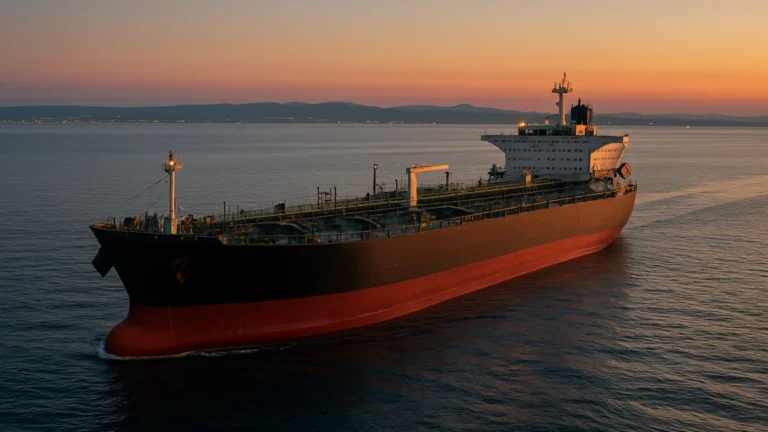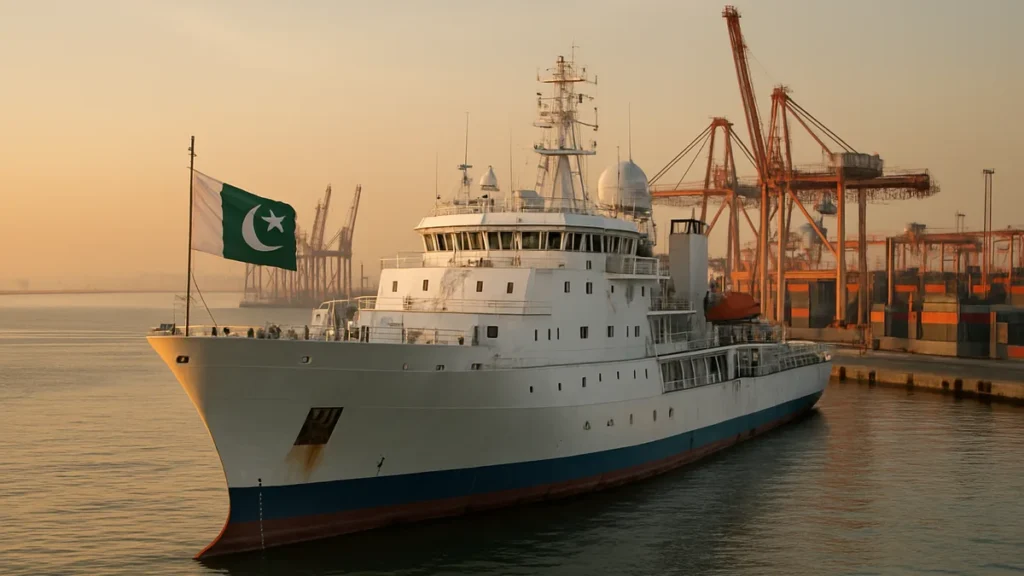
Turkish Energy Minister Alparslan Bayraktar landed in Karachi on Thursday with a delegation representing Turkiye. His visit came ahead of the arrival of the seismic research ship Oruç Reis, which is expected at Karachi port on Friday.
Once in port, the vessel will carry out a survey to judge whether oil and gas deposits exist in Pakistan’s offshore waters. Federal Petroleum Minister Ali Pervaiz Malik, Sindh Minister Zulfikar Ali Shah and Petroleum Secretary Hamid Yaqoob Sheikh received Bayraktar at Karachi airport. Bayraktar and Malik are scheduled to welcome the vessel at the port on Friday.
Oruç Reis to begin offshore survey work
The vessel is built to examine the seabed and gather geological data that can point to likely oil and gas deposits. Its deployment is part of a wider energy partnership between Islamabad and Ankara, and officials see the visit as a sign of growing cooperation in the sector.
Malik said earlier that Pakistan would give full support to Turkiye’s offshore project, which he described as an important milestone in bilateral ties. He also instructed relevant institutions to coordinate closely on security, maritime arrangements and operational needs so that the ship’s arrival and survey would go smoothly. The Turkish Petroleum project manager thanked Pakistani authorities for their cooperation and support.
Officials expect the arrival to open a new chapter in Pakistan’s effort to find offshore oil and gas, which could help the country depend less on imported energy.
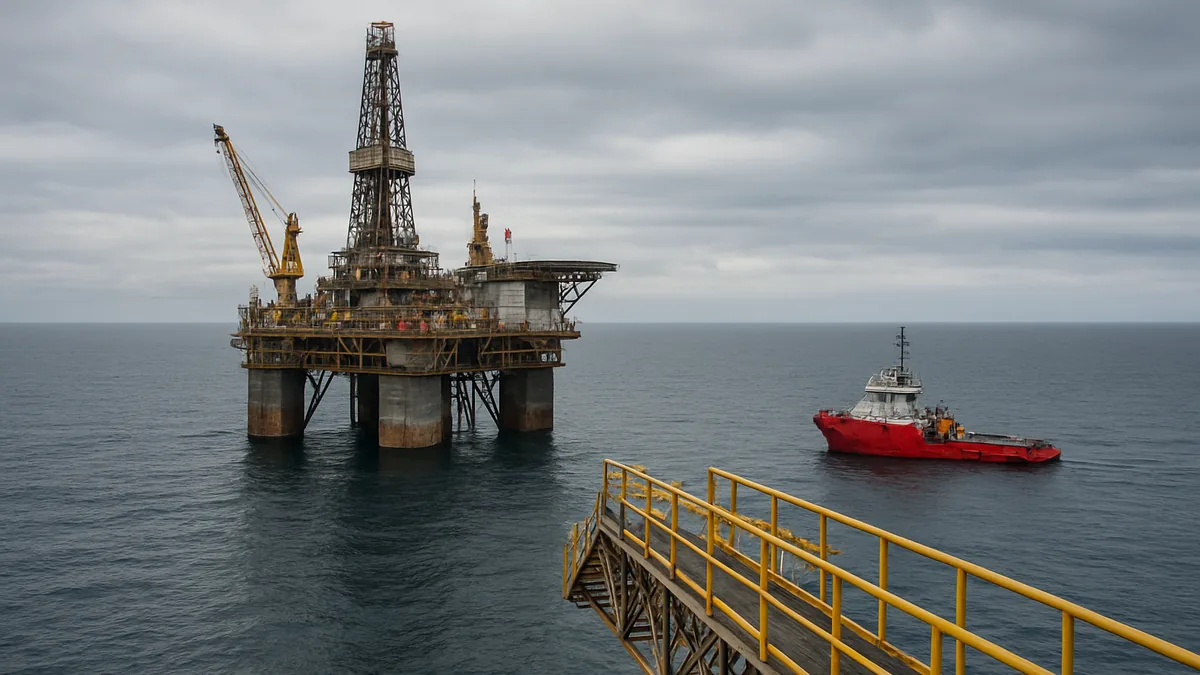
Pakistan’s untapped offshore and onshore resources
Pakistan is trying to restart offshore exploration after almost two decades. An assessment cited in the Petroleum Division’s 2025 investment brochure put the country’s yet-to-find onshore and offshore resources at about 3.585 billion barrels of oil and 66.26 trillion cubic feet of natural gas. These are estimates of undiscovered resources, not proven or commercially recoverable reserves, and only exploration and drilling can establish their real value.
According to an Arif Habib Limited research report based on Pakistan Petroleum Information Service data, existing recoverable reserves stood at roughly 276 million barrels of oil and 20.664 trillion cubic feet of gas by June 2026. The country currently produces around 65,000 barrels of oil and about three billion cubic feet of gas a day. Its gas demand is estimated at around four billion cubic feet daily.
Pakistan spends billions of dollars each year on imported energy, including liquefied natural gas, so developing domestic resources is a key part of its energy security strategy. To attract investment and revive exploration in largely untapped maritime areas, Pakistan recently auctioned offshore exploration blocks for the first time in nearly two decades.
How the Pakistan-Turkiye exploration partnership developed
Pakistan and Turkiye moved toward joint offshore exploration in April 2025, when state-backed and domestic energy companies from both countries agreed to take part together in Pakistan’s offshore bidding round. The government offered 40 offshore blocks in the Indus and Makran basins, the first licensing round of its kind since 2007.
In October 2025, Pakistan awarded 23 of the 40 blocks to four consortia led by domestic exploration companies, with international partners including Turkiye’s state-owned Turkish Petroleum Corporation (TPAO). The successful bids covered about 53,500 square kilometres of offshore territory. The four consortia committed around $80 million for exploration over an initial three-year period, and investment could climb to between $750 million and $1 billion if projects advance to exploratory drilling.
The same month, Pakistan Petroleum Limited agreed to transfer operatorship of Eastern Offshore Indus Block-C to Turkish Petroleum Overseas Company, a wholly owned TPAO subsidiary. Under that arrangement, the Turkish firm received a 25 per cent participating interest, while PPL kept 35 per cent. The Oil and Gas Development Company Limited and MariEnergies each took a 20 per cent stake.
On December 2, 2025, Prime Minister Shehbaz Sharif witnessed the signing of further exploration and production agreements between Turkish Petroleum and Pakistani companies. The deals cover three offshore and two onshore areas and involve MariEnergies, Fatima Petroleum, OGDCL, PPL, Prime Energy and Government Holdings.
Limited drilling record shapes expectations
Pakistan’s offshore drilling history is thin. Reuters reported that only 18 offshore wells have been drilled since independence in 1947. One of the most notable recent efforts, the Kekra-1 well drilled in 2019 by a consortium led by the US energy giant ExxonMobil, did not establish commercially viable hydrocarbon deposits, and ExxonMobil subsequently left Pakistan.
Limited discoveries, investment difficulties and geological risks have all held back offshore work. The partnership with Turkiye is expected to bring international expertise, technology and capital into a sector that has remained largely unexplored.
The seismic survey, however, is only an early step. Its results will help identify promising geological structures, but exploratory drilling will be needed to determine whether commercially viable oil and gas deposits exist. The government hopes the renewed drive will strengthen domestic energy supplies, lower import dependence and draw new international investment into the petroleum sector.