
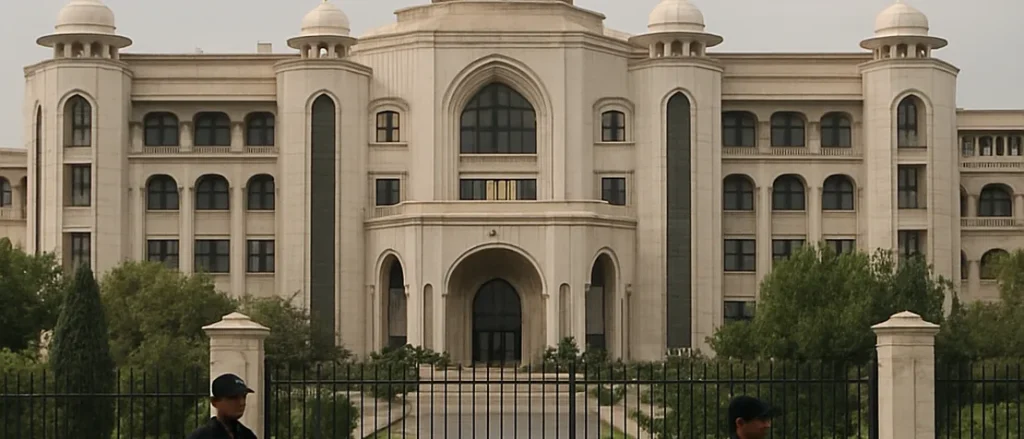

Prime Minister Shehbaz Sharif is scheduled to chair an important meeting at the Prime Minister’s House on Saturday as the federal government evaluates constitutional options for Khyber Pakhtunkhwa (KP), including the possible imposition of emergency rule or governor’s rule. The meeting will also focus on reviewing the province’s current security situation.
The gathering is expected to bring together key stakeholders to examine reports from security agencies and assess the legal and administrative measures available to the federal government amid rising tensions with the Pakistan Tehreek-e-Insaf (PTI)-led provincial administration. Among the proposals under consideration is the imposition of emergency in 12 districts of KP, including all the merged districts formerly known as the Federally Administered Tribal Areas (FATA).
These proposed steps aim to safeguard the lives and property of citizens and could involve the federal government exercising enhanced powers within the province. The meeting will also review constitutional provisions related to emergency measures and provincial administration. While important decisions may be made following consultations, no final announcements are expected before the meeting concludes.
The constitutional debate centers on Articles 232 and 234. Article 232 allows for the proclamation of an emergency in cases of war, external aggression, or internal disturbances threatening the security of Pakistan or parts of it. Article 234 provides for federal intervention if a provincial government cannot function the Constitution. Each article has distinct legal criteria and procedures, and any action must comply with these constitutional requirements. The government has not publicly declared any intention to impose such measures.
The consultations come amid PTI’s ongoing long march towards Islamabad, led by KP Chief Minister Sohail Afridi, which has intensified the political standoff between the federal and provincial governments. The march entered its sixth day on Friday, having started on October 4 after failed negotiations between the government and PTI to prevent the protest. PTI demands the release of its founder, Imran Khan, while the federal government has expressed concerns about security and the provincial administration’s cooperation in counterterrorism efforts.
Discussions about emergency measures or governor’s rule have been ongoing among senior government officials. On October 4, Interior Minister Mohsin Naqvi met with KP Governor Faisal Karim Kundi in Peshawar to discuss the province’s law and order situation and developments related to the march. A statement from the Governor House expressed concern about the possibility of terrorists crossing security checkpoints during the protest and affirmed that the governor’s office would fulfill its constitutional role if the president and prime minister deemed emergency measures or governor’s rule necessary.
Governor Kundi later stated that such measures would be imposed if deemed essential by the president and prime minister to protect the province amid the security challenges. He also defended his decision to convene meetings on law and order despite objections from the provincial government.
Earlier on Friday, Pakistan People’s Party (PPP) Chairman Bilawal Bhutto Zardari said the federal government was prepared to impose governor’s rule or emergency in KP but that his party urged the Centre to consider these as last-resort options and instead pursue negotiations. Speaking at a ceremony in Karachi, Bilawal emphasized that the PPP opposed governor’s rule or emergency and favored resolving the political dispute through dialogue.
He noted that the federal government had been in contact with President Asif Ali Zardari and the PPP regarding the security situation, especially in KP, and suggested that the situation might have worsened without the PPP’s push for a political solution. Bilawal criticized the PTI-led provincial government for prioritizing confrontational politics over public welfare and undermining negotiation efforts. He warned that if Chief Minister Afridi continued to obstruct talks, responsibility for any future imposition of governor’s rule or emergency would lie with him. Bilawal also questioned why Afridi would risk his government’s future by resisting dialogue.
Governor Kundi, meanwhile, vowed to continue holding security meetings and challenged PTI marchers to cross Swabi, describing the protest as a “circus.” At a press conference at the Governor House, he defended his decision to meet with the chief secretary and police chief to review law and order, stating that someone needed to take responsibility while the chief minister was engaged with the long march. His remarks came after Afridi criticized the governor’s meetings as unconstitutional. Kundi maintained that these meetings were necessary to assess security and that he would continue fulfilling his duties.
The upcoming meeting at the Prime Minister’s House is expected to focus on the federal government’s security assessment and constitutional options. However, it remains uncertain whether these consultations will result in an emergency declaration, governor’s rule, or continued efforts to resolve the standoff through political dialogue.