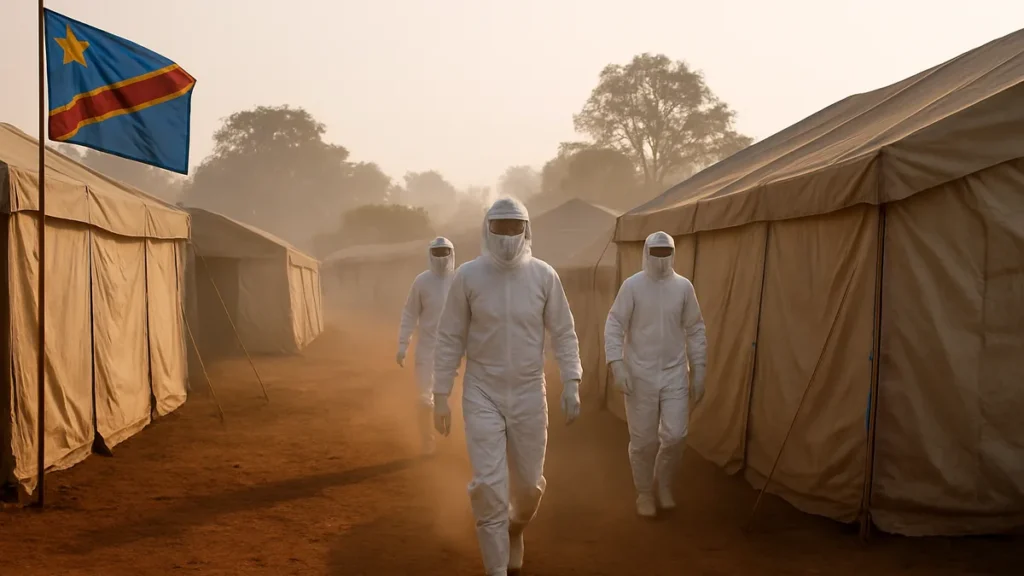
The continent’s leading health body says the Ebola outbreak in the Democratic Republic of the Congo remains uncontrolled half a year after its declaration. Jean Kaseya, director-general of the Africa Centres for Disease Control and Prevention (Africa CDC), made the comments in an interview on Sunday.
Kaseya warned that if the outbreak is not halted soon, it could become the most severe Ebola event the world has faced. According to government data, more than 11,200 cases and 5,500 deaths have been recorded since the outbreak was announced on May 15.
Cases spreading beyond contact lists and clinics
Kaseya said more than 80 percent of new cases appear outside known contact lists. He added that over 65 percent of deaths have taken place in the community, away from health centres.
Also read: DR Congo Ebola Cases Surpass 11,000 as Deaths Reach 5,387 · Millions in Ebola aid going missing in DR Congo, MSF warns
Infections have now been reported in East, Central and West Africa, which gives the outbreak the widest geographic reach of any Ebola outbreak on the continent so far. Eight of the DRC’s 26 provinces are affected.
Delayed detection, conflict and strained health services have allowed the virus to move faster than in earlier outbreaks, officials said.
Rare Bundibugyo strain complicates containment
The outbreak is caused by the Bundibugyo strain of the Ebola virus, which is rare and can trigger haemorrhagic fever. No vaccine or treatment has yet been developed specifically for this strain, which kills about half of those it infects.
The outbreak is the second-largest and second-deadliest Ebola outbreak on record. Only the 2014-2016 West African epidemic was bigger, infecting more than 28,600 people and killing more than 11,000.
Funding gaps and coordination problems with donors
Kaseya described poor coordination between the DRC and its donors as “a collective failure.” Of the $2.9bn donors pledged to fight Ebola, only $1.3bn has been released, he said.
He stressed that blame was not the goal, saying Africa CDC was working closely with Kinshasa to prevent money being wasted through duplication. He also said the DRC was moving to digitise payments for health workers who had gone months without pay.
Vaccine trials and recoveries reported
Earlier this month, the World Health Organization (WHO) approved clinical trials of two new Ebola vaccines and expects results in early 2027. WHO Director-General Tedros Adhanom Ghebreyesus wrote on X that transmission is slowing in several early epicentres.
The WHO also said at least 3,000 people who had Ebola virus disease in the DRC have recovered and returned home.