



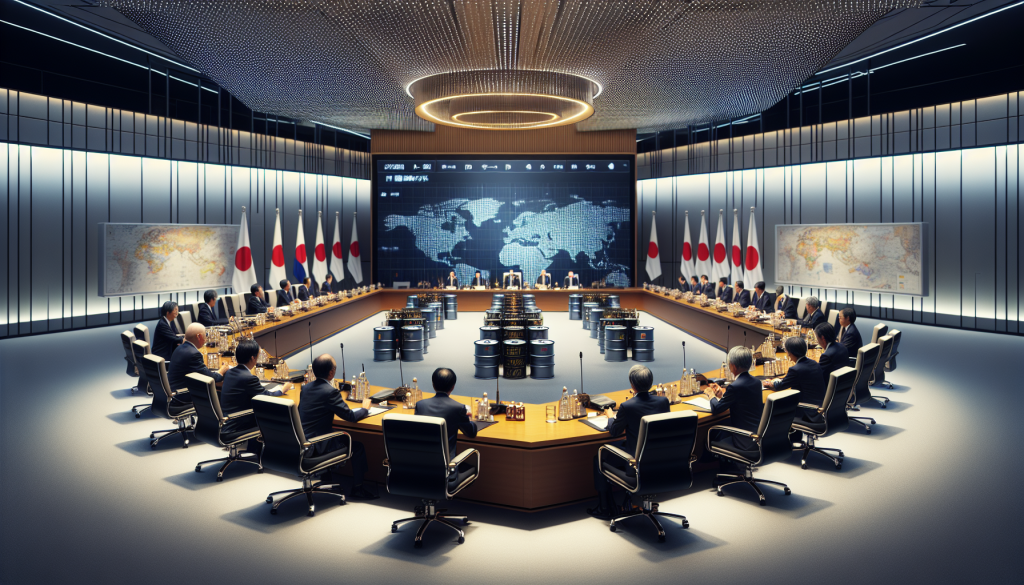
Indonesia’s president visited Tokyo this week as part of Asia’s growing efforts to barter fuel and mitigate severe shortages caused by the ongoing conflict in the Middle East, a crucial source of the region’s energy. The urgency to find alternatives has escalated, especially after China, the world’s second-largest economy, imposed bans on fuel exports. Meanwhile, countries like South Korea and Thailand are attempting to leverage the recent lifting of U.S. sanctions on Russian energy as a temporary solution.
The situation is becoming increasingly dire for less affluent nations. The Philippines has declared a national energy emergency, Sri Lanka has reduced its workweek to four days while rationing fuel, and Myanmar has restricted car usage to alternate days. Indonesia, Southeast Asia’s largest economy and the world’s fourth most populous country, is also expected to announce energy restrictions soon.
“Maintaining rational economic relationships is critically important,” President Prabowo Subianto stated to Japanese business leaders in Tokyo following agreements signed on Monday involving long-term oil, gas, and geothermal power projects. He emphasized that the geopolitical instability in the Middle East creates strategic uncertainty regarding energy security.
In the short term, Jakarta may finalize a deal to increase liquefied natural gas supplies to Tokyo in exchange for liquefied petroleum gas, a vital cooking fuel, said Djoko Siswanto, head of Indonesia’s oil and gas regulator SKK Migas. Although Prabowo and Japan’s Sanae Takaichi agreed to strengthen cooperation on energy security during their Tuesday meeting, neither confirmed the swap arrangement.
Japan’s government-backed oil and gas company Inpex is reportedly negotiating a similar barter deal with India, exchanging LPG for naphtha and crude oil, based on an internal Japanese government document. Vietnam has also sought Japan’s assistance for energy supplies, while the Philippines recently received diesel shipments from Tokyo. Japan’s trade minister highlighted the importance of maintaining fuel supplies to Southeast Asian countries with which it has supply chains but refrained from commenting on specific agreements.
Japan, which depends on the Middle East for approximately 95% of its oil and 11% of its liquefied natural gas imports, holds one of the world’s largest energy stockpiles despite its resource scarcity.
Australia’s role as a major energy producer and exporter positions it as a key player in negotiations with Asian partners for jet fuel supplies, which are at risk of depletion, analysts noted. The Australian government is engaging with major suppliers such as China, Singapore, and South Korea, Foreign Minister Penny Wong stated this month.
However, China’s ban on refined fuel exports, including jet fuel, to protect its economy from energy disruptions, along with a similar ban by Thailand, has severely impacted Vietnam, which relies on these neighbors for over 60% of its jet fuel. Vietnam’s aviation regulator has urged authorities to secure additional jet fuel from Brunei, India, Japan, and South Korea.
While bilateral agreements with alternative suppliers may alleviate shortages, experts warn that a prolonged crisis would require coordinated multilateral efforts. Hiroshi Hashimoto, senior fellow at Japan’s Institute of Energy Economics, suggested that Asian countries might need to develop frameworks to support each other and explore alternative supply sources if the conflict continues.
Russia could emerge as an unlikely energy supplier for some Asian nations following the U.S. granting a temporary waiver on sanctions related to the Ukraine conflict. South Korea recently imported Russian naphtha, a key raw material for plastics used in various industries, and is seeking crude oil supplies, its energy ministry. India has increased its oil purchases from Russia, with Bangladesh, Thailand, and Sri Lanka also in discussions.
However, finalizing deals with Russian oil companies before the U.S. sanctions waiver expires on April 11 remains challenging, noted Janaka Rajakaruna, chairman of Sri Lanka’s state-run Ceylon Petroleum Corporation.
Smaller countries like New Zealand are acutely aware of their vulnerability amid the intensifying fuel scramble expected in the coming months. Prime Minister Christopher Luxon has recently held phone talks with leaders from Singapore, Malaysia, and South Korea—New Zealand’s largest refined product suppliers—as well as with the head of the European Commission.
Associate Energy Minister Shane Jones has also reached out to major commodity traders and other stakeholders to secure fuel supplies. He warned, “Unless options are developed, our small size means we risk being overlooked in the frenzied search for fuel in the next two to three months.”

Leave an opinion