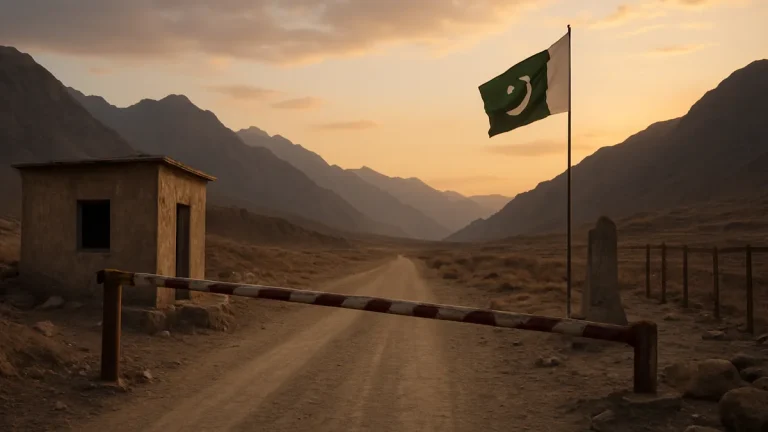
TAFTAN: In the wake of missile strikes launched by the United States and Israel over the weekend, Pakistani nationals residing in Iran hurriedly crossed into Pakistan, carrying their belongings and recounting scenes of chaos and fear. The remote border crossing between Iran’s Mirjaveh and Pakistan’s Taftan in Balochistan province has become a focal point for those seeking safety, with a continuous flow of people passing through the large metal gates amid heightened tensions.
Since Saturday, powerful explosions have reverberated through Tehran, Iran’s capital, prompting embassies from various countries to advise their citizens to evacuate immediately. The atmosphere in Tehran quickly deteriorated as missile attacks intensified, leading to widespread panic among foreign nationals, including Pakistanis. Ameer Muhammad, a 38-year-old trader, described the situation as overwhelming, explaining that many Pakistanis who had been living in Tehran and other Iranian cities rushed to leave simultaneously, resulting in severe congestion at the border terminal.
“All our Pakistani brothers who were in Tehran and other cities had started to leave and were arriving at the terminal, which caused a lot of crowd pressure,” Muhammad said. He added that the surge of people created significant transportation challenges, making it difficult for many to find timely means of travel out of the country. The Taftan border crossing, situated roughly 500 kilometers from Quetta, the capital of Balochistan, is a crucial gateway for those fleeing the unrest.
Journalists on the ground observed the Iranian flag flying at half-mast near the border, with armed soldiers maintaining a vigilant presence. The scene was marked by a steady stream of individuals pushing large suitcases across the foot crossing, while freight trucks queued up in long lines, waiting to cross into Pakistan. The tense environment underscored the gravity of the situation unfolding just across the border.
Among those who escaped was Irshad Ahmed, a 49-year-old pilgrim who had been staying in a hostel in Tehran when the missile strikes began. He recounted witnessing missiles being launched near an army base close to his accommodation. “There was an army base near the hostel, and we saw many missiles being fired,” Ahmed recalled. Following the attacks, he and others sought assistance from the Pakistani embassy in Tehran, which facilitated their safe evacuation to Pakistan.
On the political front, Prime Minister Shehbaz Sharif condemned the killing of Iran’s Supreme Leader, Ayatollah Ali Khamenei, calling it a breach of international law. He emphasized that targeting heads of state or government is a long-standing violation of diplomatic norms. Expressing solidarity with the Iranian people, Sharif extended Pakistan’s condolences on the loss of Khamenei, highlighting the shared grief between the two nations during this difficult time.
Meanwhile, Saqib, a teacher working at the Pakistani embassy in Tehran, described the situation prior to the missile strikes as relatively stable. However, the attacks on Saturday night drastically changed the circumstances, forcing embassy staff and Pakistani nationals to evacuate. “Before we left, the situation was normal. The situation was not that bad,” he said. “The situation became bad on Saturday night, when attacks caused precious lives to be lost.” His account reflects the sudden escalation of violence that compelled many Pakistanis to abandon their homes and seek refuge across the border.