



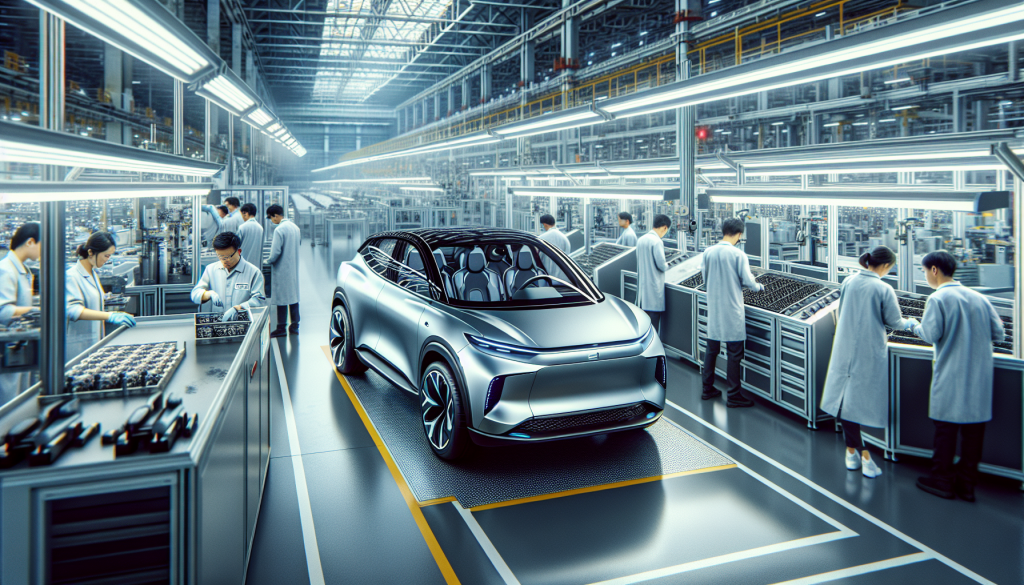
Tesla is working on a new compact and more affordable electric SUV, with recent supplier discussions focusing on manufacturing processes and component specifications. This vehicle will be a completely new model, distinct from Tesla’s existing Model 3 and Model Y, insiders. The compact SUV is expected to measure approximately 4.28 meters (around 14 feet) in length, notably shorter than the Model Y’s 15.7 feet.
Production is anticipated to take place primarily at Tesla’s Shanghai factory, with plans to potentially expand manufacturing to the United States and Europe. However, the project remains in early development stages, and no official production approval has been confirmed. The timing for the vehicle’s launch is uncertain, with production unlikely to begin within this year.
This initiative follows CEO Elon Musk’s decision to halt a previously planned low-cost electric vehicle project in 2024, as Tesla shifted focus toward robotaxis and humanoid robots. A key question is whether this new compact SUV signals a return to mass-market human-driven EVs or aligns more closely with Tesla’s autonomous vehicle ambitions. One insider suggested the model could serve both purposes, offering options for fully autonomous driving as well as traditional human control.
A Tesla employee noted that while the company aims for full autonomy across its lineup, many global markets may not adopt or approve driverless vehicles for years. Offering a model that can be driven manually or autonomously could increase sales potential and help maintain factory utilization.
Analysts predict Tesla may face a third consecutive year of declining sales in traditional EVs, which currently generate most of the company’s revenue. Tesla’s robotaxi operations remain limited, with a small fleet in Austin, Texas, all monitored by human safety drivers.
The new compact SUV is expected to be priced significantly below Tesla’s entry-level Model 3, which starts at $34,000 in China and about $37,000 in the US. Cost savings will come from a smaller battery, resulting in a reduced driving range compared to the Model Y’s 306 to 327 miles. Additionally, the vehicle will likely feature a single electric motor rather than the dual-motor setup found in current performance models. The car is also expected to be lighter, weighing around 1.5 metric tons compared to the Model Y’s roughly two tons.
Tesla has a history of announcing ambitious projects that face delays or cancellations. For example, concept vehicles like the Roadster supercar and Semi freight truck were unveiled in 2017 but have yet to reach mass production.
Since its founding in 2008, Tesla’s mission has been to produce affordable, mass-market electric vehicles to combat climate change. CEO Musk once aimed for Tesla to sell 20 million vehicles annually by 2030, nearly doubling Toyota’s current global sales. The much-anticipated $25,000 EV, often dubbed the “Model 2,” was expected to drive this growth but was abandoned in 2024 in favor of focusing on robotaxis.
Following the cancellation, Musk described making a $25,000 human-driven EV as “pointless” and “silly,” emphasizing the company’s commitment to autonomous vehicles. A former Tesla manager noted that developing a new affordable traditional car would mark a significant shift from Tesla’s strategy through mid-2025, which prioritized robotaxis to reduce costs per mile.
When Tesla introduced new “standard” trims of the Model 3 and Model Y last fall, these versions were only modestly cheaper and stripped-down, with US prices of $36,990 and $39,990 respectively. These price points have not significantly boosted Tesla’s sales or attracted a broader buyer base.
Meanwhile, Tesla continues to highlight its robotaxi and humanoid robot projects, which have helped maintain its market valuation near $1.3 trillion—far exceeding its financial fundamentals. Last year, investors approved a compensation package potentially worth up to $1 trillion in Tesla stock for Musk, tied to product and financial milestones.
The company plans to begin production this month of the two-door Cybercab robotaxi, a concept vehicle unveiled in 2024 that lacks pedals and a steering wheel. However, the timeline for its commercial release or deployment in a Tesla-operated robotaxi fleet remains unclear. Notably, Tesla has not yet applied for a federal exemption required to sell a vehicle without traditional driving controls, the National Highway Traffic Safety Administration.

Leave an opinion