

Pakistan reaffirmed its dedication to safeguarding Saudi Arabia’s sovereignty, territorial integrity, and security, while firmly rejecting reports that Pakistani fighter jets participated in cross-border strikes targeting Houthi forces in Yemen. This was stated during a weekly press briefing by the Foreign Office Spokesperson, Ambassador Sajjad Haider Khan.
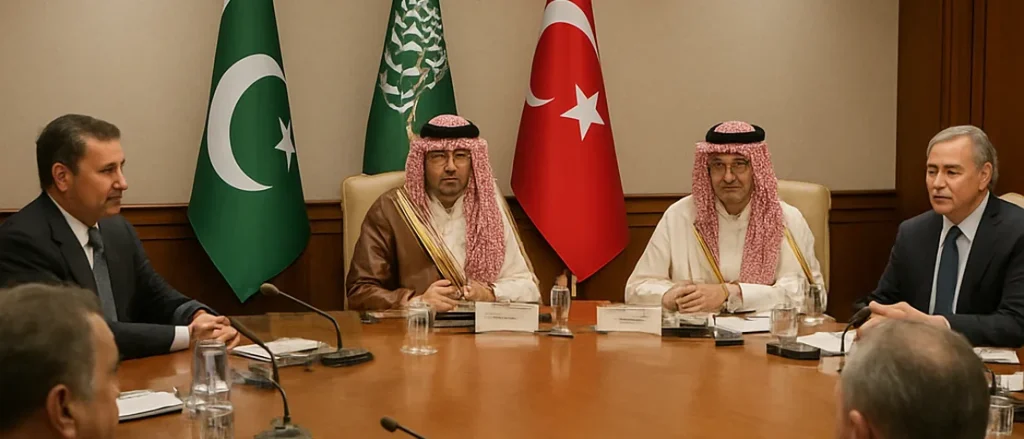
He explained that the Makkah alliance is a defensive pact designed to protect the sovereignty and territorial integrity of its member states and to enhance their collective deterrence capabilities. Referring to the emergency meeting of the Strategic Political and Defence Committee of the Makkah Joint Defence Agreement held in Riyadh on October 5, Khan noted that Pakistan, Saudi Arabia, and Turkiye agreed to advance the practical implementation of their collective defence commitments.
Pakistan was represented at the meeting by Deputy Prime Minister and Foreign Minister Senator Mohammad Ishaq Dar, Defence Minister Khawaja Muhammad Asif, and Chief of Army Staff and Chief of Defence Forces Field Marshal Syed Asim Munir. The committee reviewed the security situation and threats facing Saudi Arabia, condemning attempts to target the holy cities of Makkah and Madinah, as well as attacks on urban centers, civilians, and economic infrastructure.
The three countries approved measures to boost readiness, military integration, and their collective ability to respond to security threats. Khan clarified that the alliance’s purpose is to defend member countries against aggression, emphasizing that Pakistani forces would not cross into Yemen to attack Houthi forces but could be deployed to defend Saudi territory and uphold its sovereignty.
He highlighted that Pakistan maintains a significant military presence and resources in Saudi Arabia and that the alliance will continue to assess threat perceptions and determine operational needs its mandate. The spokesperson dismissed rumors about Pakistani fighter jets participating in airstrikes against the Houthis as unfounded.
Addressing Pakistan’s military presence in Saudi Arabia, Khan stated that Pakistani armed forces have been stationed in the Kingdom in various roles since 1982, including logistical support and training missions. Any further deployments will be based on operational requirements and decisions made by the alliance’s headquarters.
Khan expressed Pakistan’s concern over the escalating regional tensions, especially given that around 2.5 million Pakistanis live in Saudi Arabia. He underscored that the security situation could jeopardize the safety of Pakistani nationals and reiterated Islamabad’s commitment to their welfare. Pakistan has consistently advocated for de-escalation, dialogue, and diplomacy, while maintaining its commitment to protecting Saudi Arabia’s sovereignty.
On diplomatic efforts, Khan said Pakistan continues to support political dialogue aimed at reducing tensions between the United States and Iran. He noted that direct communication between the two countries, including discussions on seven key points, reflects progress achieved through Pakistan’s mediation. The Islamabad Memorandum of Understanding remains active, and Pakistan is prepared to continue facilitating a negotiated solution if necessary. He emphasized that diplomacy is crucial for regional peace and stability, though its success depends on the willingness of the involved parties to pursue peaceful resolutions.
Separately, Khan reported that Pakistan raised concerns about terrorism originating from Afghan territory during the eighth meeting of the Moscow Format Consultations on Afghanistan, held in Moscow on October 5. Pakistan participated constructively, but no joint statement was issued because the Afghan Taliban delegation did not agree to retain previously agreed language on terrorism. He stressed that terrorism emanating from Afghanistan poses a serious security threat to neighboring countries, particularly Pakistan, and stated that the absence of a joint statement should not diminish the importance of ongoing regional dialogue.
The spokesperson also reiterated Pakistan’s stance on the Jammu and Kashmir dispute, describing it as unresolved and requiring a settlement in line with relevant United Nations Security Council resolutions and the aspirations of the Kashmiri people. He welcomed recent remarks by the UN Secretary-General regarding the role of the United Nations Military Observer Group in India and Pakistan (UNMOGIP), calling for its strengthened presence and role alongside efforts for a just resolution of the conflict.
Khan further disclosed that Pakistan lodged a strong protest with India following the killing of two Pakistani civilians by Indian Border Security Force personnel in the Bedian sector along the international border on October 2. Pakistan demanded an immediate, transparent, and credible investigation and appropriate action against those responsible.
Additionally, he reported that four injured Pakistani crew members of MT Honour 25, along with the mortal remains of three Pakistani nationals, were repatriated from Addis Ababa to Karachi on October 4. The remaining three crew members returned on October 7, with Pakistani missions facilitating their safe return.