

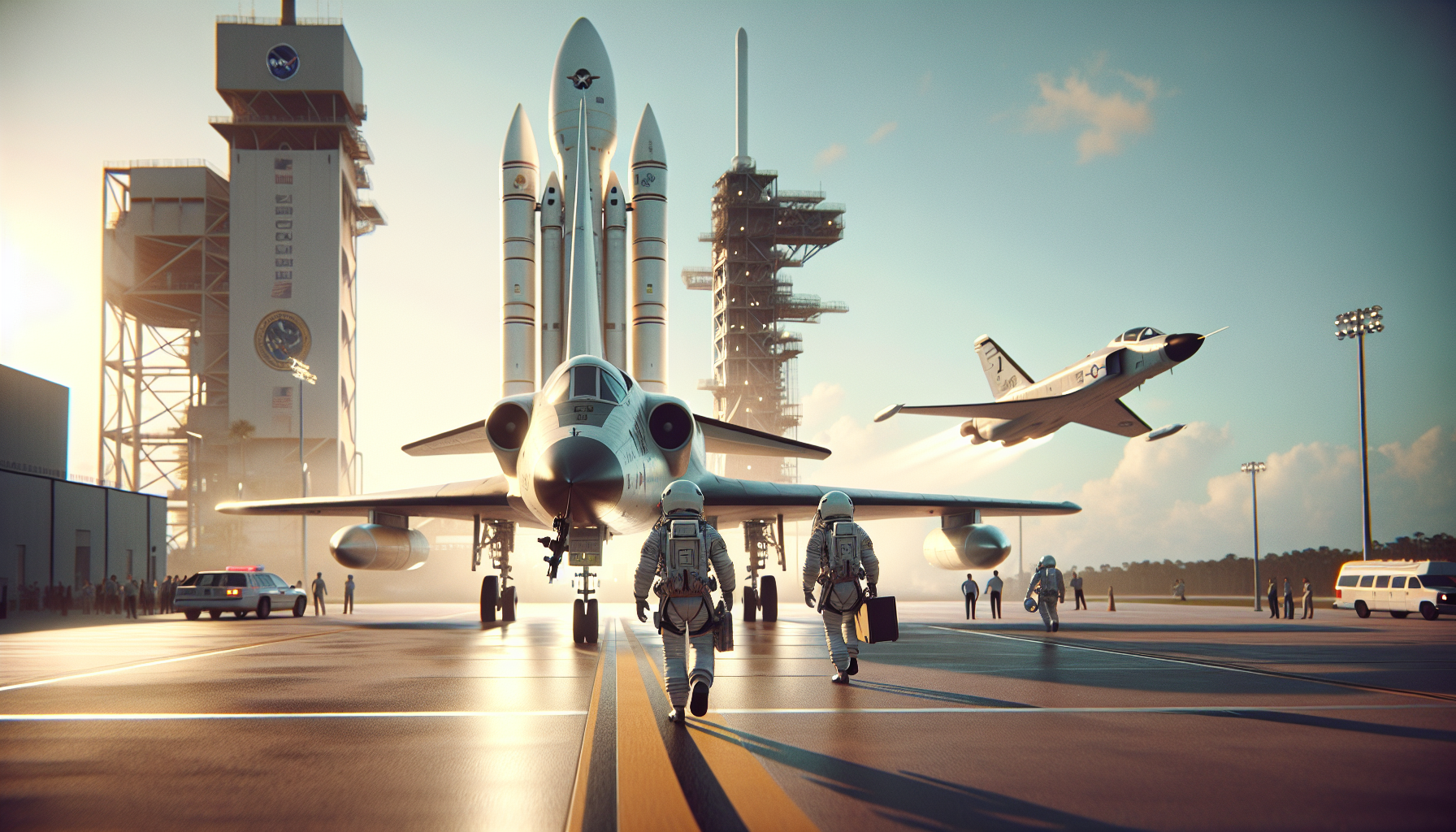
Four astronauts designated for NASA’s Artemis II mission arrived in Florida on Friday, marking the start of their final preparations for the first human journey to the Moon in more than five decades. The team, consisting of NASA astronauts Reid Wiseman, Victor Glover, Christina Koch, and Canadian Space Agency astronaut Jeremy Hansen, flew from Houston, Texas, to the Kennedy Space Center in Northrop T-38 jets.
They are set to launch as early as April 1 aboard NASA’s formidable Space Launch System (SLS) rocket. The crew will travel inside an Orion capsule designed for deep space missions. This approximately 10-day expedition will involve a rapid orbit around the Moon before returning to Earth.
Mission commander Wiseman expressed excitement upon arrival, stating that the world has eagerly awaited this milestone. He emphasized the extensive preparation involved and appreciated the warm Florida climate as they begin this final mission phase.
Artemis II represents the first crewed flight in NASA’s multi-billion-dollar Artemis program. Although it will not attempt a lunar landing, the mission will send astronauts farther from Earth than any previous human spaceflight. It aims to test Orion’s life-support systems, navigation, communications, and heat shield capabilities.
Key contractors include Boeing, responsible for the SLS core stage; Northrop Grumman, which builds the rocket’s solid-fuel boosters; and Lockheed Martin, the manufacturer of the Orion spacecraft. Since their selection in 2023, the crew has undergone over two years of rigorous training.
Since March 18, the astronauts have been in preflight quarantine at NASA’s Johnson Space Center in Houston and will soon relocate to the Astronaut Crew Quarters in Florida ahead of the launch.
Notably, pilot Victor Glover will become the first Black astronaut to travel near the Moon, while Koch will be the first woman to achieve this milestone. Hansen will be the first non-American astronaut to venture beyond low Earth orbit. Except for Hansen, all crew members have previous spaceflight experience.
Last year, Wiseman remarked on the crew’s readiness for any outcome, including the possibility of returning to Earth immediately, spending days orbiting Earth, or continuing to the Moon, underscoring the mission’s test nature.
The crew members bring extensive experience: Wiseman, 50, logged 165 days aboard the International Space Station (ISS) during a 2014 mission launched via Russian Soyuz and has served as NASA’s chief astronaut. Glover, 49, spent 168 days in space starting in 2020 as pilot of NASA’s Crew-1 mission on the SpaceX Crew Dragon. His Navy career included combat and test pilot roles.
Koch, 47, holds the record for the longest continuous spaceflight by a woman, spending 328 days aboard the ISS in 2019. She is trained in electrical engineering and physics and has conducted extended research expeditions in Antarctica. Hansen, 50, embarking on his first spaceflight, has been a Canadian astronaut since 2009, symbolizing the strong U.S.-Canadian collaboration in human spaceflight and robotic contributions to the ISS.
In a significant development, NASA plans further Artemis missions aimed at establishing a sustainable human presence on the Moon and paving the way for crewed missions to Mars in the future.
