



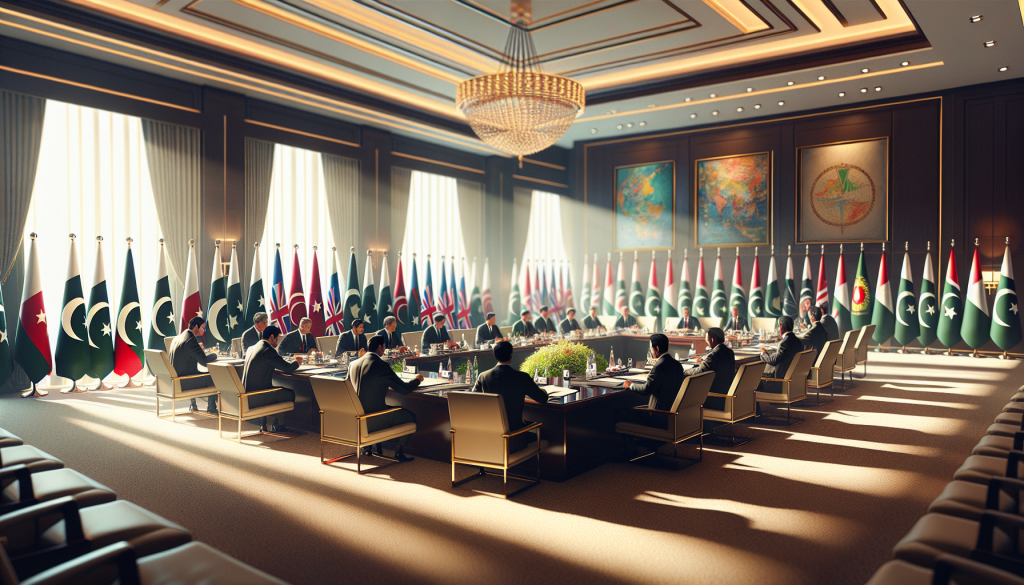
Deputy Prime Minister and Foreign Minister Ishaq Dar emphasized the necessity for the United States and Iran to honor their ceasefire agreements following the conclusion of intense negotiations held in Islamabad. The trilateral talks, which commenced on Saturday afternoon, lasted nearly 21 hours but ended without a formal agreement.
US Vice President JD Vance, leading the American delegation, stated that despite extensive discussions on critical issues, no consensus was reached. He remarked that the failure to reach an agreement was more detrimental to Iran than to the United States. After the press briefing, Vance left Islamabad with what he described as the “final and best offer” from the US, expressing uncertainty about Iran’s response. He departed at 7:08 a.m., acknowledging Pakistani officials including Deputy Prime Minister Ishaq Dar, Chief of Army Staff and Chief of Defence Forces Field Marshal Asim Munir, and Interior Minister Mohsin Naqvi.
Addressing the outcome, Dar conveyed his gratitude to both delegations for responding to Prime Minister Muhammad Shehbaz Sharif’s call for an immediate regional ceasefire and for accepting the invitation to hold peace talks in Islamabad. He noted that the US delegation was led by Vance, while Iran’s delegation was headed by Speaker of Parliament Bagher Ghalibaf.
Dar highlighted his and Field Marshal Syed Asim Munir’s roles in mediating multiple rounds of intense and constructive negotiations that extended into the early hours of Sunday. On behalf of Pakistan, he expressed appreciation for both parties recognizing Pakistan’s efforts in facilitating the ceasefire and mediation.
He voiced hope that both sides would sustain the positive momentum, stating, “We hope that the two sides continue with the positive spirit to achieve durable peace and prosperity for the entire region and beyond.” Stressing the importance of maintaining commitments, Dar said, “It is imperative that the parties continue to uphold their commitment to ceasefire.”
Reaffirming Pakistan’s ongoing role, Dar assured that Pakistan would continue to support dialogue and engagement between Iran and the US in the forthcoming days.
The conflict originated on February 28 after coordinated US-Israeli strikes targeted Iran’s leadership and infrastructure, resulting in over 2,000 fatalities and significant regional instability. Iran retaliated with operations disrupting shipping through the Strait of Hormuz and attacks on Israeli and US targets.
A ceasefire was declared on April 8, with Pakistan playing a key mediatory role. However, substantial disagreements remain. The US has proposed a 15-point framework addressing nuclear and missile concerns, sanctions relief, and reopening the Strait of Hormuz. Conversely, Iran has offered a 10-point plan seeking increased control over the waterway, transit fees, and comprehensive sanctions removal.
The international community has widely supported Pakistan’s diplomatic efforts aimed at reducing tensions and facilitating negotiations for lasting peace.

Leave an opinion