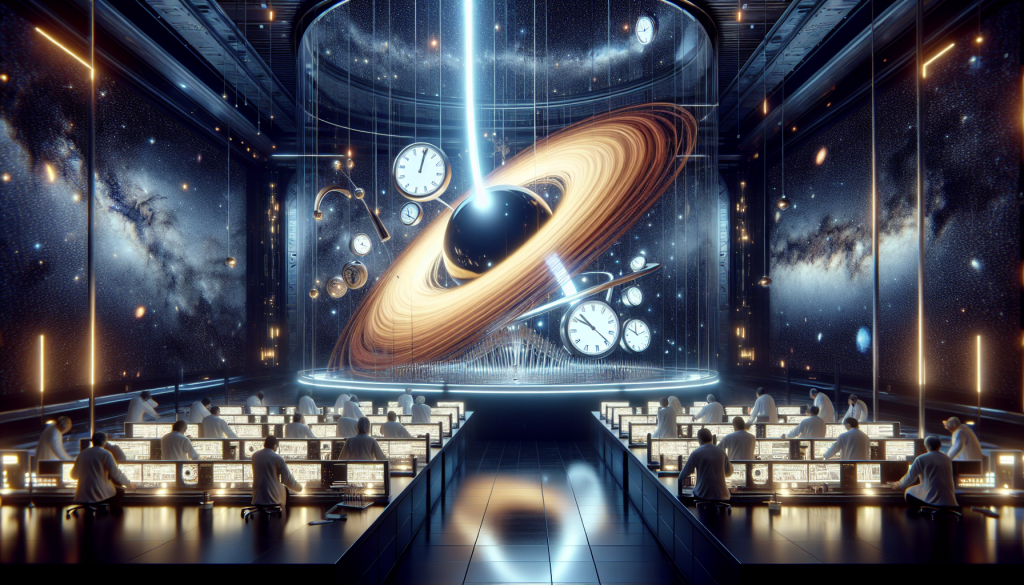
Time travel has long fascinated scientists and the public alike, with Albert Einstein’s theory of relativity providing a crucial framework for understanding its possibilities. Einstein’s theory, developed in the early 20th century, revolutionized physics by introducing the concept that time is not absolute but relative and intertwined with space. This groundbreaking idea laid the foundation for modern physics and opened the door to theoretical discussions about traveling through time.
In a significant development, Einstein’s equations suggest that under certain extreme conditions, such as near black holes or at speeds approaching that of light, time dilation occurs—where time can slow down or speed up relative to an observer. This phenomenon implies that moving forward or backward in time might be theoretically possible, although practical time travel remains beyond current technological capabilities. The theory also challenges our conventional understanding of causality and the linear progression of time.
Meanwhile, the concept of time travel continues to inspire both scientific inquiry and popular culture, influencing everything from theoretical physics research to science fiction narratives. Understanding Einstein’s contributions helps contextualize ongoing debates about the nature of time and the universe. As research advances, the implications of relativity theory remain profound, shaping how humanity perceives the fabric of reality and the potential for future discoveries in the realm of time travel.