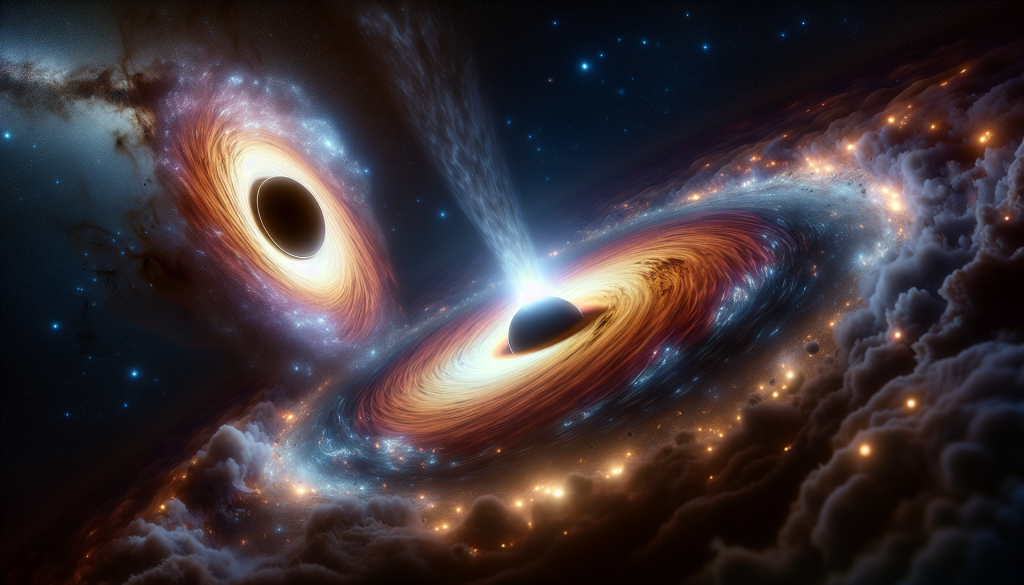
In a significant development in astrophysics, scientists have forecasted that two supermassive black holes will collide within the next century. These colossal cosmic entities, each millions to billions of times the mass of our sun, reside at the centers of distant galaxies. Their impending merger is expected to release an enormous amount of energy, primarily in the form of gravitational waves, rippling through the fabric of spacetime. Such events are rare and provide valuable insights into galaxy evolution and the behavior of gravity under extreme conditions.
Meanwhile, the potential impact of this collision on Earth has become a topic of interest among researchers and the public alike. Despite the immense scale of the event, experts emphasize that the vast distances separating our planet from these black holes will shield Earth from any direct physical effects. However, the detection of gravitational waves from this merger could enhance our understanding of the universe and improve technologies related to space observation and astrophysics.
Notably, this predicted collision underscores the dynamic and ever-changing nature of the cosmos. It also highlights the importance of continued investment in space science and observation tools, such as gravitational wave detectors and powerful telescopes. By studying such extraordinary phenomena, humanity can deepen its comprehension of fundamental physics and the life cycles of galaxies, ultimately enriching our knowledge of the universe we inhabit.