

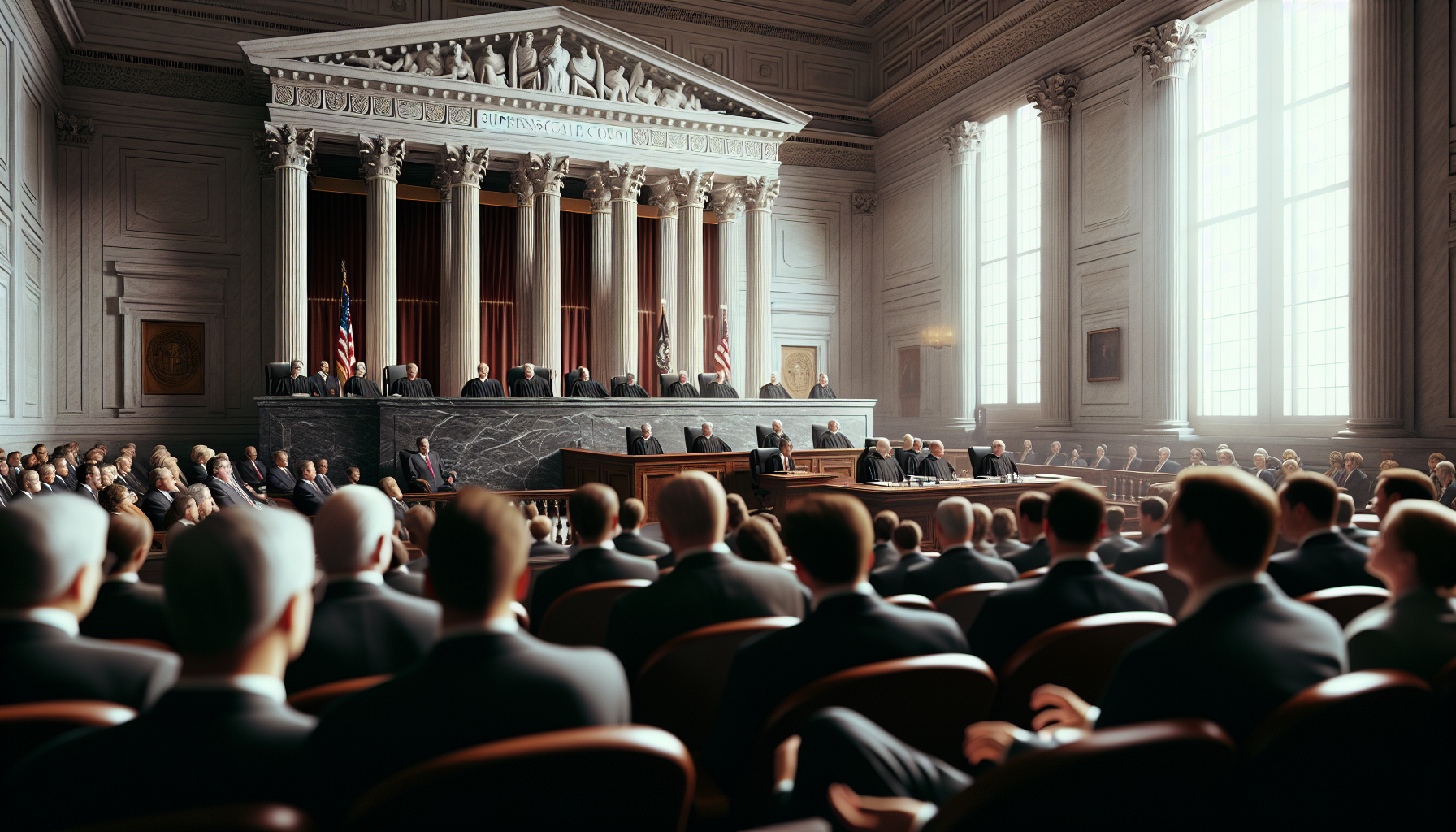
In a rare and historic event, President Donald Trump attended part of the Supreme Court hearing on his administration’s attempt to limit birthright citizenship in the United States. The justices posed rigorous questions about the legality of Trump’s executive order, which challenges a longstanding interpretation of the 14th Amendment’s Citizenship Clause.
Trump, dressed in a dark suit and red tie, arrived at the ornate courtroom by motorcade from the White House and sat in the front row of the public gallery. He departed midway through the session shortly after the government’s attorney finished presenting the administration’s case.
Both conservative and liberal justices scrutinized the Justice Department lawyer defending Trump’s directive, and later questioned the attorney representing the plaintiffs opposing the order. The case stems from a lower court’s injunction blocking Trump’s executive order that directed federal agencies not to recognize as citizens children born in the U.S. if neither parent is a citizen or a lawful permanent resident, commonly known as a green card holder.
Trump is the first sitting president to attend oral arguments at the Supreme Court. He was accompanied by Commerce Secretary Howard Lutnick during his roughly 90-minute visit to the courthouse.
Solicitor General D. John Sauer, representing the administration, argued that unrestricted birthright citizenship is out of step with most modern nations and undermines the value of American citizenship. He claimed it encourages illegal immigration and rewards those who violate immigration laws by prioritizing them over lawful immigrants.
The lower court had ruled that Trump’s directive violates the citizenship provisions of the 14th Amendment and federal law, based on a class-action lawsuit filed by parents and children affected by the order. The Citizenship Clause has traditionally guaranteed citizenship to anyone born on U.S. soil, with limited exceptions such as children of foreign diplomats or enemy forces.
Chief Justice John Roberts, a conservative, questioned Sauer’s interpretation of the phrase “subject to the jurisdiction thereof” in the 14th Amendment, describing it as unusual. Roberts noted that historically, this phrase excluded only narrow categories like children of ambassadors or hostile occupying forces, and questioned how it could be expanded to include all undocumented immigrants.
Liberal Justice Sonia Sotomayor cited historical congressional records from the adoption of the 14th Amendment and the Civil Rights Act of 1866, which she said clearly rejected the administration’s legal theory. She pointed out that lawmakers at the time affirmed that everyone born in the U.S. would be citizens. Sauer countered by asserting there was a common understanding that children of temporary visitors or sojourners did not receive citizenship.
The 14th Amendment, ratified in 1868 after the Civil War, overturned a prior Supreme Court decision that denied citizenship to people of African descent. The administration contends that birthright citizenship has incentivized illegal immigration and given rise to “birth tourism,” where foreign nationals travel to the U.S. to secure citizenship for their children.
Justice Elena Kagan, a liberal, challenged the administration’s reliance on obscure historical sources, stating the 14th Amendment’s text does not support their interpretation. Sauer replied that their view was backed by Illinois Senator Lyman Trumbull, a prominent anti-slavery advocate in the 1860s.
Conservative Justice Brett Kavanaugh questioned the relevance of citing foreign laws, noting that while many countries do not grant birthright citizenship, this may be a policy consideration rather than a constitutional one.
Arguing for the challengers, American Civil Liberties Union attorney Cecillia Wang maintained that Trump’s order is unlawful. She emphasized the widely understood rule that everyone born in the U.S. is a citizen, a principle enshrined in the 14th Amendment to prevent government officials from undermining citizenship rights. Wang warned that altering this clear standard would cause significant legal and social disruption.
Historically, some 19th-century presidents argued cases before the Supreme Court after their terms, including John Quincy Adams, Grover Cleveland, and Benjamin Harrison. William Howard Taft uniquely served as both president and later as the Supreme Court’s chief justice. Outside the courthouse, demonstrators protested Trump’s presence and policies with signs opposing changes to birthright citizenship.
Attorney General Pam Bondi accompanied Trump to the Supreme Court. The president has previously criticized justices he appointed, especially after the court struck down his global tariffs in February, calling some appointees “an embarrassment to their families.”
Restricting birthright citizenship remains a top priority for Trump, who issued the directive on his first day back in office as part of broader immigration enforcement policies. Critics accuse him of racial and religious bias in his immigration stance. The administration argues that being born in the U.S. is insufficient for citizenship without satisfying the “subject to the jurisdiction thereof” requirement, excluding children of undocumented immigrants or those in the country temporarily under visas.
