

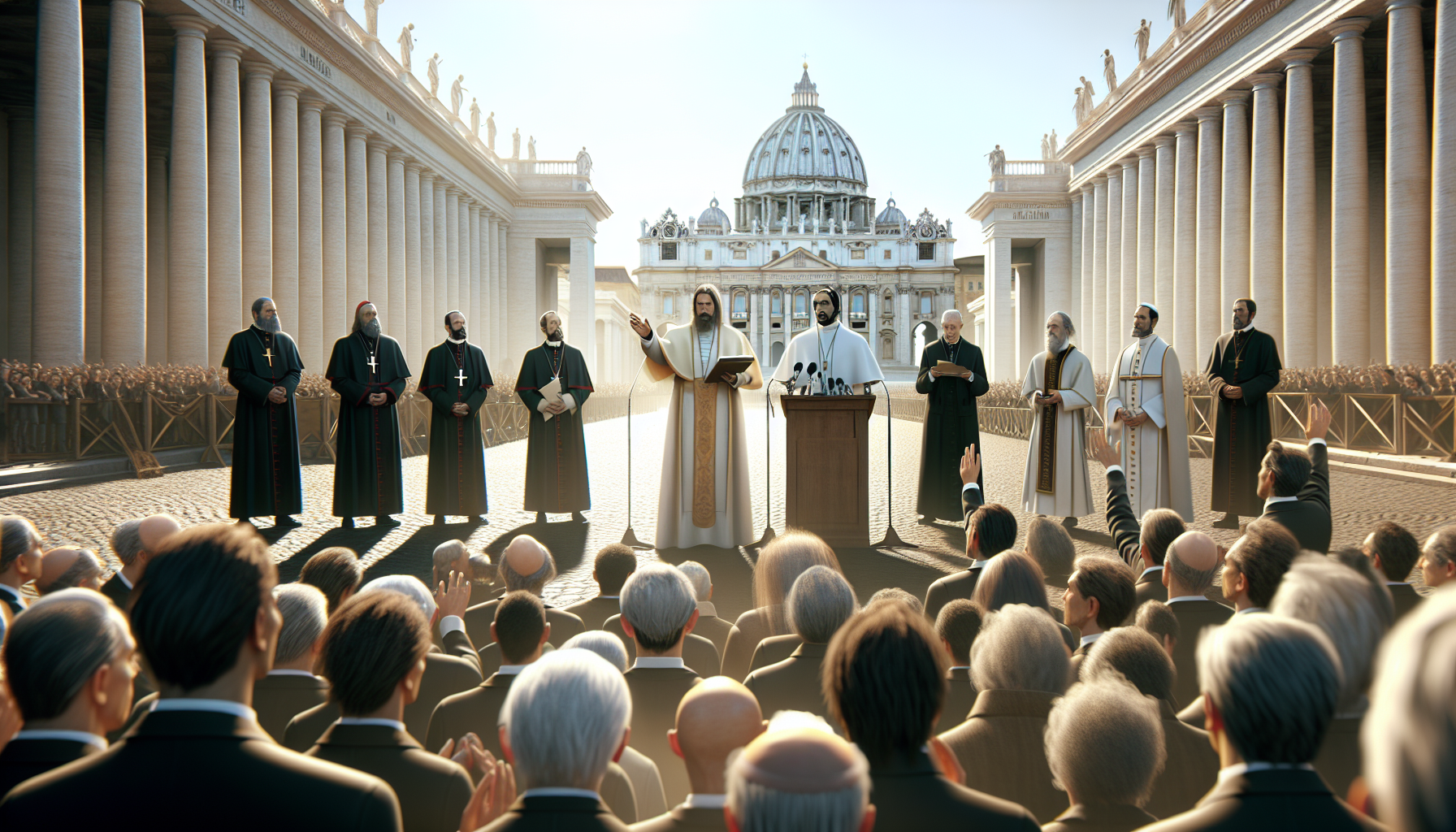
Italian political and religious leaders expressed strong support for Pope Leo on Monday after former U.S. President Donald Trump launched a sharp attack against the pontiff. This confrontation has placed Prime Minister Giorgia Meloni in a challenging position, as she seeks to maintain Italy’s close relationship with the Vatican while managing her political alliance with Trump.
Trump ignited controversy by labeling Pope Leo as “terrible,” prompting a rare direct response from the pope himself. The pontiff declared he harbors “no fear” of the U.S. administration and reaffirmed his commitment to speaking out against the U.S.-led war on Iran and advocating for migrants’ rights. Meloni, who has fostered a close rapport with Trump in recent years, issued a statement supporting the pope as he embarked on a significant four-nation tour of Africa. However, she notably refrained from directly addressing Trump’s criticism.
In her statement, Meloni expressed hope that the Holy Father’s mission would contribute to resolving conflicts and restoring peace both within and between nations. This carefully worded message underscored her backing of the pope without openly condemning the U.S. president.
The absence of a direct rebuke toward Trump was seized upon by Meloni’s political adversaries, who argue that her association with the former U.S. leader is becoming a political liability. Public opinion polls indicate that 66% of Italians hold a negative view of Trump, largely due to his aggressive foreign policies. Angelo Bonelli, a prominent figure in the left-wing AVS party, criticized Meloni sharply, accusing her of failing to denounce Trump’s “unacceptable blasphemy” against the pope and the Catholic community. Bonelli also referenced a subsequent Trump post featuring an AI-generated image of himself as Jesus.
Meanwhile, Deputy Prime Minister Matteo Salvini, who has also aligned himself with Trump in the past, openly criticized the former president’s remarks. Salvini emphasized that Pope Leo is a spiritual leader for billions of Catholics and a tireless advocate for peace. He argued that attacking the pope was neither wise nor constructive, signaling a subtle distancing of Europe’s far-right from the MAGA movement.
The pope’s dual role as the bishop of Rome and spiritual leader to millions of Italian Catholics makes politicians across the spectrum cautious about confronting him. Former centre-left Prime Minister Matteo Renzi described Trump’s attack as an unprecedented act of aggression against the Roman Pontiff. Renzi stressed the importance of defending Pope Leo, both for believers and non-believers, highlighting the pope’s role as a “builder of bridges” in contrast to Trump’s reputation as a “destroyer of relationships and civilization.” He added, “Trumps come and go, popes remain,” echoing an Italian proverb, “chi mangia papa crepa,” meaning “whoever tries to devour the pope dies.” This saying reflects centuries of historical tension between papacies and secular rulers.
Church historian Alberto Melloni reinforced this perspective, noting that Trump’s attack was a grave misstep. Melloni cited the example of Italy’s House of Savoy, which repeatedly clashed with the Vatican but was ultimately swept aside, while the papacy endured. Antonio Spadaro, a Roman Catholic priest and undersecretary of the Vatican’s Dicastery for Culture and Education, interpreted Trump’s criticism as a sign of the pope’s influence. Spadaro wrote on X that if Pope Leo were irrelevant, he would not warrant any response. Instead, the pope’s words provoke opposition, demonstrating the Church’s moral authority—not as a political counterforce, but as a realm where power is measured by standards beyond its control.
