

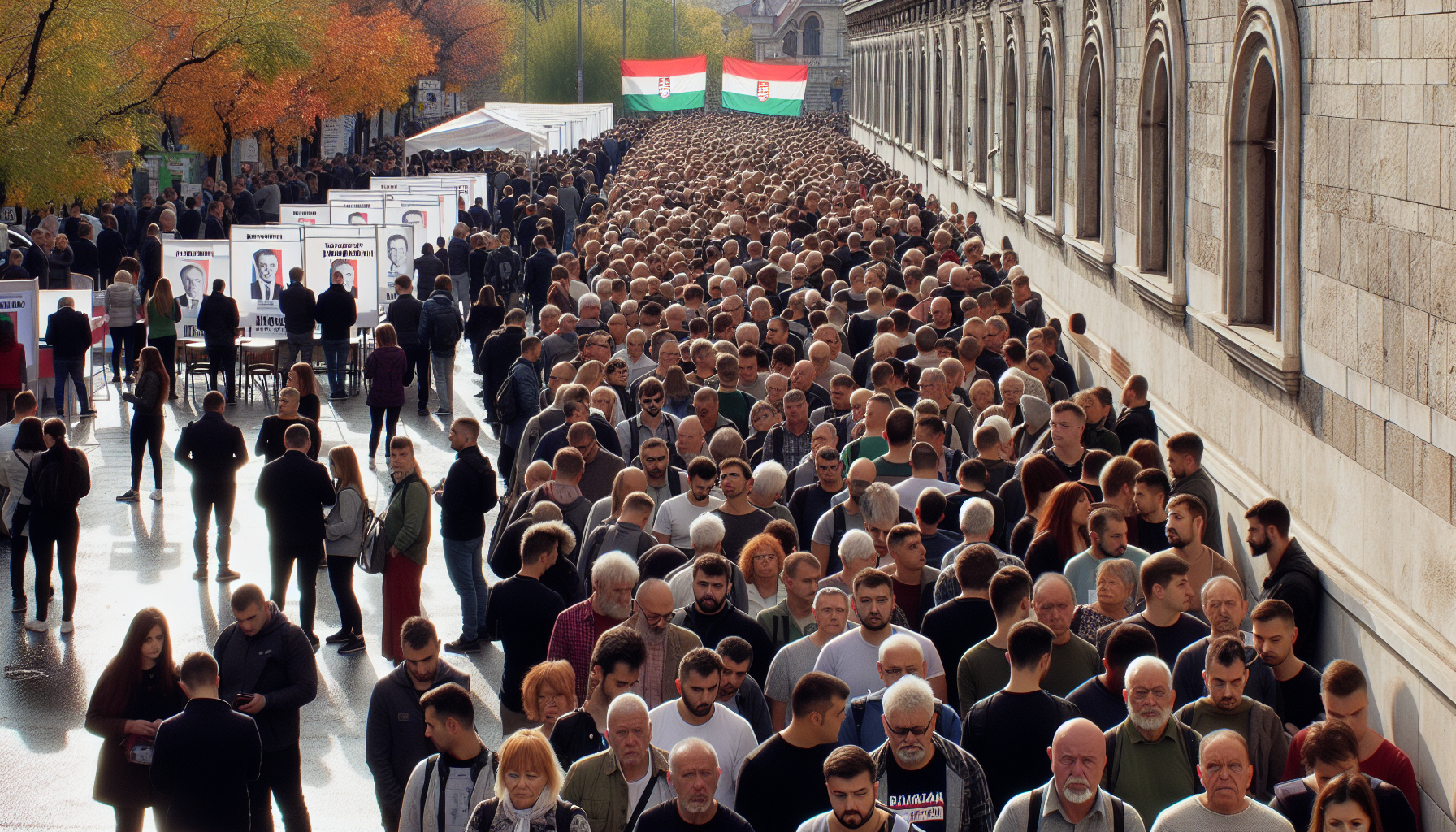
Hungarians participated in an election on Sunday that has the potential to conclude Prime Minister Viktor Orban’s 16-year reign, unsettle Russia, and send reverberations through right-wing factions in the West, including the White House under U.S. President Donald Trump. Orban, known for his eurosceptic nationalist stance, has established a model of “illiberal democracy” that serves as an inspiration for Trump’s Make America Great Again (MAGA) movement and its European supporters.
However, after three years marked by economic stagnation and rising living expenses, coupled with allegations of oligarchs close to the government accumulating wealth, many Hungarians have grown disillusioned with Orban, who is 62 years old. Recent opinion polls indicate Orban’s Fidesz party is trailing behind Peter Magyar’s emerging centre-right opposition, the Tisza party, by 7 to 9 percentage points, with Tisza polling between 38% and 41%.
Pollsters anticipated an unprecedented voter turnout, and by 1300 GMT, 66% of eligible voters had cast their ballots, a significant increase from 52.75% at the same time during the 2022 election. Television broadcasts showed long lines outside several polling stations in Budapest.
After voting in Budapest, Magyar declared that Hungarians were making a historic choice “between East and West” and urged citizens to report any voting irregularities, emphasizing that election fraud is a serious offense. He expressed confidence in the results, stating the key question was whether Tisza would secure a simple majority or a two-thirds majority in the 199-seat parliament, which would enable constitutional amendments.
Orban, who also voted in the same Budapest district and has won the last four elections, told reporters that Hungary’s constitution must be respected and the people’s decision honored. Four years ago, the OSCE Office for Democratic Institutions and Human Rights acknowledged that the election was conducted professionally but noted that an uneven playing field may have influenced the outcome.
Voters expressed contrasting views on the election’s stakes. Mihaly Bacsi, 27, who voted for Tisza, said the country needed a better public atmosphere, criticizing the current government for exacerbating tensions. Conversely, 83-year-old Istvan Stofka supported Orban, praising Fidesz for fulfilling promises since the regime change and endorsing the continuation of welfare and family policies.
Orban framed the election as a choice between “war and peace.” During the campaign, his government extensively warned that Magyar would involve Hungary in Russia’s war with Ukraine, an accusation Magyar firmly denies. The election is closely monitored in Brussels, where many EU leaders have criticized Orban for undermining democratic institutions, media freedom, and minority rights while maintaining close ties with Russia and aligning with Trump.
An Orban defeat could deprive Russia of its strongest ally within the EU and potentially unlock a 90-billion-euro ($105 billion) EU loan critical to Ukraine’s war efforts, which Orban has been blocking.
Orban has received endorsements from the Trump administration, including a recent visit by Vice President JD Vance to Budapest, as well as support from the Kremlin and far-right European leaders. Nevertheless, his campaign has been unsettled by media allegations of government collusion with Moscow, which Orban denies, asserting his aim is to safeguard Hungary’s national identity, Christian values, and security within the EU.
Meanwhile, Magyar, a former Orban supporter aged 45, has capitalized on public dissatisfaction with alleged corruption and declining living standards, especially among younger voters eager for change. Despite Tisza’s lead in polls, analysts warn the result remains uncertain due to many undecided voters, electoral map changes favoring Fidesz, and the influence of ethnic Hungarians in neighboring countries who predominantly support the ruling party.
If Tisza wins, reversing Orban’s legal and institutional reforms could prove challenging for a new government holding only a simple parliamentary majority. Polling stations are scheduled to close at 7 p.m. (1700 GMT). ($1 = 0.8533 euros)
